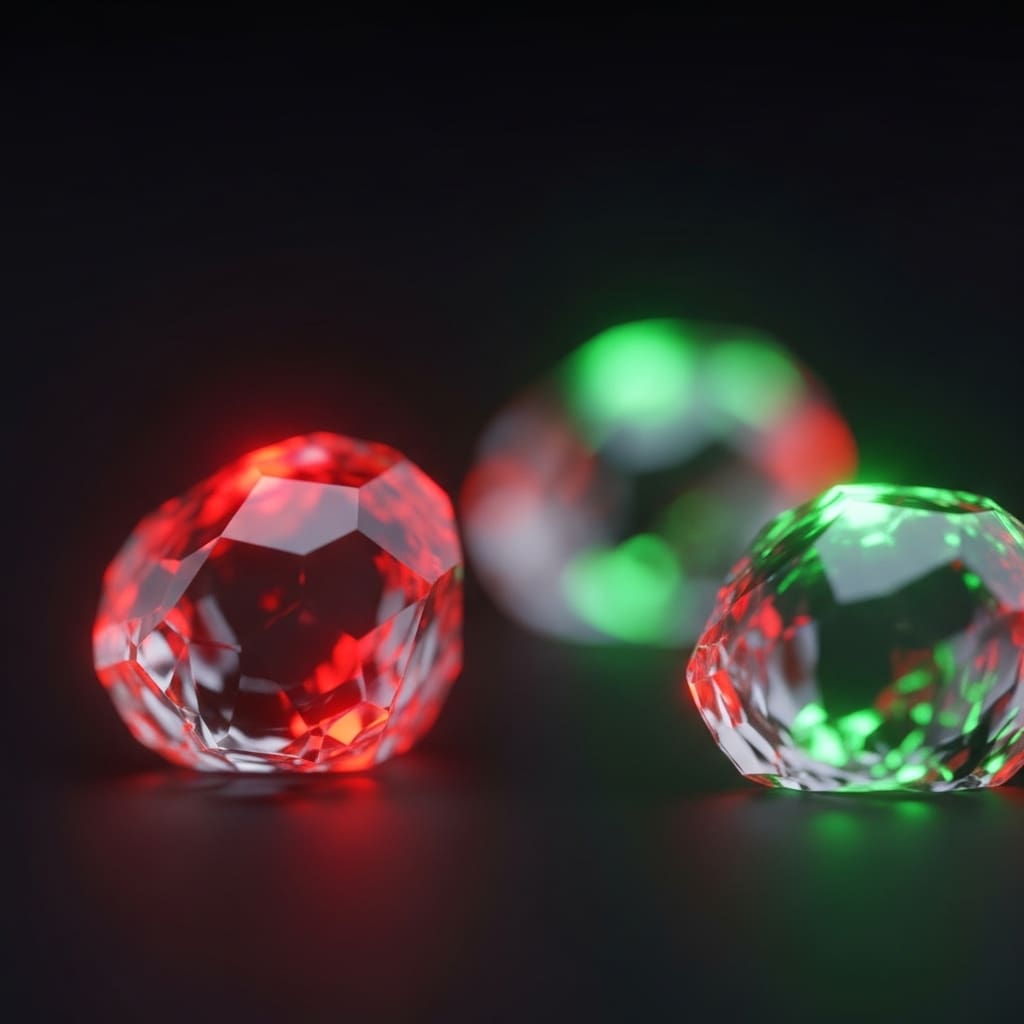
Scientists are increasingly focused on optimising light emission from novel materials for applications such as radiation detection. Muhammad S. Muhammad, Dilruba A. Popy, and Hamza Shoukat, alongside John M. Lane, Neeraj Rai, and Vojtech Vanecek, demonstrate a significant advance in this field through the design and synthesis of two new hybrid organic-inorganic perovskites. Their research reveals that these 2D layered halide perovskites, (C15H16N)2CdCl4 and ((Br)C15H15N)2CdCl4, exhibit remarkably efficient photoemission originating from the organic component, achieving photoluminescence quantum yields of up to 50.83%. This represents a substantial improvement over existing materials and establishes a pathway for engineering hybrid metal halides with highly efficient, organic-based light emission for fast scintillation technologies.
These innovative compounds, (C15H16N)2CdCl4 and ((Br)C15H15N)2CdCl4, represent a significant leap forward in the design of materials for fast scintillation applications and radiation detection.
The research demonstrates a compositional and structural approach to hybrid metal halides, deliberately maximizing photoemission from the organic portion of the material. Unlike conventional hybrid halides where the inorganic framework dominates optical properties, this work prioritizes the organic component’s luminescence.
The newly synthesized materials possess 2D layered Ruddlesden-Popper-type perovskite structures, enabling enhanced stability and processability alongside exceptional photophysical characteristics. Optical spectroscopy and detailed density functional theory studies confirm that the observed blue-white light emission originates specifically from the trans-stilbene organic cations within the hybrid structure.
Notably, the photoluminescence quantum yield (PLQY) values achieved are among the highest reported for this class of materials, reaching 50.83% for (C15H16N)2CdCl4 and 26.60% for ((Br)C15H15N)2CdCl4. This represents a substantial improvement, up to a five-fold increase, over the emission efficiency of the precursor organic salt, C15H16NCl, which exhibited a PLQY of only 10.33%.
The enhanced environmental and thermal stability of these hybrids, coupled with their outstanding optical properties, positions them as strong candidates for practical applications beyond basic research. This work establishes a pathway for creating highly efficient, organic-based light emitters within hybrid metal halide frameworks, opening new avenues for materials design in optoelectronics and related fields.
Crystallographic data collection and refinement procedures
Powder X-ray diffraction measurements were performed at ambient temperature utilising a Rigaku MiniFlex600 system with a Ni-filtered Cu Kα radiation source. Polycrystalline samples underwent scanning across a 2θ range of 2 to 90 degrees, employing a 0.02° step size. Photoluminescence and radioluminescence properties were characterised using a HORIBA Jobin Yvon Fluorolog-3 spectrofluorometer with a xenon lamp source and Quanta-φ integrating sphere, collecting data ranging from 250 to 750nm via the two-curve method.
Photoluminescence lifetime measurements were performed using a time-correlated single-photon counting method on both a custom epi-illuminating fluorescence microscope and a Horiba Jobin Yvon spectrofluorometer, employing a 405nm pulsed laser and a single-photon avalanche photodiode. Radioluminescence, afterglow, and photoluminescence spectra were measured with a custom-made spectrofluorometer, utilising a tungsten X-ray tube and a steady-state xenon lamp as excitation sources.
Enhanced photoluminescence from trans-stilbene cations in Ruddlesden-Popper cadmium halides
Photoluminescence quantum yields of 50.83 % and 26.60 % were achieved for the new hybrid materials (C15H16N)2CdCl4 and ((Br)C15H15N)2CdCl4, respectively. These compounds, possessing 2D layered Ruddlesden-Popper type perovskite structures, exhibit blue-white light emission originating from the organic structural components.
Spectroscopic analysis and density functional theory studies confirm that photoemission arises specifically from the trans-stilbene organic cations within the hybrid structures. The observed photoluminescence yield represents up to a 5-fold increase in light emission efficiency when compared to the precursor salt C15H16NCl, which has a photoluminescence quantum yield of 10.33 %.
This substantial improvement establishes these materials among the highest performing light emitters currently known. The research demonstrates that compositional and structural engineering of hybrid metal halides can yield highly efficient photoemission originating from organic components. Synthesis of ((Br)C15H15N)2CdCl4 involved dissolving 0.162g of ammonium salt 1a in 20 mL methanol, combined with 0.057g of CdCl2·2.5H2O dissolved in 25 mL methanol at 50°C, resulting in a 69% yield of 0.143g.
Similarly, the formation of (C15H16N)2CdCl4 utilized 0.100g of ammonium salt 1b and 0.045g of CdCl2·2.5H2O in methanol, yielding 0.097g of product with 73% efficiency. The resultant composites demonstrate the potential for integration into various optoelectronic devices.
Enhanced luminescence via rigidification of trans-stilbene cations within layered cadmium halide perovskates
Scientists have developed two new hybrid organic-inorganic materials, (C15H16N)2CdCl4 and ((Br)C15H15N)2CdCl4, which exhibit remarkably efficient blue-white light emission originating from their organic components. These compounds possess layered perovskite structures and demonstrate photoluminescence quantum yields of 50.83% and 26.60% respectively, representing a substantial improvement over the 10.33% yield observed in the precursor organic salt.
Spectroscopic analysis and theoretical modelling confirm that the light emission arises from the trans-stilbene organic cations within the hybrid structures. The enhanced emission efficiency is attributed to the rigid structural framework provided by the inorganic metal halide sheets, which limits non-radiative decay pathways and reduces intersystem crossing.
Detailed analysis of the photoluminescence decay kinetics reveals complex temporal behaviour, with both materials exhibiting fast and slow decay components, similar to those observed in stilbene single crystals. The materials also demonstrate good environmental and thermal stability, alongside their high light emission efficiency.
The authors acknowledge that the observed luminescence is sensitive to molecular packing within the materials, and further investigation into optimising this arrangement could yield even greater efficiencies. Future research may focus on exploring these compounds for applications in fast scintillation technologies, such as radiation detection, benefitting from their combination of high light output and stability. These findings demonstrate a viable strategy for engineering hybrid metal halides with efficient organic-based photoemission, opening avenues for tailored optoelectronic materials.
👉 More information
🗞 Optimized Photoemission from Organic Molecules in 2D Layered Halide Perovskites
🧠 ArXiv: https://arxiv.org/abs/2602.06740