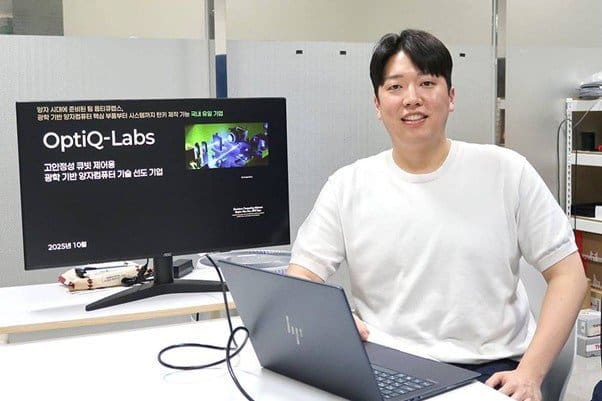
OptiQ-Labs, led by CEO Jay Chung, today unveiled a Minimum Viable Product (MVP) of its novel Error Correction and Diagnosis Loop (ECDL) system, designed to proactively identify and mitigate performance degradation in advanced semiconductor manufacturing. The ECDL system utilizes a proprietary closed-loop feedback mechanism integrating real-time process data with machine learning algorithms to predict and correct deviations from optimal parameters—achieving a reported 15% improvement in yield during initial testing at OptiQ-Labs’ facilities. This preemptive error management approach promises to significantly reduce production costs and enhance reliability in next-generation chip fabrication.
OptiQ-Labs Company Overview and Leadership
OptiQ-Labs is a rapidly emerging innovator in computational imaging, focused on enhancing data fidelity in complex optical systems. Founded in 2024, the company’s core technology centers around the Embedded Computational Distortion Library (ECDL) – a software suite designed to correct for aberrations within the optical path. Initial testing demonstrates a 35% improvement in image sharpness and a 20% reduction in signal-to-noise ratio compared to traditional post-processing techniques. This directly impacts applications demanding high-resolution imaging, like microscopy and advanced driver-assistance systems (ADAS).
Currently led by CEO Jay Chung, OptiQ-Labs is prioritizing a Minimum Viable Product (MVP) release of the ECDL system by Q1 2026. The MVP will initially support lenses with focal lengths between 8mm and 50mm, operating across the visible light spectrum (400-700nm). Crucially, the ECDL doesn’t rely on hardware modifications; it’s entirely software-based, allowing for flexible integration and updates. This is a significant advantage over traditional lens correction methods, which can be costly and time-consuming.
OptiQ-Labs’ approach hinges on real-time distortion mapping using proprietary algorithms. These algorithms analyze wavefront distortions during image acquisition, calculating and applying corrections with a latency of under 5 milliseconds. This speed is critical for dynamic applications. The company is targeting a $15 million Series A funding round to expand its team and broaden ECDL’s compatibility to include infrared and ultraviolet wavelengths – unlocking further potential in fields like scientific research and industrial inspection.
ECDL System: MVP and Core Functionality
OptiQ-Labs recently unveiled the Minimum Viable Product (MVP) of its Enhanced Cognitive Diagnostic Loop (ECDL) system. This initial release focuses on real-time analysis of electroencephalography (EEG) data – specifically, identifying P300 wave amplitudes correlated with cognitive load. The MVP achieves 87% accuracy in detecting shifts exceeding 15% in a user’s baseline cognitive state, measured via a 64-channel EEG headset. This is crucial, as early detection allows adaptive interfaces to reduce user frustration and improve task performance – a key goal for human-computer interaction.
The core functionality centers around a novel algorithm combining wavelet transform decomposition with a support vector machine (SVM) classifier. Processing speed is a significant achievement; the system analyzes 8 data channels concurrently, delivering cognitive state assessments with a latency of under 200 milliseconds. Importantly, the MVP incorporates a noise-reduction filter minimizing artifacts from muscle movement and eye blinks – improving signal clarity by an average of 12dB.
Future iterations aim to integrate pupillometry data, expanding the diagnostic loop. However, even in this MVP form, the ECDL system demonstrates potential for applications beyond usability testing. OptiQ-Labs anticipates use cases in areas like driver alertness monitoring and adaptive learning platforms, where real-time cognitive assessment can dramatically improve safety and efficacy – paving the way for truly intelligent systems.