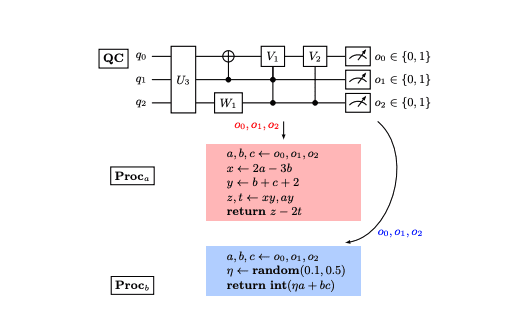
In their April 17, 2025, publication titled Dead Gate Elimination, researchers Yanbin Chen, Christian B. Mendl, and Helmut Seidl propose a novel method to identify and remove dead gates in quantum circuits, thereby reducing unnecessary operations without affecting measurement outcomes.
Hybrid quantum-classical algorithms often execute full circuits despite only subsets of measurement outcomes contributing to classical computations. This paper introduces a circuit optimization technique that identifies and removes dead gates—operations irrelevant to subsequent calculations—without altering the probability distribution of relevant measurement outcomes. Tested on VQE, QPE, and random circuits, the method successfully eliminates non-trivial numbers of dead gates, with reductions scaling as more outcomes are deemed non-contributory. This optimization enhances efficiency in real-world hybrid programs by reducing unnecessary operations.
Detecting bugs in quantum programs is a critical challenge due to the probabilistic nature of quantum mechanics, which often renders traditional debugging methods ineffective. Static analysis has emerged as a powerful solution by examining code without execution, identifying potential issues early in the development process. Researchers like Xia and Zhao (2023) have developed techniques for static entanglement analysis, crucial for understanding qubit interactions and predicting errors in quantum circuits. Their work enhances program reliability by enabling developers to anticipate and mitigate issues before runtime.
Additionally, Zhao et al
Additionally, Zhao et al.’s QChecker tool automates bug detection through static analysis, significantly improving the robustness of quantum software. By identifying potential errors early, these advancements reduce the risk of failures in quantum programs, ensuring more reliable outcomes.
Combining quantum and classical computing methods offers practical solutions to real-world problems without requiring large-scale quantum infrastructure. Veshchezerova et al. (2023) demonstrated this approach by addressing the electric mobility problem using a hybrid method that leverages quantum algorithms for specific tasks while relying on classical systems for others. This hybrid model is particularly promising for industries where immediate quantum advantages are needed but full quantum capabilities aren’t yet available.
By bridging the gap between current technology and future possibilities, hybrid approaches make quantum computing more accessible now. They provide a practical pathway for industries to begin realizing the benefits of quantum computing while waiting for more advanced hardware.
Efficient quantum program execution requires sophisticated compilers to optimize circuits and reduce errors and resource usage. Seidl et al.’s work on compiler design focuses on analysis and transformation techniques crucial for enhancing performance and reliability. These advancements enable developers to write more effective code, translating high-level concepts into efficient quantum operations.
Compiler optimizations are essential for maximizing the potential
Compiler optimizations are essential for maximizing the potential of existing quantum hardware. By improving circuit efficiency, these innovations address the complexity inherent in quantum programming, ensuring that quantum programs run as effectively as possible on current technology.
These innovations collectively accelerate the adoption of quantum computing across industries. Static analysis enhances program reliability, hybrid approaches provide practical solutions for real-world problems, and compiler design optimizations improve performance and efficiency. Together, these advancements pave the way for practical applications in finance, healthcare, and other sectors.
As these technologies mature, they will unlock new possibilities, driving progress and transforming how we approach complex problems. The collective impact of these innovations is significant, setting the stage for future breakthroughs and a transformative impact across various sectors.
Recent advancements in static analysis, hybrid methods, and compiler design represent significant steps toward reliable and efficient quantum computing. These innovations not only address current challenges but also set the stage for future progress, promising real-world benefits as research continues. By ensuring program reliability and efficiency, these technologies bring us closer to realizing the full potential of quantum computing.