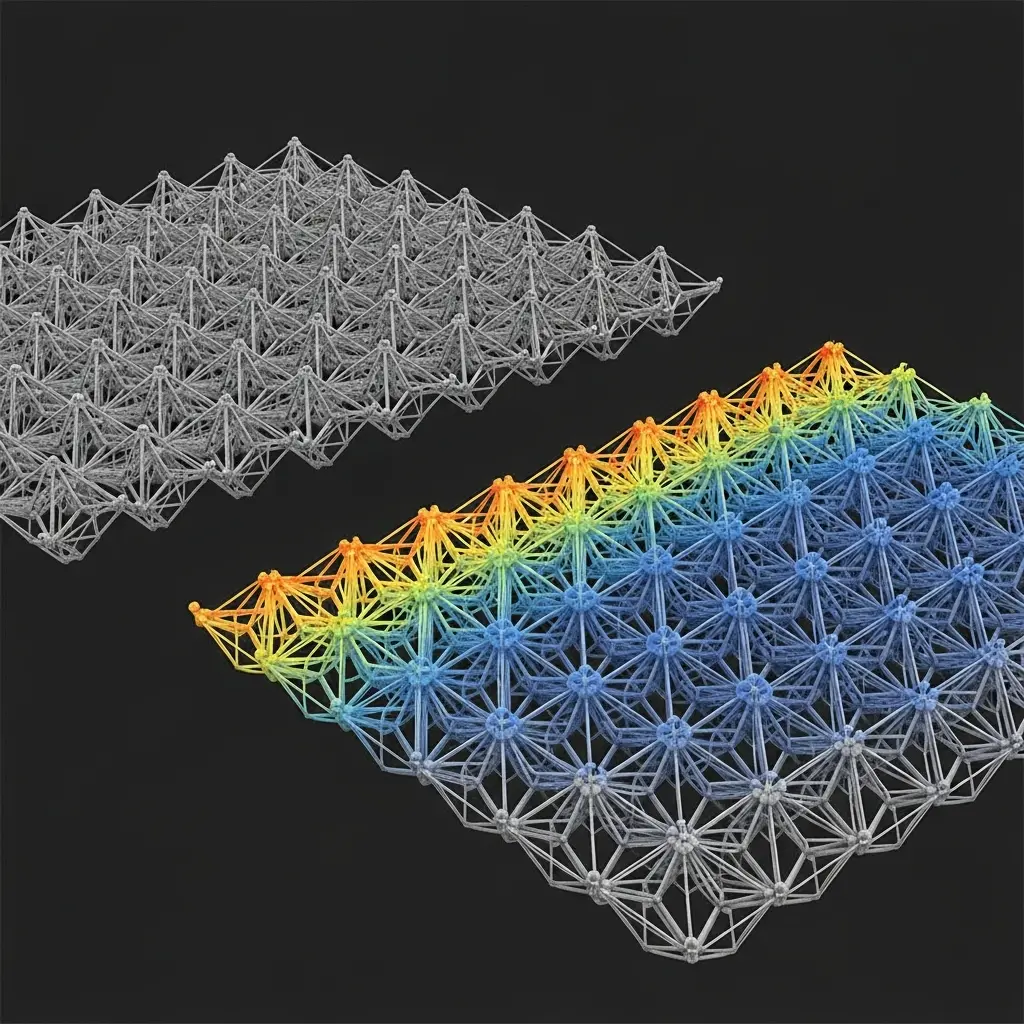
Designing chiral metasurfaces with precise optical properties presents a significant hurdle in nanophotonics, as their geometry and response are intricately linked, making traditional design methods slow and inefficient. Davide Filippozzi, Arash Rahimi-Iman, and colleagues at Justus-Liebig-Universit ät Gießen address this challenge by integrating a powerful evolutionary algorithm, known as NEAT, into a machine-learning framework. This innovative approach allows the system to independently develop optimal neural network architectures, bypassing the need for manual design and improving the speed and accuracy of metasurface optimisation. The team demonstrates that these automatically evolved networks not only match the performance of conventionally designed models, but also offer greater efficiency and the potential for transfer learning between simulations and real-world experiments, paving the way for adaptable, self-configuring systems for automated photonic design.
NEAT Optimizes Chiral Metasurface Inverse Design
Scientists developed a machine-learning framework to design chiral metasurfaces, structures that manipulate light, by integrating the NeuroEvolution of Augmenting Topologies (NEAT) algorithm with a deep-learning optimization pipeline. This work addresses the challenge of efficiently designing these complex structures, where the relationship between geometry and optical properties is nonlinear, and conventional methods often require extensive manual tuning. The team engineered a system where NEAT autonomously evolves both the topology and connection weights of neural networks, creating task-specific architectures without human intervention, while a reinforcement-learning strategy refines the model’s understanding of the design space. The study pioneered a method employing a dataset of 9,600 simulated gallium phosphide metasurface geometries, generated through computational modeling, to evaluate NEAT’s performance under various conditions.
Researchers systematically varied input dimensionality, feature-scaling techniques, and data size to determine optimal configurations for the evolving neural networks, finding that standardized feature scaling consistently yielded the best results. The resulting NEAT-evolved neural networks, characterized by their compact size, demonstrated predictive accuracy and generalization comparable to, and sometimes exceeding, that of initially used dense networks. Experiments employed rigorous coupled-wave analysis simulations to model the spectral properties of the metasurfaces, providing a foundation for the machine-learning algorithms to learn the complex relationship between structure and optical response. This approach successfully predicted metasurface designs exhibiting strong circular dichroism in the visible spectrum, and importantly, enabled transfer learning between simulated and experimentally fabricated structures, demonstrating the potential for real-world applications. This research achieves a scalable path toward adaptive, self-configuring machine-learning frameworks for automated photonic design, offering a powerful tool for rapidly prototyping and creating metasurfaces with tailored optical functionalities.
Automated Chiral Metasurface Design via NeuroEvolution
Scientists have achieved a breakthrough in the automated design of chiral metasurfaces, nanoscale structures that interact with light, by integrating a sophisticated machine-learning technique called NeuroEvolution of Augmenting Topologies (NEAT) into an existing deep-learning optimization framework. This work overcomes a central challenge in nanophotonics, the complex relationship between a metasurface’s geometry and its optical properties, by enabling the automatic configuration of neural network architectures tailored to the specific design task. The team’s approach eliminates the need for manual network design, allowing the model to dynamically adapt its complexity to the optimization problem. Experiments involved a dataset of 9,600 simulated gallium phosphide metasurface geometries, each meticulously designed and analyzed using electromagnetic simulations, to determine their optical response.
The researchers tested NEAT under various conditions, including different input dimensionalities and data sizes, and investigated feature scaling methods, specifically normalization and standardization, to optimize training efficiency and convergence. Results demonstrate that standardized feature scaling consistently yielded the best performance, predicting both strong circular dichroism and preferred handedness reflectance. The NEAT-evolved neural networks, despite being relatively compact, achieved predictive accuracy and generalization comparable to, and in some cases exceeding, that of manually designed networks. Measurements confirm that these models successfully predict metasurfaces exhibiting strong circular dichroism in the visible spectrum, with the ability to transfer learning from simulated data to experimental data. This capability paves the way for adaptive, self-configuring machine-learning frameworks that can accelerate the design of photonic devices and potentially link data-driven design with automated fabrication processes.
NEAT Designs High-Performance Chiral Metasurfaces
This research demonstrates a new approach to designing chiral metasurfaces, nanoscale structures that interact with light, by integrating a technique called NeuroEvolution of Augmenting Topologies (NEAT) into a machine-learning pipeline. The team successfully used NEAT to automatically design the architecture of neural networks, eliminating the need for manual tuning typically required in these systems. These evolved networks then accurately predicted the optical properties of metasurfaces, achieving comparable or improved performance compared to networks with manually designed structures. The resulting models are not only accurate but also resource-efficient, allowing for the successful prediction of metasurfaces exhibiting strong circular dichroism, a key property for many optical applications, and enabling the transfer of learning from simulated designs to real-world experimental data.
Investigations revealed that standardized feature scaling consistently improved performance, suggesting that careful data preparation enhances the efficiency of the neuroevolutionary process. The researchers highlight a three-pronged benefit to their approach, encompassing data evolution, structural design evolution, and machine-learning model architecture evolution, all working in concert to optimise the design process. The authors acknowledge that the performance of the NEAT algorithm is influenced by factors such as input dimensionality and data size, requiring careful consideration when applying this method to different problems.
🗞 A NEAT Approach to Evolving Neural-Network-based Optimization of Chiral Photonic Metasurfaces: Application of a Neuro-Evolution Pipeline
🧠 ArXiv: https://arxiv.org/abs/2512.23558