

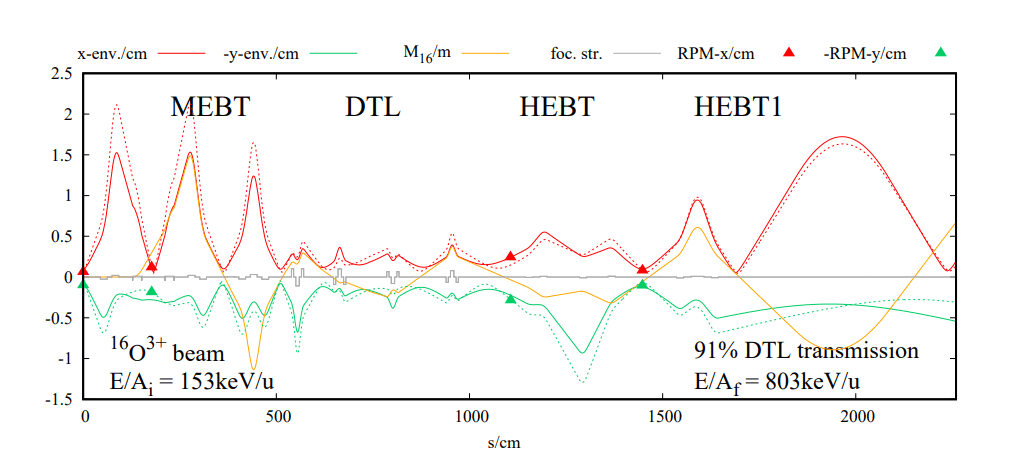
Optimising the delivery of rare isotopes presents a significant challenge in nuclear physics, and researchers are continually seeking ways to improve accelerator performance. O. Shelbaya, O. Hassan, and R. Baartman, working with colleagues at TRIUMF, now present a method for accurately modelling and optimising the magnetic fields within the facility’s rare isotope beam postaccelerator. The team quantifies the impact of ‘fringe fields’, disturbances at the edges of magnetic components, using a well-established technique, and demonstrates how this improved modelling allows for faster and more efficient tuning of the accelerator. This advancement provides operators with a powerful tool to maximise the delivery of rare isotope beams, enabling crucial research in nuclear science and medicine.
At TRIUMF, the Isotope Separator and Accelerator (ISAC) facility produces rare isotopes using proton beams from a large cyclotron. Postacceleration occurs using the Radioisotope Beam (RIB) postaccelerator. Scientists developed a method, based on detailed modelling, to accurately predict and optimise beam behaviour, allowing operators to efficiently tune the variable energy drift tube linac for delivering rare isotope beams. This approach enhances beam delivery and improves control over charged particle beams within the accelerator facility.
Rare Isotope Beam Tuning and Optimization
Researchers emphasize using sophisticated beam dynamics simulations with the TRANSOPTR code to predict and optimise beam behaviour, reducing the need for time-consuming experimental adjustments. TRANSOPTR, a second-order transfer matrix code, models complex accelerator lattices and is continually refined for ISAC. The MEBT prepares the beam for injection into the DTL, ensuring proper matching of beam properties. The DTL, a linear accelerator, increases beam energy, requiring accurate modelling of its structure and focusing elements. The HEBT transports the beam to experimental areas.
Scientists implemented autofocusing techniques, combined with TRANSOPTR simulations, to automate the tuning process and improve efficiency. They also applied Bayesian optimisation to beam steering, further enhancing the tuning process. Machine learning, specifically Random Forest algorithms, classifies profile monitor data to improve beam diagnostics. Simulations are consistently validated against experimental measurements, demonstrating their accuracy and predictive power, with excellent agreement between simulated and measured beam envelopes. This results in reduced tuning time and improved beam quality and transmission.
The research addresses technical challenges including accurately modelling the fringing fields of magnetic and electrostatic elements, incorporating higher-order effects like chromatic aberrations, and managing the complexity of the DTL’s structure. Ensuring proper matching of beam properties between accelerator stages is also critical. Reliable beam diagnostics and monitoring are essential for validating simulations and ensuring optimal performance. This work presents a comprehensive overview of efforts to optimise the ISAC accelerator complex using advanced simulation techniques, machine learning, and automated tuning methods, resulting in significant improvements in beam quality, tuning efficiency, and overall facility performance.
Precise Quadrupole Magnet Field Model Achieved
Scientists achieved precise modelling of quadrupole magnets, incorporating fringe field effects previously omitted from beam optic simulations. Measurements performed on Danfysik L1 quadrupoles, using a modified pseudo-Langevin function, yielded accurate fitting parameters, demonstrating sub-percent agreement across the relevant current range. This provides a compact and robust model for magnetic saturation, surpassing the accuracy of polynomial fits. Detailed electromagnetic modelling was conducted using Opera-3D, based on the physical geometry of the magnets, and validated with TRANSOPTR simulations.
The team determined effective magnetic lengths and characterised fringe field regions, revealing significant optical properties. Analysis established an effective length and aperture radius for the modelled quadrupole. Comparisons between updated parameters derived from these simulations and previously used values demonstrate non-negligible changes to lattice performance. These findings pave the way for improved tuning efficiency, reduced configuration space for linac optics, and the development of autonomous tuning algorithms currently under development at TRIUMF. The accurate modelling achieved in this study is essential for maximizing accelerated radioactive beam production and minimizing overhead tuning times.
Fringe Fields Resolved, Beam Tuning Improved
Scientists demonstrated that previously unmodelled fringe field effects arising from quadrupole magnets significantly impacted beam transport, particularly in the medium-energy section. By incorporating detailed magnetic modelling, conducted using Opera-3D, into the TRANSOPTR beam optics model, the team achieved excellent agreement between simulations and measured data. The upgraded model accurately predicts beam behaviour through the drift-tube linac without requiring iterative, manual adjustments to quadrupole gradients. This advancement enables parallel, simulation-based tuning of the entire accelerator, streamlining operations and improving efficiency for future experiments. The team validated the model by successfully reconstructing beam envelopes through the linac and loading the optimised optics directly into the control system, achieving high transmission rates. Despite potential limitations as the accelerator ages, this research represents a significant step forward in accelerator physics, providing a more accurate and efficient means of controlling and optimising ion beam delivery.
👉 More information
🗞 Matching Optimization for TRIUMF’s Rare Isotope Linac
🧠 ArXiv: https://arxiv.org/abs/2509.20292


