Research demonstrates a method for evaluating transformation pathways converting complex problems—specifically kSAT instances—into QUBO form, optimising for hardware metrics. Stability analysis of transformation parameters supports automation, while structural considerations benefit error correction and link to existing quadratisation techniques.
The efficient translation of complex computational problems into a format suitable for execution on emerging quantum hardware represents a significant challenge. Researchers are increasingly focused on developing ‘toolchains’ – automated sequences of transformations – to bridge the gap between abstract problem definitions and the specific constraints of quantum devices. Understanding how these transformations impact problem structure and performance is vital for optimising these toolchains. In a new study, Lukas Schmidbauer, Wolfgang Mauerer (Technical University of Applied Sciences Regensburg, and Siemens AG) et al., investigate the relationship between parameters and transformation pathways within such toolchains, specifically focusing on the conversion of k-SAT (a class of logical problems) instances into QUBO (Quadratic Unconstrained Binary Optimisation) form – a common format for quantum annealers and gate-based quantum computers. Their work, entitled ‘SAT Strikes Back: Parameter and Path Relations in Quantum Toolchains’, details how analysing the stability of transformation parameters and pathways can improve the predictability and ultimately, the efficacy of these automated systems, with potential benefits extending to the development of more robust error correction schemes.
Automated Translation Pathways for Quantum Optimisation
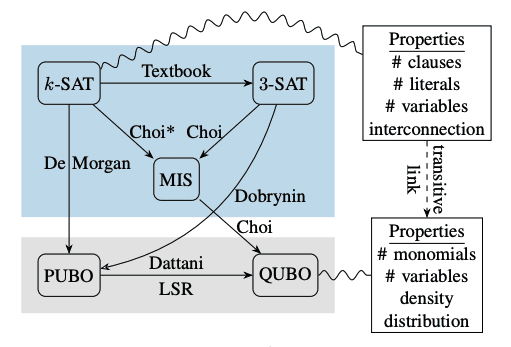
Researchers are developing automated toolchains to translate complex computational problems into forms suitable for execution on quantum hardware. A key focus lies on transforming instances of k-satisfiability (k-SAT) – problems determining if a Boolean formula can be satisfied with certain variable assignments – into Quadratic Unconstrained Binary Optimisation (QUBO) problems. QUBO formulations represent optimisation tasks where the goal is to minimise or maximise a quadratic polynomial with binary variables, a format readily addressed by quantum annealers and certain gate-based quantum algorithms.
Multiple transformation pathways exist between k-SAT and QUBO, each with differing computational costs and performance characteristics. Crucially, these pathways are not equivalent. Researchers are actively evaluating these routes, optimising for metrics aligned with specific hardware capabilities, and developing methods to pre-assess their validity. This pre-assessment is vital for streamlining quantum computation and ensuring efficient resource allocation.
The emphasis on stability and predictability within these transformation pathways is paramount. Consistent performance is essential for building reliable automated systems capable of consistently delivering optimal QUBO formulations. Understanding the impact of free parameters and transformation choices on the final QUBO structure allows for the creation of robust and repeatable processes. This work also has implications for quantum error correction; by understanding how problem structure influences the transformation process, scientists can potentially design more effective error-correcting codes.
Researchers are considering problem structure at a high level of abstraction, with the aim of informing the design of error-correcting codes at lower layers of the quantum system. This holistic approach seeks to improve overall performance and reliability. The work builds upon established mathematical foundations of quadratization – the process of converting a problem into QUBO form – demonstrating its crucial role in preparing problems for quantum annealing and other optimisation algorithms.
Analysis focuses on the structure and characteristics of the input k-SAT problem, the intermediate representations generated during transformation, and the final QUBO formulation. This detailed examination provides insights for optimising the entire process, ultimately enhancing the performance of quantum optimisation algorithms and broadening their applicability.
The pursuit of automation is driven by the need to scale quantum algorithms and deploy them in practical applications. A key development is the potential for self-optimising systems capable of selecting the most appropriate transformation pathway based on the characteristics of the input problem.
Researchers are also investigating the physical realisation of quantum hardware, specifically superconducting qubits, including the widely used transmon qubit architecture. Advancements in error mitigation and characterisation techniques are being explored to address the challenges of noise and decoherence – the loss of quantum information – and improve the reliability of quantum systems.
The research acknowledges the promise of surface codes as a viable approach to quantum error correction, suggesting that insights gained from structural analysis at higher abstraction levels can contribute to the development of more effective error-correcting codes. Combining these insights with advancements in hardware development is seen as crucial for creating robust and scalable quantum computing systems.
👉 More information
🗞 SAT Strikes Back: Parameter and Path Relations in Quantum Toolchains
🧠 DOI: https://doi.org/10.48550/arXiv.2505.22060