Adiabatic quantum computation promises to solve complex problems by gently evolving a quantum system towards the solution, but the process can be slow and sensitive to imperfections. Researchers at The Hebrew University of Jerusalem – David Turyansky, Yotam Zolti, and Yair Cohen, along with colleagues, now present a new method for optimising the control pulses that drive this evolution, significantly accelerating adiabatic protocols. Their approach centres on identifying pulses that keep the quantum system firmly in its lowest energy state throughout the computation, ensuring a robust and efficient path to the solution. This innovation demonstrates success in both simulations of complex optimisation problems using Rydberg atom arrays and experiments on real quantum hardware via the IBM quantum platform, representing a substantial step towards practical and scalable adiabatic quantum computation.
Quantum technologies hold immense promise for advancements in computation, sensing, and materials science, but precisely controlling quantum systems remains a significant challenge. A robust approach, such as adiabatic quantum computation and adiabatic control, guides a system slowly between states to minimise errors. However, the need for slow evolution limits the speed of these processes.
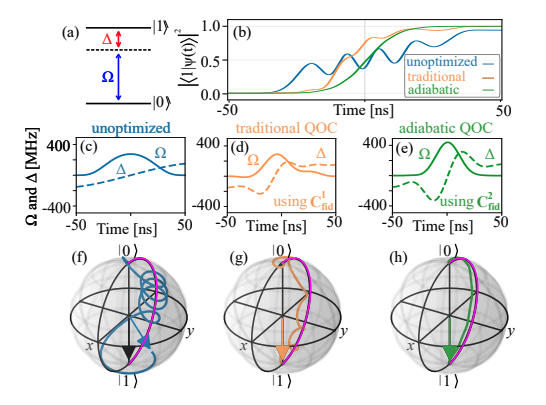
Researchers have developed a new method for optimising control pulses to accelerate adiabatic protocols, achieving faster and more efficient quantum control without sacrificing accuracy. Traditional methods struggle to balance speed and accuracy, often requiring detailed knowledge of a quantum system’s internal workings—a difficult task for complex systems. This new research introduces a pulse optimisation method that identifies control pulses which keep the quantum system closely aligned with its lowest energy state throughout the evolution, effectively suppressing errors and enabling faster, more reliable control.
Crucially, this method doesn’t require detailed knowledge of
Crucially, this method doesn’t require detailed knowledge of the system’s internal structure, making it broadly applicable to a wide range of quantum systems. The team employs advanced optimisation algorithms to search for the best pulse shapes efficiently. They successfully demonstrated this approach on several quantum systems, implementing rapid adiabatic passage in simple systems and extending it to more complex multi-level systems.
Furthermore, they solved a complex graph optimisation problem using adiabatic quantum computation with a system of fourteen qubits, validating their results through both simulations and experiments on IBM quantum hardware and Rydberg atom arrays. This research also highlights the versatility of adiabatic quantum computation (AQC) for solving complex optimisation and machine learning problems. By introducing a novel optimisation technique based on minimising an adiabatic cost function, the researchers designed optimal control pulses for AQC, achieving superior performance compared to traditional methods in areas like finding the Maximum Independent Set of graphs and accelerating Stimulated Raman Adiabatic Passage (STIRAP).
The team’s approach, termed adiabatic Quantum Optimal Control (QOC), focuses on engineering pulses that keep the evolving system aligned with its instantaneous lowest energy state. This results in pulses that are more robust than those generated by traditional optimisation methods, and comparable to those achieved through computationally intensive ensemble optimisation, but with significantly reduced computational runtime. They successfully applied this method to optimise an Adiabatic Quantum Computation with a 14-qubit atom array, and future research will focus on further improving AQC by seeking pulses that adhere to approximate lowest energy states.
Experiments on both simulated and real quantum hardware,
Experiments on both simulated and real quantum hardware, including IBM quantum systems and Rydberg atom arrays, demonstrate the robustness of these optimised pulses against common sources of error, such as variations in control beams and atomic motion. This confirms the potential of this approach to unlock the full potential of quantum technologies by enabling faster, more efficient, and more reliable quantum control.
🗞 Pulse optimization in adiabatic quantum computation and control
🧠 DOI: https://doi.org/10.48550/arXiv.2507.09770