

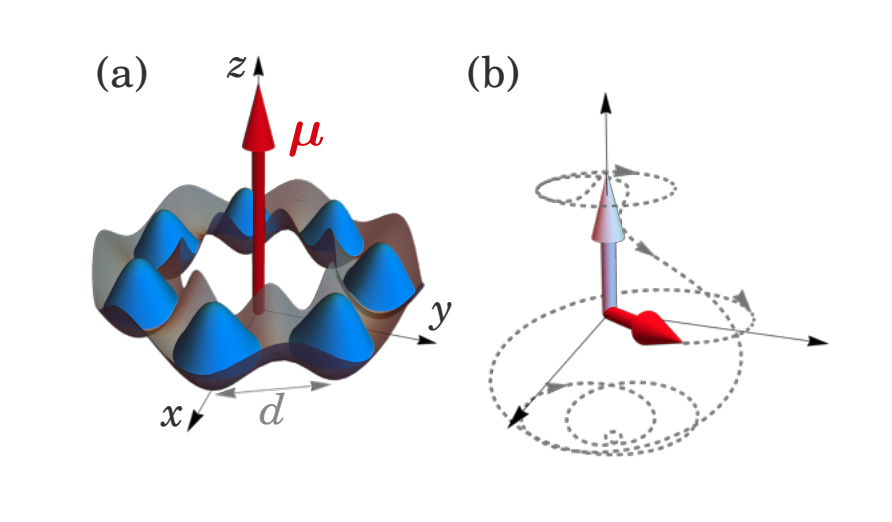
Controlling the quantum state of matter is crucial for developing advanced technologies, and researchers are continually seeking more precise and efficient methods to achieve this. Héctor Briongos-Merino, along with colleagues at the University of Strathclyde and the University of Nottingham, now demonstrate a powerful new technique for manipulating quantum systems using dipolar interactions between ultracold atoms arranged in a ring lattice. The team’s approach relies on carefully timed changes to a magnetic field, driving the system with just two control functions to generate specific quantum states with circulating currents. This method achieves perfect fidelity in engineering these current states across a broad range of systems, and consistently reaches theoretical limits when perfect fidelity is not possible, representing a significant step forward in precise quantum control.
This work proposes and analyses a method that exploits the natural dipolar interaction of ultracold atoms arranged on a ring-shaped lattice, focusing on generating specific quantum states with entangled circulation. The technique requires precise, time-dependent control over the orientation of a magnetic field, a capability readily available in ultracold atom laboratories. The system’s evolution is governed by just two independent control functions, simplifying the control process. Numerical tests demonstrate that this control method can reliably engineer entanglement.
Controlling Dipolar BECs in Atomtronic Circuits
This research details a method for controlling and manipulating ultracold dipolar Bose-Einstein condensates within specifically designed atomtronic circuits, which are ring-shaped lattices of atoms. The core goal is to achieve precise control over these systems, leveraging their unique properties for quantum simulation and potentially for building new quantum technologies. The work covers theoretical aspects and practical considerations for building and operating the atomtronic circuits. The research emphasizes the importance of controllability, the ability to steer the quantum state of the system using external controls, such as magnetic fields.
Researchers employ Lie group theory to analyze and ensure controllability, highlighting how exploiting the system’s symmetries can simplify the control process. Practical considerations include building the atomtronic circuits using magnetic traps and precisely controlling the magnetic field gradient. The research utilizes the dipolar Bose-Hubbard Hamiltonian, a theoretical model that describes the system, including the long-range dipolar interactions between the atoms. The model incorporates key parameters, such as the hopping amplitude, the on-site interaction strength, and the dipolar interaction strength.
A significant portion of the work focuses on analyzing the ground state of the system within the ring lattice configuration. The research provides a detailed mathematical proof demonstrating that the ground state of the system, in a ring lattice with an even number of sites, exhibits inversion symmetry. This proof relies on the Perron-Frobenius theorem for positive symmetric matrices, establishing the properties of the ground state eigenvector. The mathematical rigor underscores a deep understanding of the underlying quantum principles. Key findings demonstrate that achieving precise control over ultracold dipolar BECs is essential for realizing their potential in quantum simulation and other applications.
Exploiting the symmetries of the system significantly simplifies the control problem. The mathematically proven result establishes ground state symmetry in a ring lattice with an even number of sites. The work demonstrates the power of mathematical tools, such as Lie group theory and the Perron-Frobenius theorem, in analyzing complex quantum systems.
Atomic Ring Control Reveals Symmetry Limitations
Researchers have demonstrated a high degree of control over ultracold atoms arranged in a ring-shaped lattice, achieving nearly perfect state manipulation through precise control of magnetic fields. This work focuses on engineering specific current states within the atomic system, crucial for quantum information processing and simulation. The team’s approach leverages the natural dipolar interactions between the atoms, offering a pathway to manipulate their quantum properties without external forces. The research reveals that complete control is not always possible, particularly in systems with an even number of lattice sites.
This limitation arises from an inherent symmetry within the atomic arrangement, which restricts the range of achievable quantum states. Specifically, the symmetry divides the possible states into two groups, and the control method can reliably manipulate states within only one of these groups. Even with this restriction, the team consistently achieves very high fidelity, nearly 99. 9%, in preparing the desired states when working within the accessible subspace. Interestingly, the researchers identified specific, naturally occurring states within the system that are immune to manipulation via this dipolar control.
These “dipolar-immune” states remain unchanged throughout the process, further limiting the range of achievable configurations. However, these immune states do not prevent the creation of desired states within the accessible subspace. Through numerical simulations using a sophisticated optimization algorithm, the researchers have identified control trajectories, precise sequences of magnetic field adjustments, that maximize the fidelity of state preparation. These simulations confirm that the method is effective for various system sizes and numbers of atoms, paving the way for experimental realization and potential applications in quantum technologies.
Dipolar Control Reaches Fidelity Limits
This work demonstrates the effective use of precisely controlling the orientation of dipoles to manipulate ultracold dipolar gases and achieve high-fidelity preparation of specific quantum states. Researchers successfully engineered current states with perfect fidelity in many cases, and in others, reached the theoretical limits imposed by the system’s inherent properties. The method relies on manipulating just two control functions, making it practical for implementation in existing ultracold atom laboratories. The study identified fundamental limits to fidelity stemming from symmetries within the system, the presence of invariant states, and the constraints of the “hard-core boson regime,” a specific condition governing the atomic interactions.
Researchers verified that these limits are attainable through their control method. These findings establish dipolar optimal control as a valuable tool for manipulating dipolar systems and highlight the significant role of dipolar interactions in advancing quantum technologies. Future research will focus on extending this dipolar optimal control technique to more complex systems, such as two-dimensional lattice arrays and continuous rings, where understanding the system’s symmetries will be crucial for identifying accessible states. The authors acknowledge that the method’s performance is influenced by the hard-core boson regime, meaning that the preparation of states outside this regime is limited to projections onto the accessible subspace.
🗞 Dipolar optimal control of quantum states
🧠 ArXiv: https://arxiv.org/abs/2507.22822


