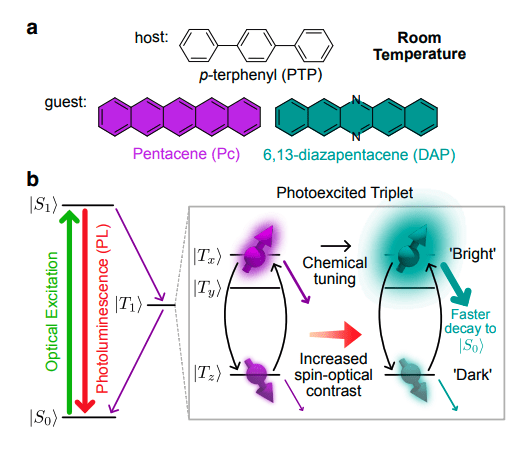
On March 31, 2025, researchers led by Sarah K. Mann demonstrated a significant advancement in optically detected magnetic resonance (ODMR) by achieving room-temperature molecular spin contrasts of 40% using a nitrogen-substituted pentacene derivative, surpassing the performance of solid-state systems.
Researchers demonstrate enhanced optical magnetic resonance (ODMR) detection in molecular systems by achieving room-temperature contrasts of 40% using a nitrogen-substituted pentacene derivative. This surpasses the 30% contrast typical in solid-state defects like diamond’s nitrogen-vacancy centers. The improved contrast arises from accelerated anisotropic intersystem crossing, as shown through time-dependent pulsed ODMR. Additionally, high-contrast room-temperature ODMR is demonstrated in self-assembled nanocrystals, highlighting the potential of chemically tunable molecular spins for advanced optoelectronic applications.
Recent breakthroughs in condensed matter physics have opened new avenues for understanding the fundamental properties of materials and their potential applications in quantum technologies. From organic nanocrystals to spin-based systems, researchers are pushing the boundaries of what is possible at the atomic and molecular levels. This article explores some of the most exciting developments in this field and their implications for future technologies.
Quantum Technologies and Spin-Based Systems
One of the most promising areas of research involves the manipulation of electron and nuclear spins in solid-state systems. For instance, studies on photoexcited triplet states have demonstrated the potential for ultrafast entangling gates between nuclear spins, paving the way for advanced quantum computing architectures. These findings, highlighted in Nature Physics, underscore the importance of spin-based systems in achieving scalable quantum technologies.
Moreover, researchers have successfully developed techniques to read out and control single nuclear spins using metastable electron spin ancillas. This work, published in Nature Nanotechnology, represents a significant step forward in the quest for precise quantum state manipulation. Such advancements are not only advancing our understanding of quantum mechanics but also bringing us closer to practical applications in fields like secure communication and high-precision sensing.
Organic materials, particularly polycyclic aromatic hydrocarbons (PAHs), have emerged as a fascinating class of materials for photonic quantum technologies. Studies on self-assembled nanocrystals of PAHs have shown that these structures exhibit photostable single-photon emission, making them ideal candidates for applications in quantum optics and cryptography. This research, featured in ACS Nano and Nature Materials, highlights the potential of organic molecules to revolutionize the field of quantum communication.
In addition to their role in quantum technologies, organic nanocrystals are also being explored for their unique optical and electronic properties. Research into functional organic nanocrystals, as detailed in recent reviews, is uncovering new ways to harness these materials for applications ranging from light-emitting diodes (LEDs) to bioimaging.
Another notable development in condensed matter physics is the realization of room-temperature solid-state masers. Traditionally, masers have required cryogenic conditions to operate efficiently, but recent breakthroughs, such as those reported in Nature, have demonstrated the feasibility of operating these devices at ambient temperatures. This advancement not only simplifies the practical implementation of masers but also opens new possibilities for their use in sensing and communication technologies.
Furthermore, advancements in quantum measurement techniques are enabling researchers to track the orientation and behavior of fluorescent nanodiamonds within living cells. As reported in Nature Nanotechnology, these developments are bridging the gap between quantum physics and biology, offering new tools for studying cellular processes at the nanoscale.
👉 More information
🗞Chemically Tuning Room Temperature Pulsed Optically Detected Magnetic Resonance
🧠 DOI: https://doi.org/10.48550/arXiv.2503.24341