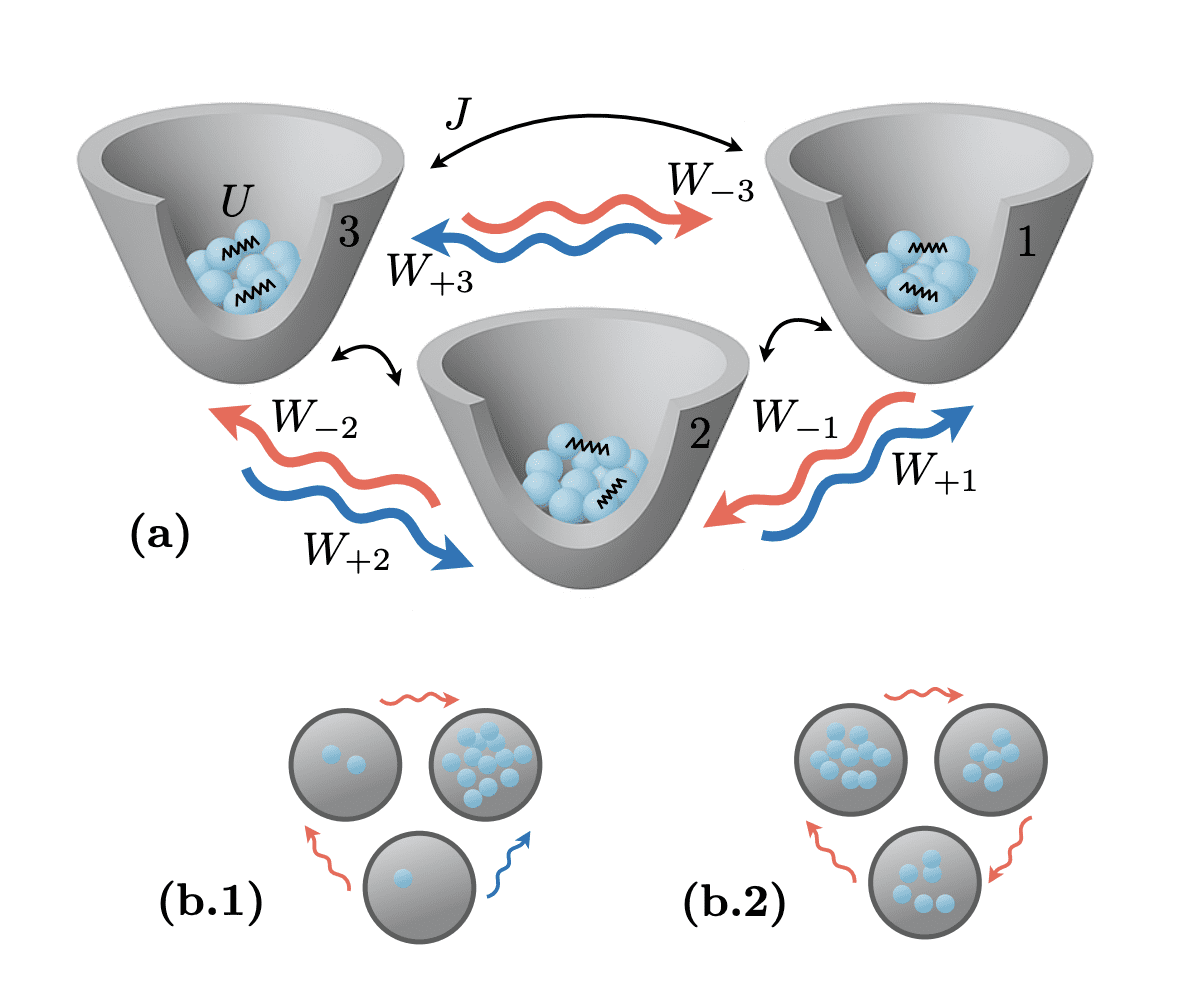
Research establishes a link between classical chaotic trajectories and the spectral properties of open quantum systems, utilising the SU(3) Bose-Hubbard trimer as a model. Positive Lyapunov exponents correlate with Wigner-Dyson statistics, indicating chaos, while a phase-space inverse participation ratio quantifies localisation and entropy scales with system dimension.
The behaviour of open quantum systems, those interacting with their environment, often exhibits characteristics mirroring classical chaotic systems, yet retaining uniquely quantum features. Understanding this correspondence is crucial for modelling a wide range of physical phenomena, from the dynamics of complex molecules to the behaviour of many-body systems far from equilibrium. Researchers at the Beijing Computational Science Research Center, namely M. A. R. Griffith, S. Rufo, Stefano Chesi, and Pedro Ribeiro, explore this connection in their recent work, entitled ‘Quantum and Semi-Classical Signatures of Dissipative Chaos in the Steady State’. They investigate how classical chaotic behaviour, characterised by sensitive dependence on initial conditions, manifests in the quantum properties of a system at its steady state, utilising a specific model – the SU(3) Bose-Hubbard trimer – and combining exact diagonalisation techniques with semiclassical Langevin dynamics to establish a clear link between classical trajectories and the resulting quantum spectral properties.
The correspondence between classical dynamical behaviour and the quantum properties of open systems receives substantial clarification through recent research utilising the SU(3) Bose-Hubbard trimer as a model. This investigation establishes a direct link between the nature of classical trajectories and the statistical properties of a system’s steady-state density matrix, thereby solidifying the connection between classical chaos and quantum statistical behaviour. Classical trajectories can converge to fixed points, oscillate in limit cycles, or exhibit chaotic behaviour, and this research demonstrates how each of these behaviours influences quantum properties. Specifically, regular dynamics, indicated by non-positive Lyapunov exponents – a measure of the rate of separation of infinitesimally close trajectories – produce Poissonian level statistics, while chaotic dynamics, characterised by positive exponents, result in Wigner-Dyson statistics, a different type of statistical distribution.
Symmetry plays a crucial role in shaping both the dynamics and quantum characteristics of these systems. Strong symmetries restrict the system’s evolution to lower-dimensional manifolds, effectively suppressing chaos and promoting localisation, where the quantum state becomes confined to a smaller region of phase space. Conversely, weaker symmetries preserve the global structure of the phase space, allowing chaotic behaviour to persist and manifest in the quantum properties. To quantify this localisation, researchers introduce the phase space inverse participation ratio (IPR), a metric that measures the degree of localisation within the phase space. The IPR effectively defines an effective dimension for the support of the Husimi distribution – a quasi-probability distribution used to represent quantum states in phase space – and provides a valuable tool for characterizing the spatial extent of quantum states.
The research confirms the scaling of entropy with the effective dimension, aligning with expectations derived from classical dynamics and reinforcing the validity of the semiclassical framework employed. This framework relies on stochastic mixtures of coherent states – quantum states that closely resemble classical states – and accurately reproduces not only average observable quantities but also more subtle features, such as spectral correlations and localisation properties. This demonstrates the framework’s power in bridging the gap between classical and quantum descriptions. The study confirms that dissipative chaos, where energy is lost from the system, leaves a discernible imprint on the steady-state density matrix, mirroring observations in closed quantum systems and suggesting a universal connection between chaos and quantum behaviour.
Future research should extend these findings to more complex systems, investigating the limits of the semiclassical approximation and the emergence of purely quantum effects. Further investigation into the potential for controlling and manipulating quantum chaos is also warranted, with potential applications in quantum information processing and the development of novel quantum technologies. The advancement of both theoretical tools and experimental techniques will be crucial for deepening our understanding of the interplay between classical and quantum chaos.
This research opens new avenues for exploring the fundamental connections between classical and quantum mechanics, providing a deeper understanding of the behaviour of complex systems. The findings have implications for a wide range of fields, including condensed matter physics, quantum optics, and quantum information processing. By bridging the gap between classical and quantum descriptions, this work paves the way for developing new technologies and applications based on the principles of quantum chaos.
👉 More information
🗞 Quantum and Semi-Classical Signatures of Dissipative Chaos in the Steady State
🧠 DOI: https://doi.org/10.48550/arXiv.2506.14961