

The pursuit of faster data processing and communication increasingly focuses on manipulating sound waves at gigahertz frequencies, known as hypersound. Edson R. Cardozo de Oliveira, from Université Paris-Saclay, and Gastón Grosman, from the Instituto de Nanosistemas, alongside their colleagues, now demonstrate a new way to control these high-frequency sound waves using materials that respond to their surroundings. The researchers created a unique resonator from a mesoporous thin film, a material riddled with nanoscale pores, and observed a significant shift in acoustic resonance frequency as humidity changed, a phenomenon not previously reported. This discovery offers a simple and effective method for tuning hypersound confinement and establishes a versatile platform for developing environment-responsive devices that could revolutionise fields reliant on high-speed data transmission and sensing.
Mesoporous Film Pore Size Characterization
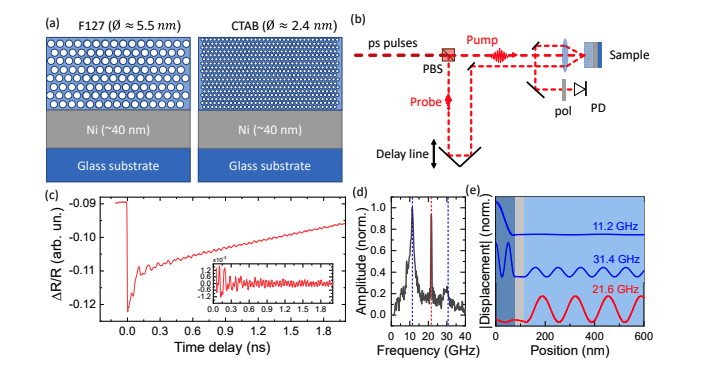
This supplemental material details the characterization of mesoporous thin films (MTFs) created using two different templates: F127 and CTAB. The research focuses on understanding and controlling the pore size and thickness of these films, crucial for creating environmentally responsive hypersound materials. Films created with the F127 template exhibited a wetting threshold at approximately 70% relative humidity and had pore diameters of 5. 5 nm during water absorption and 3 nm during desorption, with a porosity of around 38%. CTAB films showed a sharper transition in water content at 50% relative humidity and smaller pore diameters of 2.
The films contract slightly during desorption, and a contraction of approximately 15% in film thickness occurred after heat treatment at 350°C to remove the template material. This material provides detailed characterization of the pore structure and thickness control of the MTFs, demonstrating that different templates result in different pore sizes and porosities, factors that must be considered during fabrication.
Humidity Sensing Using Laser-Detected Acoustic Waves
The research team investigated acoustic wave behavior within specially engineered thin films, focusing on how these waves respond to changes in humidity. They employed a pump-probe technique to measure high-frequency sound waves, in the gigahertz range, providing a sensitive method for detecting subtle shifts in resonance caused by environmental factors. A key innovation was the design of an open-cavity resonator, where the mesoporous film forms the topmost layer, directly exposed to the surrounding environment, allowing external stimuli, such as humidity, to directly influence the acoustic properties of the material. To fully understand the observed acoustic behavior, the researchers developed detailed computer simulations using a transfer matrix method, which modeled both the optical and acoustic properties of the layered structure.
By carefully matching the simulated results with experimental data, the team confirmed that specific resonance frequencies corresponded to vibrations within the mesoporous film itself, while others originated from the substrate. This detailed analysis revealed a significant shift in the resonance frequency with changing humidity levels, demonstrating a strong sensitivity of approximately 0. 8 GHz, suggesting potential applications in sensors and other devices responsive to environmental conditions.
Tunable Nanoscale Acoustics with Mesoporous Films
Researchers have developed a novel nanoacoustic resonator based on mesoporous thin films, demonstrating a new approach to controlling sound waves at the nanoscale and opening possibilities for advanced devices. These films exhibit strong acoustic resonances in the gigahertz range, relevant for high-speed data processing and communication. The team discovered that these resonances are remarkably sensitive to changes in the surrounding environment, specifically humidity, allowing for tunable control of sound confinement within the material. The researchers fabricated these resonators by layering a mesoporous silica film onto a substrate, creating an open-cavity structure directly exposed to the atmosphere.
By monitoring the acoustic response of these films under varying humidity levels, they observed a pronounced shift in the resonant frequency, demonstrating a simple and effective method for tuning hypersound. Importantly, the study revealed that the resonant frequency is primarily determined by the thickness of the film, rather than the size of the pores within it, simplifying the design and fabrication of these resonators. Furthermore, the experimental results align well with detailed numerical simulations, validating the team’s approach and providing a deeper understanding of the underlying physics.
Humidity Tunes Nanoacoustic Resonances in Thin Films
This research demonstrates tunable confinement of nanoacoustic resonances within a novel mesoporous thin film resonator. The team successfully created a device where acoustic resonances can be altered by external humidity, representing the first demonstration of externally reconfigurable hypersound devices based on this principle. This was achieved through an open-cavity design, simplifying detection by enabling the use of standard transient reflectivity techniques. Analysis of resonator dimensions and pore sizes, supported by numerical simulations, confirms that resonance frequencies are primarily determined by material properties and film thickness. This work provides a new tool for investigating the structural properties of mesoporous thin films and opens possibilities for sensing applications and fundamental studies of nanoscale phenomena, ultimately advancing the field of tunable and responsive nanophononic applications.
🗞 Towards Environmentally Responsive Hypersound Materials
🧠 ArXiv: https://arxiv.org/abs/2507.19688


