

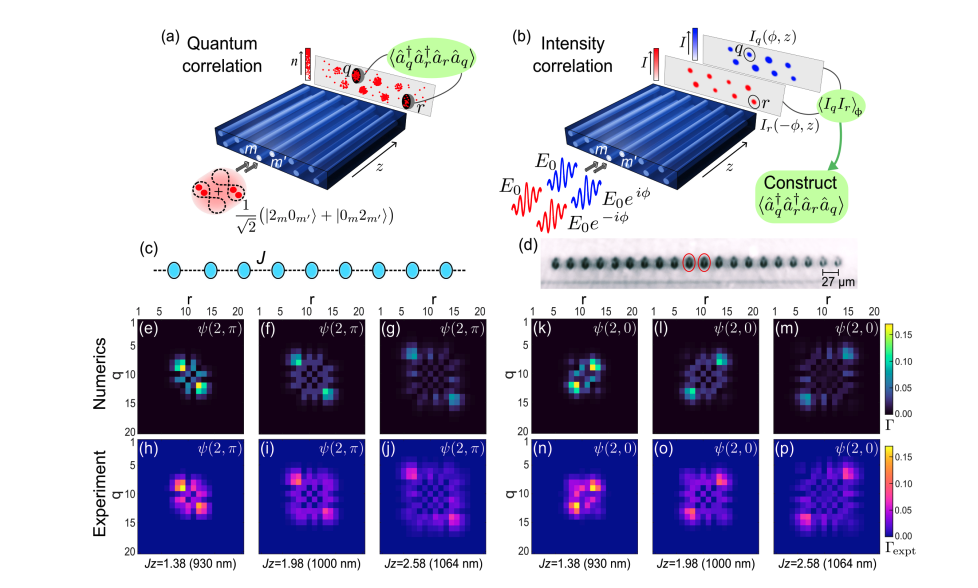
The behaviour of correlated photons holds immense potential for advancing quantum technologies, and researchers are now exploring how to precisely control their interactions within complex structures. Rishav Hui, Trideb Shit, and Marco Di Liberto, alongside colleagues at the Indian Institute of Science and the Universitá degli Studi di Padova, demonstrate experimental construction of multi-photon states, known as NOON states, within a specially designed photonic lattice. Their work reveals how these states exhibit surprising localization and delocalization properties dependent on both the number of photons and their relative phases, achieving a probability of 50% for localization under specific conditions. This ability to manipulate correlated photons within a lattice represents a significant step towards building sophisticated photonic networks capable of performing complex quantum computations and secure communications.
NOON State Propagation in Photonic Lattices
This research investigates how path-entangled photon pairs, described by a NOON state, behave within photonic lattices. These lattices, created using carefully designed photonic structures, manipulate light propagation in unique ways. NOON states enhance the precision of interferometric measurements beyond classical limits, but maintaining their fragile quantum coherence during propagation through complex materials presents a significant challenge. This work addresses the need to develop robust quantum systems for applications in quantum sensing and metrology. Conventional interferometers are limited by inherent noise, restricting achievable precision.
NOON states offer a pathway to overcome this limitation, but their susceptibility to decoherence hinders practical implementation. Understanding how NOON states evolve within specifically engineered photonic environments is therefore essential for realising their full potential. Researchers aim to observe how the lattice structure influences the entanglement and coherence of the NOON state, and to determine the factors that contribute to its preservation or degradation. By carefully controlling the lattice parameters and monitoring the output state, the team seeks to gain insights into the fundamental mechanisms governing quantum transport in these systems and to establish a pathway towards building more resilient quantum devices.
To experimentally emulate these states, researchers developed an intensity correlation measurement protocol using coherent laser light with tunable relative phases.
NOON State Localization in Flatband Lattices
This document provides supporting information for a study investigating the behavior of NOON states in different types of flatband lattices. The core focus is on understanding how the lattice geometry influences the localization or delocalization of these states and how this relates to entanglement. It expands on the main paper’s findings by providing detailed theoretical derivations, exploring different lattice geometries, and presenting numerical results. Key concepts include NOON states, which are important for precision measurements and quantum information processing; flatband lattices, which support localized states and enhance interactions; and the tight-binding model, a simplified model used to describe the electronic structure of solids.
Researchers utilise concepts like Bloch modes and localization/delocalization to analyse the behaviour of NOON states. The document begins with an analysis of rhombic lattices, providing mathematical descriptions of NOON state behaviour and demonstrating how localization probability depends on the phase of the input state. It identifies scaling laws governing localization probability as a function of the number of photons and explains how this relates to the lattice’s Bloch modes. A similar analysis is then performed on sawtooth lattices, comparing the behaviour of NOON states in both geometries. Key findings include a strong dependence of localization probability on the phase of the input state, suggesting control over photon entanglement.
The observed scaling laws indicate that entanglement can be optimised by choosing the appropriate number of photons, and the geometry of the lattice significantly impacts NOON state behaviour. These results suggest that lattices can be engineered to enhance photon entanglement. The findings of this study could have important applications in quantum metrology, quantum information processing, and materials science, potentially leading to the development of new materials with enhanced quantum properties.
NOON State Control in Photonic Lattices
This research demonstrates a novel localization-delocalization effect in a rhombic photonic lattice, where light behaves in unusual ways. Researchers observed how the probability of finding multiple photons depends on both the phase and the number of photons comprising a NOON state. The team successfully showed that, depending on these factors, photons can either become localized at certain points within the lattice or spread out, exhibiting a clear dependence on the properties of the NOON state. The significance of this work lies in its ability to predict the interference of correlated photons within complex photonic networks, potentially advancing the field of quantum photonics.
By developing a method to emulate these multi-photon states using standard laser light, the researchers have created a versatile tool for investigating multi-particle localization, complementing studies in other areas like ultracold atoms and Rydberg polaritons. The authors acknowledge that imperfections in the lattice and interactions between photons could influence the observed effects, suggesting these are important areas for future investigation. They also highlight the potential of their experimental approach to create and study other complex entangled states in photonic networks.
🗞 Experimental Construction of NOON State Dynamics in Photonic Flat Band Lattices
🧠 ArXiv: https://arxiv.org/abs/2508.21700


