
The quest to build practical quantum computers just received a significant boost. NVIDIA’s cuQuantum SDK is now integrated into two leading quantum simulation packages – QuTiP and scQubits – dramatically accelerating the design and study of next-generation qubits. This integration unlocks unprecedented simulation speeds – up to 4000x faster on GPU nodes – enabling researchers to model more complex and less noisy quantum systems than ever before. By tackling a key bottleneck in quantum development, this collaboration promises to accelerate the prototyping of novel quantum devices and bring us closer to realizing the full potential of quantum computing.
cuQuantum SDK for Quantum Simulation
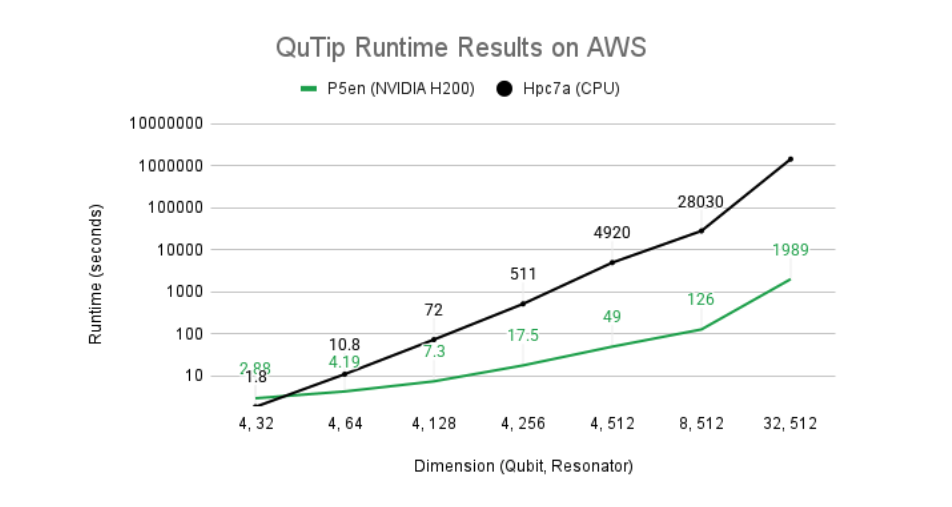
NVIDIA’s cuQuantum SDK is rapidly becoming a pivotal tool for accelerating quantum simulation, with recent integrations into the widely-used Python packages QuTiP and scQubits promising significant performance gains for researchers and quantum processing unit (QPU) designers. The SDK, comprised of libraries for both circuit and device-level simulations, allows for end-to-end acceleration in workflows focused on novel qubit design and analysis. Notably, a new cuQuantum plugin, qutip-cuquantum, developed by Alexandre Blais’ group at the University of Sherbrooke, delivers up to a 4000x speedup when simulating large transmon-resonator systems on an 8x GPU node hosted on AWS, compared to CPU-based simulations. This leap in performance not only facilitates the study of more complex quantum systems, including scaling simulations to Hilbert spaces previously unattainable, but also contributes to less noisy simulations – a critical factor in building practical quantum computers. Simultaneously, Jens Koch’s group at Northwestern University has integrated cuQuantum into scQubits, their open-source package for modeling superconducting qubits, achieving up to a 54x speedup over advanced CPUs for specific simulations. These combined advancements empower researchers to rapidly prototype and refine quantum device designs, explore more complex dynamics, and ultimately push the boundaries of quantum computing technology. The availability of cuQuantum on AWS further democratizes access to these powerful simulation capabilities, allowing a wider range of users to benefit from GPU-accelerated quantum workflows.
QuTiP and scQubits Integration Details
NVIDIA’s cuQuantum SDK is now deeply integrated into two leading Python-based quantum simulation packages, QuTiP and scQubits, dramatically accelerating workflows for qubit design and analysis. For QuTiP, a widely used tool for simulating open quantum systems, researchers at the University of Sherbrooke developed the qutip-cuquantum plugin, delivering up to a 4000x speedup when simulating large transmon-resonator systems on an 8x GPU node hosted on AWS. This leap in performance isn’t just about speed; it allows for the simulation of less noisy systems and expands the scope of possible simulations by enabling access to much larger Hilbert spaces – researchers successfully modeled a 64-state transmon qubit paired with a 512-state resonator, a task previously computationally prohibitive. Similarly, scQubits, a popular package for modeling superconducting qubits developed at Northwestern University, benefits from cuQuantum integration, achieving a 54x speedup over advanced CPUs for certain simulations. This acceleration empowers QPU designers and researchers to rapidly prototype novel device designs, understand the impact of complex dynamics, and ultimately improve quantum device performance, addressing critical bottlenecks in the path towards scalable quantum computing. Both integrations leverage NVIDIA GPUs to unlock significant performance gains, enabling the study of more intricate quantum systems than previously possible.
Performance Gains with NVIDIA GPUs
NVIDIA GPUs are delivering substantial performance gains in the burgeoning field of quantum computing, as evidenced by new integrations of the NVIDIA cuQuantum SDK within leading simulation packages. Specifically, cuQuantum has been successfully integrated into both Quantum Toolbox in Python (QuTiP) and Superconducting Qubits (scQubits), dramatically accelerating workflows for the design and study of novel qubits. Researchers at the University of Sherbrooke achieved a remarkable 4000x speedup when simulating large transmon-resonator systems by leveraging an 8x GPU node hosted on AWS with the newly developed qutip-cuquantum plugin for QuTiP. This leap in performance not only facilitates the simulation of more complex quantum systems—including scaling to 64-state qubits paired with 512-state resonators—but also addresses a critical bottleneck in quantum computing development: noise reduction. Simultaneously, the combination of scQubits and cuQuantum yields significant speedups over advanced CPUs, with certain superconducting qubit simulations experiencing a 54x improvement. This enhanced speed allows for rapid prototyping of new device designs and a deeper understanding of complex dynamics affecting qubit performance, ultimately pushing the boundaries of what’s possible in quantum device engineering. The availability of cuQuantum on AWS further democratizes access to these powerful simulation capabilities, benefiting both QPU designers and researchers striving to build more robust and scalable quantum computers.
Scaling Simulations and System Complexity
The pursuit of increasingly complex quantum simulations is being dramatically accelerated by NVIDIA’s cuQuantum SDK, now integrated into leading Python packages QuTiP and scQubits. Addressing a critical bottleneck in quantum computing—the ability to model larger, more realistic systems—cuQuantum delivers substantial speedups that were previously unattainable. Researchers at the University of Sherbrooke, utilizing a new cuQuantum plugin for QuTiP (qutip-cuquantum), have demonstrated a remarkable 4000x performance increase when simulating large transmon-resonator systems, moving from CPU-based calculations to an 8x GPU node hosted on AWS. This leap in processing power not only enables the study of less noisy systems, crucial for reliable quantum computation, but also allows for simulations scaling to significantly larger Hilbert spaces—the team successfully modeled a 64-state transmon qubit paired with a 512-state resonator, a feat impossible without multi-GPU support. Similarly, Northwestern University’s scQubits package, when combined with cuQuantum and NVIDIA GPUs, achieves a 54x speedup over advanced CPUs for specific superconducting qubit simulations. These advancements are enabling quantum device designers and researchers to rapidly prototype novel designs, understand the impact of complex dynamics, and ultimately, push the boundaries of quantum device performance by tackling simulations of unprecedented scale and complexity.