

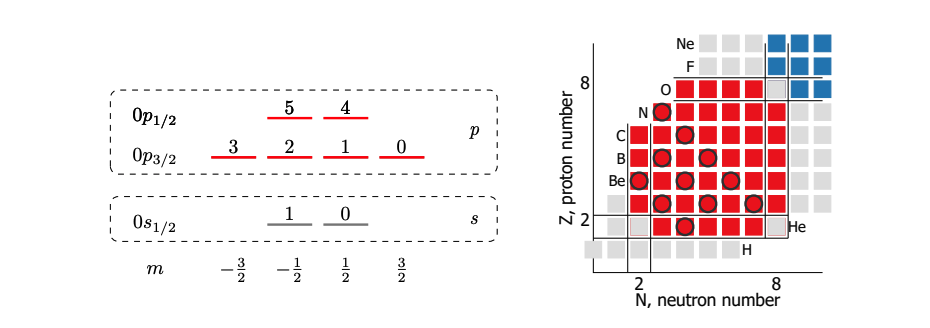
Quantum computing promises revolutionary advances across many scientific fields, and simulating the behaviour of atomic nuclei represents a particularly compelling application. Miquel Carrasco-Codina, Emanuele Costa, and Antonio Márquez Romero, all from the Departament de Física Quàntica i Astrofísica at the Universitat de Barcelona, lead a team that investigates the potential of two leading quantum algorithms for this task. The researchers compare the performance of the Unitary Coupled Cluster and Adaptive Derivative-Assembled Pseudo-Trotter methods when calculating the ground states of light nuclei, ranging from helium to boron, within the established nuclear shell model. By introducing a new way to measure computational resource usage, the team demonstrates that ADAPT excels at simulating nuclei with stable configurations, while UCC proves more efficient for those with more complex structures, establishing a crucial benchmark for future algorithm development in nuclear physics.
Quantum computing holds immense promise for the future, and simulating quantum many-body systems represents a natural application of this technology. This work presents classical simulations of the ground states of light atomic nuclei, ranging from Helium to Boron-10, calculated within the nuclear shell model. Researchers compare the performance of two leading variational quantum eigensolver algorithms, specifically the Unitary Coupled Cluster (UCC) and the Adaptive Derivative-Assembled Pseudo-Trotter (ADAPT) methods. The findings demonstrate that Slater determinants are the most efficient basis for representing the ground states of these nuclei, offering a pathway towards more tractable quantum simulations of nuclear structure. This efficiency stems from their ability to capture the dominant correlations within the nucleus, reducing the complexity of the quantum circuit required for accurate calculations.
Variational Quantum Eigensolver for Nuclear Structure
This is a comprehensive overview of research applying quantum computing to nuclear physics, specifically focusing on solving the complex nuclear many-body problem. The overarching goal is to leverage quantum computers to tackle calculations that are intractable for even the most powerful classical computers due to the exponential growth in computational complexity. The primary quantum algorithm explored is the Variational Quantum Eigensolver (VQE), a hybrid quantum-classical approach used to determine the ground state energy of a system. VQE operates by preparing a parameterized quantum state, or ansatz, and then optimising the parameters to minimise the energy expectation value, calculated on a classical computer. Key ansätze explored include the Unitary Coupled Cluster (UCC) method, widely used in quantum chemistry and adapted for nuclear physics, and the more recent ADAPT-VQE.
Researchers acknowledge the challenges associated with UCC, such as the depth of the required quantum circuits and the potential for barren plateaus, which hinder optimization. UCC constructs the wavefunction by applying unitary transformations to a reference state, systematically including higher-order correlations. However, the number of terms in the UCC expansion grows rapidly with system size, demanding significant quantum resources. The Adaptive (ADAPT) ansatz offers a promising alternative by dynamically selecting the most important interactions to include in the wavefunction, potentially reducing the complexity of the quantum circuit. ADAPT-VQE employs a derivative-based approach to identify and retain only the most significant excitation operators, thereby minimising the number of quantum gates required. Crucially, mapping the nuclear Hamiltonian onto qubits and exploiting the symmetries inherent in the system are essential for reducing computational costs. The nuclear Hamiltonian describes the total energy of the system, including kinetic and potential energy terms, and the Hilbert space encompasses all possible states of the nucleus.
Quantum circuits, sequences of quantum gates manipulating qubits, are the building blocks of these calculations. Each qubit represents a two-level quantum system, and quantum gates perform transformations on these qubits. Barren plateaus, where the optimization process stalls due to vanishing gradients, represent a significant hurdle in VQE calculations. These plateaus arise when the energy landscape becomes flat, making it difficult for the classical optimizer to find the minimum energy. Techniques like Trotterization approximate the time evolution operator, which describes how the system evolves over time, and symmetry restoration ensures the wavefunction adheres to the system’s symmetries. The nuclear shell model provides a framework for understanding the structure of atomic nuclei, based on the idea that nucleons occupy discrete energy levels, similar to electrons in atoms. Realistic effective interactions between nucleons are used within the nuclear shell model, and configuration interaction builds the wavefunction as a combination of basis states, each representing a specific configuration of nucleons within the nucleus. The choice of effective interaction significantly impacts the accuracy of the calculations.
Specific research directions include evaluating the performance of different ansätze for specific nuclei, exploiting symmetries to reduce computational cost, developing new optimization algorithms that are less susceptible to barren plateaus, and finding efficient ways to represent nuclear Hamiltonians on quantum computers. Investigating the limitations of current quantum algorithms, such as their scalability to heavier nuclei, is also crucial. Furthermore, exploring the use of error mitigation techniques to reduce the impact of noise on quantum computations is essential for achieving accurate results. The development of quantum algorithms tailored to the specific symmetries and properties of nuclei represents a promising avenue for future research. In summary, this body of research explores the potential of quantum computing to revolutionise our understanding of nuclear structure. The focus is on developing and implementing quantum algorithms, particularly VQE, to solve the nuclear many-body problem and gain insights into the properties of atomic nuclei, potentially leading to a more complete understanding of the universe’s building blocks.
🗞 Comparison of variational quantum eigensolvers in light nuclei
🧠 DOI: https://doi.org/10.48550/arXiv.2507.13819


