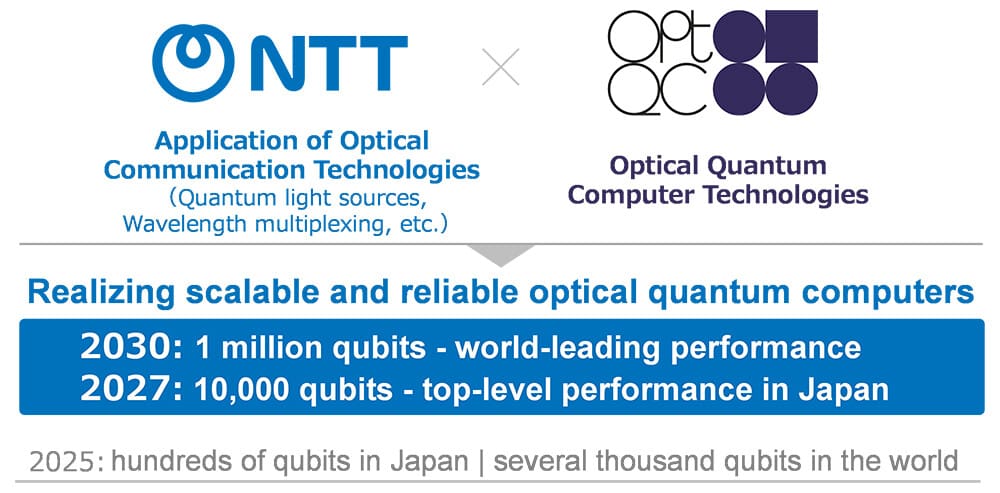
NTT, Inc. and OptQC Corp. formalized a collaboration agreement on November 18, 2025, to jointly develop scalable and reliable optical quantum computers targeting one million qubits by 2030. This partnership will integrate NTT’s advancements in optical communication technologies—including optical amplification and multiplexing for quantum light sources—with OptQC’s expertise in optical quantum computing. The initiative aims to overcome limitations of current quantum computing approaches by leveraging room-temperature operation and atmospheric pressure, ultimately enabling solutions for computationally intensive challenges in fields like drug discovery and climate change prediction.
Collaboration for Scalable Optical Quantum Computing
NTT and OptQC have forged a collaboration aiming to build scalable optical quantum computers, targeting one million qubits by 2030. This partnership leverages NTT’s expertise in optical communication – including advancements in optical amplification and multiplexing – with OptQC’s pioneering work in room-temperature optical quantum computing. Notably, NTT recently achieved quantum entanglement generation 1,000x faster than conventional methods, a breakthrough crucial for building these complex systems. This isn’t just about qubit count; it’s about overcoming the noise sensitivity inherent in quantum computation.
The key advantage of optical quantum computing lies in its potential to operate at room temperature and atmospheric pressure, sidestepping the extreme cooling requirements of many other quantum approaches. OptQC has already developed a functional room-temperature system and is currently working towards a 10,000-qubit machine through a NEDO-backed project. The collaboration will focus on scaling this technology, developing robust error correction techniques, and establishing the necessary supply chain for widespread adoption.
Beyond hardware development, NTT and OptQC will jointly explore practical applications and algorithms for these quantum computers. This includes identifying high-impact use cases – like drug discovery, materials science, and financial optimization – and creating the software infrastructure to support them. The collaboration’s roadmap anticipates initial technical studies and partnership building over the next five years, culminating in a fully functional, million-qubit optical quantum computer by the end of the decade.
Leveraging Optical Technologies and Expertise
NTT and OptQC are collaborating to build scalable optical quantum computers, aiming for one million qubits by 2030. This initiative leverages NTT’s advancements in optical communications – including optical amplification and multiplexing – combined with OptQC’s expertise in room-temperature optical quantum computing. Notably, NTT has already achieved quantum entanglement generation 1,000x faster than conventional methods using their optical amplification technology, demonstrating a key building block for larger systems.
A significant challenge in quantum computing is maintaining qubit stability. This partnership directly addresses this by focusing on error correction technologies, essential for reliable computation. Optical quantum computers, unlike many other approaches, operate at ambient conditions, sidestepping the need for expensive and complex cryogenic systems. Successfully scaling to one million logical qubits—those corrected for errors—is viewed as a critical threshold for practical quantum applications.
The collaboration isn’t solely focused on hardware. NTT and OptQC will jointly develop algorithms and use cases for these quantum computers, alongside establishing a robust supply chain. Exploration will focus on areas like drug discovery, materials science, and financial optimization – fields poised to benefit from the immense computational power. This holistic approach, from qubit development to application design, aims to accelerate the social implementation of quantum computing.
Roadmap to One Million Qubits by 2030
NTT and OptQC have forged a collaboration aiming for a one million qubit optical quantum computer by 2030. This ambitious goal leverages NTT’s expertise in optical communication – including advancements in optical amplification and multiplexing – combined with OptQC’s pioneering work in room-temperature optical quantum computing. A key breakthrough already achieved is quantum entanglement generation 1,000 times faster than conventional methods, demonstrating a significant leap towards scalable quantum processing.
Optical quantum computers offer a potential advantage over other approaches by operating at room temperature and atmospheric pressure, sidestepping the need for costly and complex cryogenic systems. NTT and OptQC will focus on developing technologies crucial for scalability – specifically multiplexing to increase qubit count – and robust error correction. Achieving one million physical qubits is only the first step; creating thousands of stable logical qubits via error correction is essential for practical applications.
This partnership isn’t solely focused on hardware. NTT and OptQC plan to jointly explore use cases, develop tailored algorithms, and establish a complete supply chain for optical quantum computers. They anticipate applications in areas like drug discovery, materials science, financial optimization, and climate modeling – tackling complex challenges currently intractable for conventional computers. Initial studies will begin immediately, with use-case verification planned within three years.
Key Technologies and Quantum Concepts
NTT and OptQC are collaborating to build scalable optical quantum computers, aiming for one million qubits by 2030. This approach leverages the benefits of light – operating at room temperature and atmospheric pressure – avoiding the extreme conditions needed by many other quantum computing methods. Crucially, NTT brings advanced optical communication technologies like amplification and multiplexing – previously used for data transmission – to enhance quantum signal strength and qubit generation speed; they’ve already achieved entanglement generation 1,000x faster than conventional methods.
Optical quantum computers rely on manipulating light to encode and process information, offering a potential path to overcome limitations of traditional silicon-based qubits. Achieving one million qubits is a key milestone because it enables the creation of robust logical qubits through error correction. Logical qubits are formed by combining multiple physical qubits, and are necessary for stable, reliable computation. NTT and OptQC are focusing on both scaling up qubit count and improving error-tolerance simultaneously.
This collaboration isn’t just about hardware. NTT and OptQC will jointly develop algorithms and software tailored for optical quantum computers, alongside building a supply chain. They’re actively seeking use cases addressing complex social challenges – such as drug discovery, materials science, and financial optimization – demonstrating a commitment to practical application. This holistic approach – combining technological innovation with real-world problem solving – is vital for the future of quantum computing.