
This research explores the proximity effect of superconductivity on confined states in semiconductors, focusing on the charge of Andreev bound states and Andreev molecules in an InSb/Al hybrid nanowire. Using an integrated quantum dot as a charge sensor, the study presents a novel approach for parity measurements of Majorana zero modes in Kitaev chains. The findings offer a new method for reading out the parity of qubit states, a significant advancement for quantum computing. The research also highlights the potential of charge sensing for MZM parity readout in Kitaev chains, a technique previously unused for detecting fractional charge differences.
What is the Proximity Effect of Superconductivity on Confined States in Semiconductors?
The proximity effect of superconductivity on confined states in semiconductors gives rise to various bound states such as Andreev bound states, Andreev molecules, and Majorana zero modes. These bound states do not conserve charge, but their fermion parity is a good quantum number. One way to measure parity is to convert it to charge first, which is then sensed. In this work, the charge of Andreev bound states and Andreev molecules in an InSb/Al hybrid nanowire is sensed using an integrated quantum dot operated as a charge sensor. This approach can be further used for parity measurements of Majorana zero modes in Kitaev chains based on quantum dots.
Majorana zero modes (MZMs) are predicted to appear at the ends of a 1D chain of spin-polarized electronic sites with superconducting pairing, which can be implemented with the use of quantum dots (QDs) coupled to superconductors. Even a minimal two-site Kitaev chain hosts MZMs in a parameter sweet spot and was recently realized in a semiconductor-superconductor hybrid nanowire. MZMs in Kitaev chains are predicted to be robust with regard to local perturbations and to obey non-Abelian statistics, allowing the demonstration of Ising anyon fusion rules and braiding.
Qubit states can be encoded in the parity of pairs of MZMs, making parity readout crucial for any quantum information experiment involving MZMs. Proposed readout techniques include circuit quantum electrodynamics, quantum capacitance measurements, and charge sensing. To read out parity with a charge measurement, it must first be converted into charge and then sensed. Although charge sensing has been applied to semiconductor-superconductor hybrids before, it has never been used to detect fractional charge differences. This can potentially be necessary for parity readout in Kitaev chains, given that the charge difference between the even ground state and the odd ground state can range from 0 to 1 e.
How is Charge Sensing Applied to Semiconductor-Superconductor Hybrids?
In this work, charge sensing measurements of a hybrid semiconductor-superconductor system are presented. First, the charge of an Andreev bound state (ABS) in its even and odd fermion parity ground states is measured. Then, a QD is coupled to an ABS to form an Andreev molecule, and its ground state parity is inferred from tunnel spectroscopy and charge sensing measurements. As opposed to transport, charge sensing does not alter the parity itself, highlighting its potential as a tool for MZM parity readout in Kitaev chains.
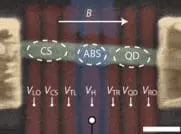
The device used in this work is an InSb nanowire placed on a thin layer of gate dielectric, below which are finger gates. The middle section of the wire, the hybrid segment, is contacted by a grounded Al thin film and hosts ABSs. A QD is defined to the left of the hybrid segment by setting VLO and VTL to create tunnel junctions in the nanowire. The QD’s electrochemical potential is controlled using VCS and is operated as a single lead QD charge sensor (CS). The tunnel gate between the CS and the hybrid segment is kept at a negative voltage to fully quench transport and ensure their coupling is only capacitive.
What is the Role of the Nanowire in the Device?
The nanowire section to the right of the hybrid segment can be either a tunnel barrier or a QD, depending on the tunnel gate voltages VRO and VTR. The nanowire is contacted by two normal CrAu leads that can be used for dc transport. The device is characterized by an SEM image, showing an InSb nanowire placed on an array of bottom gates and contacted by normal CrAu leads. A QD is defined to the left of the hybrid segment and operated as a CS. Another QD can be formed with the gates to the right of the hybrid segment.
The amplitude of the reflected rf signal of the right lead for varying voltage on the hybrid plunger gate and the right bias for an external magnetic field is measured. The superimposed line corresponds to a shift of the gate voltage corresponding to the Coulomb resonance of the CS. The Zeeman splitting of the first ABS is indicated, and additional charge accumulated on the hybrid is shown.
How is the Device Characterized?
The device is characterized by measuring the amplitude of the reflected rf signal of the left lead for varying voltage on the CS plunger gate at fixed values of VH. The amplitude of the reflected rf signal of the left lead for varying VCS and VH is also measured. The device setup and characterization involve a false-color SEM micrograph of the device, an InSb nanowire placed on an array of bottom gates, and contacted by normal CrAu leads. A QD is defined to the left of the hybrid segment and operated as a CS. Another QD can be formed with the gates to the right of the hybrid segment.
The dc equivalent circuit of the device is also presented. Both normal leads of the hybrid segment are connected to off-chip LC resonators, which are multiplexed. Each LC resonator has a bias tee that can be used to bias the leads with respect to the grounded Al. The amplitude of the reflected rf signal of the right lead for varying voltage on the hybrid plunger gate and the right bias for an external magnetic field is measured. The superimposed line corresponds to a shift of the gate voltage corresponding to the Coulomb resonance of the CS.
What are the Implications of this Research?
This research presents a novel approach to measure the charge of Andreev bound states and Andreev molecules in a hybrid nanowire using an integrated quantum dot operated as a charge sensor. This approach can be further used for parity measurements of Majorana zero modes in Kitaev chains based on quantum dots. The findings of this research have significant implications for the field of quantum computing, as they provide a new method for reading out the parity of qubit states encoded in the parity of pairs of Majorana zero modes.
The research also demonstrates the potential of charge sensing as a tool for MZM parity readout in Kitaev chains. This is a significant advancement, as charge sensing has never been used to detect fractional charge differences before. The ability to detect such differences could be crucial for parity readout in Kitaav chains, given that the charge difference between the even ground state and the odd ground state can range from 0 to 1 e.
Furthermore, the research provides valuable insights into the proximity effect of superconductivity on confined states in semiconductors. Understanding this effect is crucial for the development of quantum computing technologies, as it gives rise to various bound states that can be used for quantum information processing.
Publication details: “Charge Sensing the Parity of an Andreev Molecule”
Publication Date: 2024-04-01
Authors: David van Driel, Bart Roovers, Francesco Zatelli, Alberto Bordin, et al.
Source: PRX Quantum 5, 020301
DOI: https://doi.org/10.1103/PRXQuantum.5.020301