Nonlinear magnetism presents exciting possibilities for controlling spin-based information technologies and exploring fundamental physics, and recent work by Vincent Flynn, Benedetta Flebus, and colleagues at Boston College demonstrates a pathway to achieving novel states of matter through carefully controlled magnetic systems. The researchers reveal that a standard ferromagnetic multilayer, when driven with a direct current, exhibits a unique chiral spin-superfluid state, where magnetic excitations flow without resistance and break fundamental symmetries of space and time. This discovery is significant because it establishes a readily accessible platform for creating non-reciprocal devices, where signals travel preferentially in one direction, and opens up new avenues for investigating analogue gravity, the simulation of gravitational phenomena using condensed matter systems. By manipulating the driving force, the team further demonstrates the ability to generate ‘sonic horizons’ and observe effects analogous to Hawking radiation, bringing tabletop experiments closer to understanding the behaviour of black holes.
Nonlinear magnetization dynamics provide a pathway to novel states of matter, including nonreciprocal phases, spin superfluidity, and even analogue gravity. Scientists identify materials with independently tunable nonlinearity and non-Hermiticity as promising platforms to achieve universal behavior in systems far from equilibrium. This research demonstrates that a conventional ferromagnetic multilayer embodies this paradigm, carefully balancing a direct current drive against Gilbert damping to stabilize a chiral spin-superfluid state. The findings reveal a novel state of matter where spin dynamics exhibit unusual properties, potentially leading to new technologies and a deeper understanding of fundamental physics. This approach provides a controllable system for exploring complex quantum phenomena and investigating the interplay between magnetism and superfluidity.
Chiral Spin Superfluidity in Ferromagnetic Multilayers
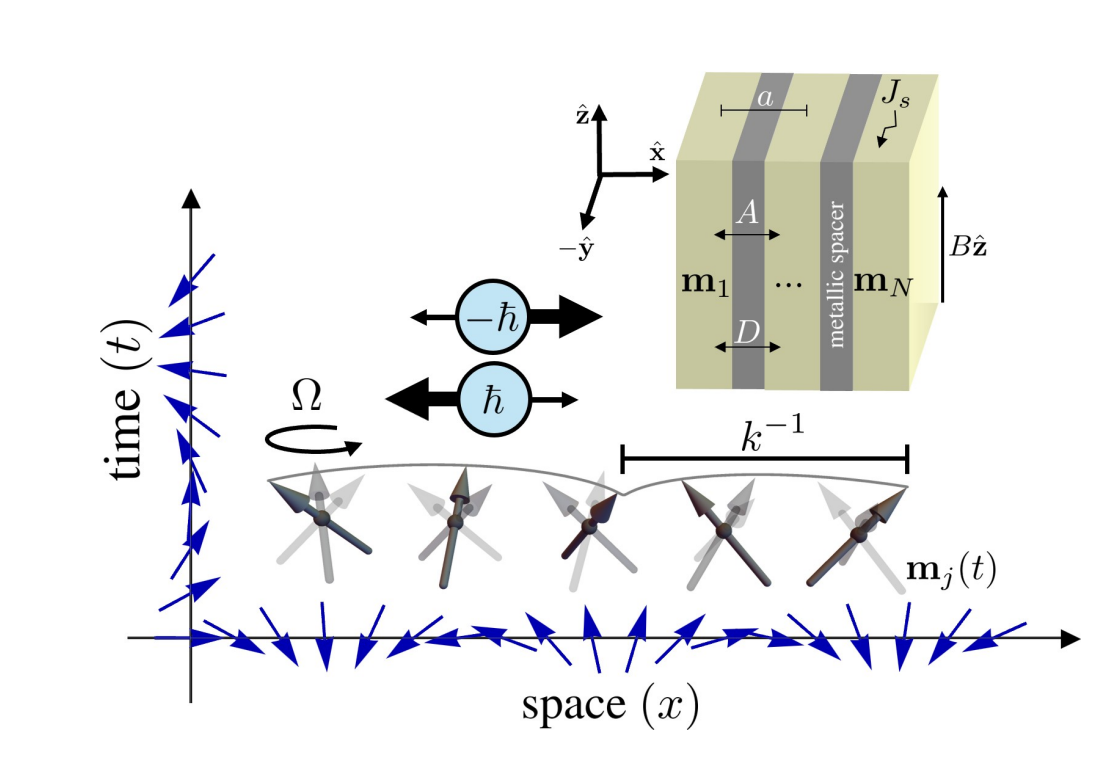
The research establishes a novel platform for investigating physics beyond equilibrium by demonstrating spin superfluidity within a ferromagnetic multilayer. Scientists engineered a system comprising ferromagnetic layers separated by metallic spacers, carefully balancing a direct current drive against Gilbert damping to stabilize a chiral spin-superfluid limit cycle. This cycle spontaneously breaks spacetime-translation symmetry, creating a superflow where magnons, quantized spin waves, exhibit directional propagation. The team applied a direct current and utilized interfacial exchange interactions, both symmetric and antisymmetric, to control the magnetization dynamics within the multilayer structure.
To analyze this complex system, the study adopted a continuum description, effectively smoothing out the magnetization to create a spatially continuous field, allowing researchers to describe the system’s evolution using a fundamental equation governing magnetization dynamics. The team derived an effective free energy functional, incorporating the effects of the applied field, saturation magnetization, and Dzyaloshinskii-Moriya interaction, a crucial factor inducing the chiral spin texture. This free energy functional was then used to define a mathematical description of the system, revealing an effective gauge field governing the magnetization’s behavior. Scientists introduced a mathematical approach, recasting the dynamics into a hydrodynamic form, yielding coupled nonlinear equations that describe the evolution of the longitudinal magnetization component and the azimuthal phase, effectively defining a local spin-continuity law.
By counteracting damping with the direct current drive, the team sought to stabilize a current-carrying configuration as a limit cycle, even in regimes where equilibrium superfluid states are forbidden. The resulting steady-state limit-cycle solution exhibits a uniformly precessing state, characterized by a linear phase winding that generates a steady, nonzero flow of spin angular momentum, defining the spin superfluid current. This research establishes a tabletop route to explore nonreciprocal transport, nonequilibrium phase transitions, and analogue-gravity kinematics.
Spin Superfluid Breaks Spacetime Symmetry
This work demonstrates a novel platform for exploring physics beyond equilibrium using a ferromagnetic multilayer heterostructure, achieving a chiral spin-superfluid limit cycle that breaks spacetime-translation symmetry. Researchers balanced Gilbert damping with a direct current drive to stabilize this unique state, resulting in a spin-superfluid diode where long-wavelength magnons of opposite chirality exhibit asymmetric dispersions and direction-selective propagation. Crucially, this nonreciprocity is flow-borne, originating from broken Galilean invariance and requiring neither structural asymmetry nor precise tuning of gain and loss. Experiments reveal that in the comoving frame of the spin-superfluid limit cycle, phase fluctuations satisfy a scalar wave equation with an effective acoustic metric, establishing a concrete analogue-gravity link.
Spatial modulation of the drive generates sonic horizons that parametrically squeeze magnons, producing a stationary two-mode squeezed state. Introducing a current-modulation junction nucleates a sonic horizon, enabling particle-hole pair production as one mode tunnels across it while its negative-energy partner is advected, yielding bursts of Hawking-like emission. The team established that the free energy functional governing the system, incorporating both exchange interactions and Dzyaloshinskii-Moriya interactions, leads to an effective anisotropy favoring magnetization perpendicular to the applied field. Measurements confirm that the resulting spin-superfluid state supports excitations with asymmetric propagation speeds, demonstrating a clear departure from conventional equilibrium behavior. This work elevates a seemingly mundane magnetic heterostructure to a platform for generating, tuning, and diagnosing spin superfluidity, emergent nonreciprocity, and Hawking-like emission with standard instrumentation.
Chiral Spin-Superfluid Diode Realized in Ferromagnet
Researchers have demonstrated a novel platform for studying physics beyond equilibrium using a ferromagnetic multilayer. This work establishes that balancing a direct current drive with Gilbert damping can stabilize a chiral spin-superfluid limit cycle, a state where spontaneous symmetry breaking occurs and the system exhibits superflow. A key finding is the realization of a spin-superfluid diode, where magnons, or spin waves, of opposite chirality propagate with differing velocities, resulting in nonreciprocal transport. This asymmetry arises not from structural properties or external gain, but from the directed motion inherent in the superflow itself, effectively breaking Galilean invariance.
The team further reveals that manipulating the drive applied to the multilayer allows for the creation of sonic horizons, analogous to event horizons in astrophysics. These horizons parametrically amplify magnons and produce Hawking-like emission of particle-hole pairs, offering a tabletop system for exploring analogue gravity phenomena. Analysis of the system’s stability reveals that the transition between stable and unstable states corresponds to the formation of a black-hole horizon, providing a kinematic signature for this process. While the current study focuses on long-wavelength magnons, the authors acknowledge that future research could investigate the behavior of shorter wavelengths and explore the potential for quantum effects within this unique system. This work opens new avenues for investigating nonequilibrium phase transitions and nonreciprocal transport using a readily accessible and controllable platform.
🗞 Nonlinear magnetization dynamics as a route to nonreciprocal phases, spin superfluidity, and analogue gravity
🧠 ArXiv: https://arxiv.org/abs/2510.21963