

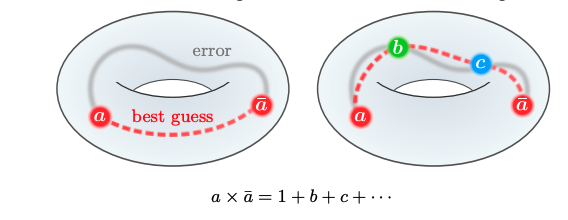
Topological order represents a promising route to robust quantum computation, but understanding its resilience to errors has largely focused on simpler, Abelian systems. Now, Dian Jing from the University of Chicago, Pablo Sala from the California Institute of Technology, and Liang Jiang, along with Ruben Verresen and colleagues at the University of Chicago, demonstrate that non-Abelian topological order can actually enhance stability against noise. The team exploits the unique way non-Abelian anyons combine, using the outcomes of these combinations to actively detect and correct errors, a process they term ‘intrinsic heralding’. This approach achieves significantly improved error correction thresholds, potentially exceeding those possible with traditional Abelian systems, and offers a new framework for designing fault-tolerant quantum computers based on the principles of topological order.
Topological order provides a natural platform for storing and manipulating quantum information. This research demonstrates that utilizing the inherent properties of non-Abelian topological order can enhance the stability of quantum information storage and manipulation. Researchers have now demonstrated that these systems can outperform their Abelian counterparts in error correction, achieving improved error correction thresholds compared to standard methods. This improvement stems from a surprising property: the very features that make non-Abelian anyons difficult to control also provide a means to enhance stability. The team discovered that by leveraging the non-deterministic fusion of non-Abelian anyons, they could design decoders that actively signal the presence of noise, a process termed ‘intrinsic heralding’.
Decoding Measurement Errors in D4 Codes
This document details a sophisticated approach to quantum error correction in a topological quantum code, specifically a D4 code. It goes beyond standard error correction by addressing not only physical errors, such as bit flips and phase flips, but also measurement errors in the non-Abelian anyons used as qubits. The research focuses on building a robust decoder that can handle these errors and achieve high fault tolerance. The decoder’s performance relies on carefully assigned weights that account for different error types and their probabilities, and utilizes a three-dimensional decoding framework, representing error syndromes as terminals in a lattice and finding the most likely error through a minimum-weight matching process.
The decoder identifies measurement errors by observing fluctuations in intermediate anyons and employing a technique called time-like heralding, which uses measurements at different times to identify and correct errors. Detailed calculations determine the probability of observing a specific syndrome given a particular error, forming the basis of an optimal decoder. The document reports the thresholds for error correction, representing the maximum error rate the decoder can tolerate while reliably correcting errors, and demonstrates the importance of handling measurement errors, a crucial step towards building a practical topological quantum computer.
Non-Abelian Anyons Enable Improved Error Correction
Researchers have demonstrated that non-Abelian topological orders can outperform their Abelian counterparts in error correction. The team focused on how errors manifest in these systems, specifically examining the behavior of anyons created by noise. Instead of forcing a match between anyons and their anti-particles, the researchers harnessed the inherent uncertainty in non-Abelian fusion. They discovered that the non-deterministic nature of non-Abelian anyons actually provides information about the original error. The team developed intrinsically heralded decoders that exploit this property, effectively reading out information from the superposition of fusion outcomes along the error path.
This allows the decoder to better identify and correct errors without needing additional “flag” qubits. Through detailed calculations and simulations, the researchers demonstrated a significant improvement in the error correction threshold for non-Abelian topological orders, achieving a threshold of 0. 218, exceeding the 0. 159 threshold obtained with standard methods. This result suggests that non-Abelian topological orders are not merely a theoretical curiosity, but a potentially powerful platform for building fault-tolerant quantum computers.
Non-Abelian Anyons Enhance Error Correction
The study further establishes a statistical mechanics model, based on Bayesian inference, to determine the optimal decoding strategy for non-Abelian topological order under various noise conditions. While the results highlight the potential for increased stability, the authors acknowledge limitations in current decoders, particularly the difficulty of accessing error information hidden within the internal degrees of freedom of non-Abelian anyons. Future research directions include extending this work to different types of non-Abelian anyons, such as Fibonacci anyons, and exploring adaptive measurement techniques to improve error detection. The team also suggests investigating the application of intrinsic heralding within cellular automata decoders and conducting numerical simulations for continuous error correction with noisy measurements, representing ongoing challenges in the field.
🗞 Intrinsic Heralding and Optimal Decoders for Non-Abelian Topological Order
🧠 ArXiv: https://arxiv.org/abs/2507.23765


