

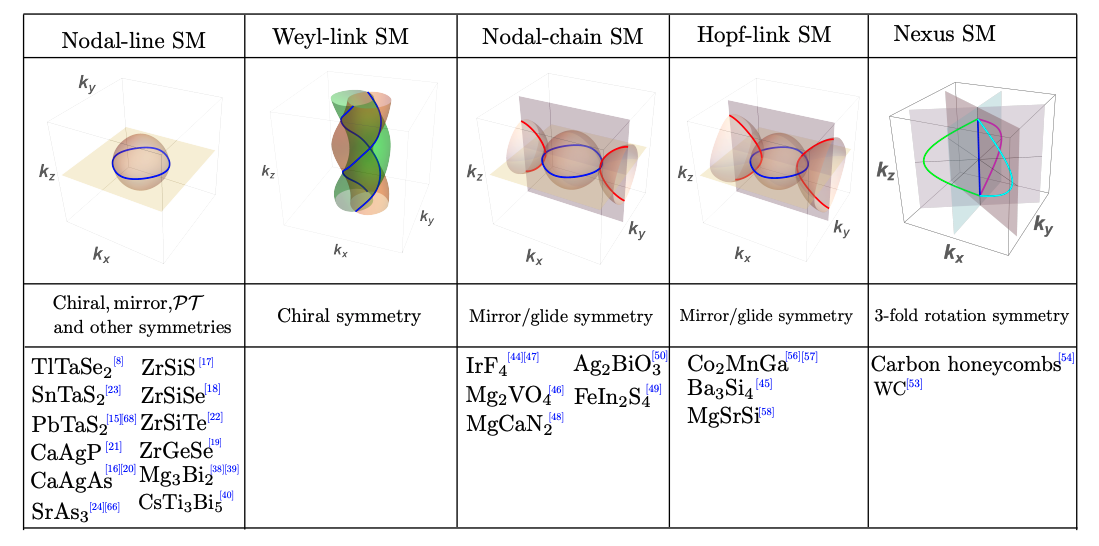
The study of topological materials continues to reveal novel states of matter with potentially transformative applications in electronics and photonics. A recent review, authored by Po-Yao Chang from National Tsing Hua University, Po-Yao Chang from Yukawa Institute for Theoretical Physics, Kyoto University, and colleagues, systematically examines nodal-line semimetals (NLSMs), a class of topological materials characterised by electronic band crossings forming lines within their electronic structure, known as the Brillouin zone. The article, entitled ‘Nodal-line semimetals and their variance’, classifies different types of NLSMs based on the arrangement of these nodal lines – which can form complex linked, knotted, or chained structures – and details their unique electromagnetic properties, including responses to light and magnetic fields, as well as the influence of strong electron interactions leading to emergent magnetic and superconducting behaviour.
Research into topological nodal-line semimetals (NLSMs) demonstrates a growing convergence between materials science and nonlinear optics, promising advancements in future technologies. Since approximately 2014, a substantial body of work has emerged, focusing on the electronic structures, electromagnetic responses, and strong correlations within these materials, revealing a complex landscape of emergent phenomena. This dedicated investigation suggests potential for device integration, particularly in areas such as advanced sensors and optical modulators.
Topological materials derive their unique properties from their band structure topology, a mathematical description of the allowed energy levels for electrons within a solid. This topology dictates the presence of protected surface states, conducting pathways on the material’s surface that are robust against imperfections and scattering. The nonlinear Hall effect, a phenomenon where an applied electric field generates a current perpendicular to both the field and the applied current, emerges as a key area of interest, linked directly to the quantum geometry of these materials. Concepts like Berry curvature, a measure of the geometric phase acquired by electrons as they move through the material, and the quantum metric, describing the infinitesimal distance between electronic states, repeatedly appear as explanations for observed nonlinearities.
Terahertz (THz) technology, utilising electromagnetic radiation between microwaves
Terahertz (THz) technology, utilising electromagnetic radiation between microwaves and infrared light, serves as a crucial tool for probing and manipulating these materials. The ability to generate and detect THz radiation allows researchers to investigate the dynamic response of topological materials and develop innovative devices operating at these frequencies. While research encompasses a broad range of topological materials, Weyl and Dirac semimetals receive considerable attention. These materials, characterised by specific band structures resembling relativistic particles, provide a well-defined platform for investigating fundamental topological phenomena and establishing a foundation for understanding more complex materials.
Future progress necessitates refining theoretical models to accurately predict and explain observed nonlinearities, particularly the nonlinear Hall effect, across diverse topological materials. Investigating the influence of material composition, crystal structure, and external stimuli on these effects will be crucial for optimising materials and devices for specific applications. Simultaneously, researchers actively explore the interplay between topology and strong correlations, where interactions between electrons significantly influence material properties. Understanding how these interactions give rise to emergent phenomena and novel functionalities remains a central challenge. Meticulous investigation of electronic structure and magnetic properties aims to identify materials with enhanced functionalities and unlock their potential for technological innovation.
👉 More information🗞Nodal-line semimetals and their variance🧠 DOI:https://doi
🗞 Nodal-line semimetals and their variance
🧠 DOI: https://doi.org/10.48550/arXiv.2507.02329


