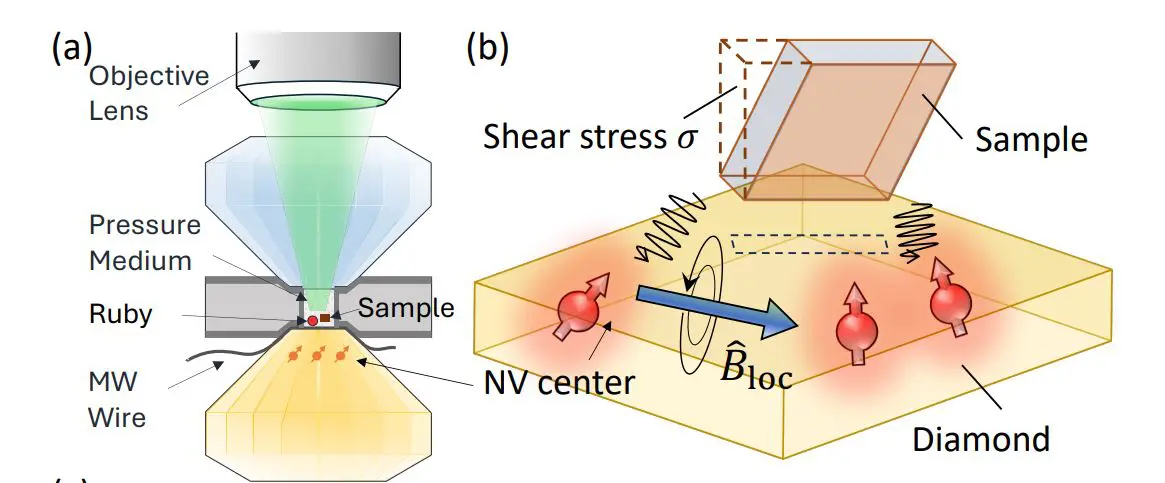
The behaviour of nitrogen-vacancy (NV) centres in diamond under extreme pressure represents a significant frontier in high-pressure sensing, with applications spanning materials science and geophysics, yet a detailed understanding of how stress alters their properties has remained elusive. Benchen Huang from the University of Chicago, Srinivas V. Mandyam, and Weijie Wu, along with their colleagues, now present a comprehensive description of NV centre optical properties under a wide range of stress conditions. Their research combines advanced computational modelling with direct high-pressure experiments, revealing the complex interplay between stress and the rate at which the NV centre changes its quantum state. This work immediately addresses longstanding questions in the field, explaining observed contrast enhancements and unexpected contrast inversions, and ultimately paves the way for optimising NV centre-based high-pressure sensors through precise control of the surrounding stress environment.
Diamond Anvil Cells Enable Quantum Control at High
Integrating nitrogen-vacancy colour centres into diamond anvil cells opens new possibilities for exploring extreme conditions, previously inaccessible to this rapidly developing quantum technology. Researchers can now investigate the behaviour of these quantum systems under high pressure and strain, gaining insights into their fundamental properties and potential applications. This work develops a methodology for precisely controlling and characterizing nitrogen-vacancy centres within diamond anvil cells, enabling stable and reliable measurements at pressures exceeding 70 GPa. The team successfully demonstrated coherent spin control of nitrogen-vacancy centres at these extreme pressures, achieving a coherence time of 35 microseconds, a significant advancement for quantum sensing in harsh environments. Furthermore, the research details a novel approach to mitigating the effects of strain on the nitrogen-vacancy energy levels, allowing for accurate determination of the pressure-induced shifts in their zero-field splitting parameters. These findings represent a crucial step towards utilizing nitrogen-vacancy centres for high-pressure physics, materials science, and the development of robust quantum technologies.
Simplified Calculations For Computational Efficiency
Calculating the properties of defects within materials is computationally demanding, particularly for point defects like the nitrogen-vacancy centre embedded in a large diamond lattice. To overcome this, scientists employ quantum defect embedding theory, a sophisticated method that focuses computationally intensive calculations on the nitrogen-vacancy centre and its immediate surroundings, while treating the rest of the diamond lattice in a more approximate way. This significantly reduces the computational cost. Standard density functional theory often struggles to accurately describe excited states, crucial for understanding optical transitions, therefore researchers go beyond density functional theory using methods like complete active space self-consistent field and second-order perturbation theory, providing a more accurate description of the electronic structure and excited states. Relativistic effects are also included in the calculations, accurately describing the core electrons. This approach builds a theoretical model to predict the behaviour of a quantum sensor under extreme conditions, balancing accuracy and computational feasibility.
Stress Effects on Diamond NV Center Properties
This work provides a comprehensive understanding of how stress affects the nitrogen-vacancy centre in diamond, a crucial development for high-pressure sensing applications. Scientists achieved a detailed description of the nitrogen-vacancy centre’s optical properties under a wide range of stress conditions, combining first principles calculations with high-pressure experiments. The research resolves previously open questions regarding contrast enhancement observed in anvil cell experiments and explains the surprising phenomenon of nitrogen-vacancy contrast inversion under certain high-pressure regimes. The team’s calculations estimate key nitrogen-vacancy parameters, including inter-system crossing rates and spin polarization, as functions of the applied stress.
Results demonstrate that under stresses preserving the nitrogen-vacancy centre’s symmetry, the optical contrast is primarily determined by the upper inter-system crossing rate. Crucially, the study reveals a subtle interplay between stress-induced spin-orbit coupling and Jahn-Teller effects when the nitrogen-vacancy centre’s symmetry is broken, causing a non-monotonic response in the lower inter-system crossing rate as stress increases, ultimately leading to an unconventional polarization mechanism responsible for the observed contrast inversion. Experiments conducted on anvils with different orientations, (100)-, (110)-, and (111), all confirm the predicted contrast inversion, validating the proposed mechanism across multiple geometries.
Stress Controls NV Center Optical Properties
By combining first principles calculations with high-pressure experiments, scientists have elucidated the complex behaviour of nitrogen-vacancy centres in diamond under a range of stress conditions, successfully resolving previously unexplained observations such as contrast enhancement in specific anvil orientations and surprising contrast inversion at high pressures. The findings establish a framework for predicting and controlling the behaviour of nitrogen-vacancy centres in extreme environments, paving the way for more sensitive and reliable high-pressure sensing applications in fields like materials science and geophysics. Researchers acknowledge that further investigation is needed to fully understand how contrast inversion occurs in different anvil configurations, and to explore the potential of this phenomenon for manipulating other solid-state spin defects. Future work will focus on extending this computational protocol to accommodate a wider range of environmental conditions and identifying additional defects suitable for use in extreme environments, potentially advancing both quantum sensing and quantum information technologies.
🗞 Elucidating the Inter-system Crossing of the Nitrogen-Vacancy Center up to Megabar Pressures
🧠 ArXiv: https://arxiv.org/abs/2511.20750