As there are many computer language frameworks out there in the wild, there are also many languages used for controlling quantum computing and there are new ones popping up all the time. Fundamentally controlling qubits via gates is the name of the game and right now there are many competing frameworks (some supported from the likes Google and IBM – think Qiskit and Cirq).
Recently published “A Retargetable Compiler for NISQ Devices” introduces the new framework named t-ket. One of the key benefits of the framework is the ability to write in one language such as Qiskit but then direct the computations at the hardware level to say, Honeywell architecture.
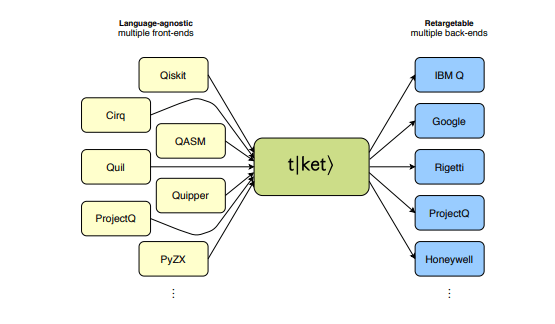
Beyond that the framework aims to be the most effective and therefore efficient at building the underlying optimised quantum circuits for a variety of devices from different vendors (IBM, Google, Honeywell, Rigetti etc) . The claim is that the code has been bench-marked and shown to be effective at reducing error by optimisation of the gates that are configured. For example as the circuit depth and the computation time builds up, then noise builds up. Whist NISQ devices are purposely designed to “live” with noise, it places limitations on what can be achieved and hence any efforts to reduce inefficiency is to be applauded. For more details, please see the paper published on the 25th March 2020 on arxiv.
The open source project is available from the Github, and whilst the project is written in C++, pytket allows you to access the framework from the python language and you can install this easily using the python pip libararies and should be familiar to people who know python
pip install pytketThe core of t|ket> is a flexible optimising compiler which supports multiple programming frameworks, and multiple quantum devices.
A Retargetable Compiler for NISQ Devices
Cambridge Quantum Computing
Established in 2014, Cambridge Quantum Computing (CQC) is a world leading independent quantum computing software company, with operations in US, Europe & Japan, and more than 60 scientists including 35+ PhD’s, in Quantum Computing (“QC”), Chemistry, Molecular Electronics, Physics, Maths, Computer Science, and Nanoscience.