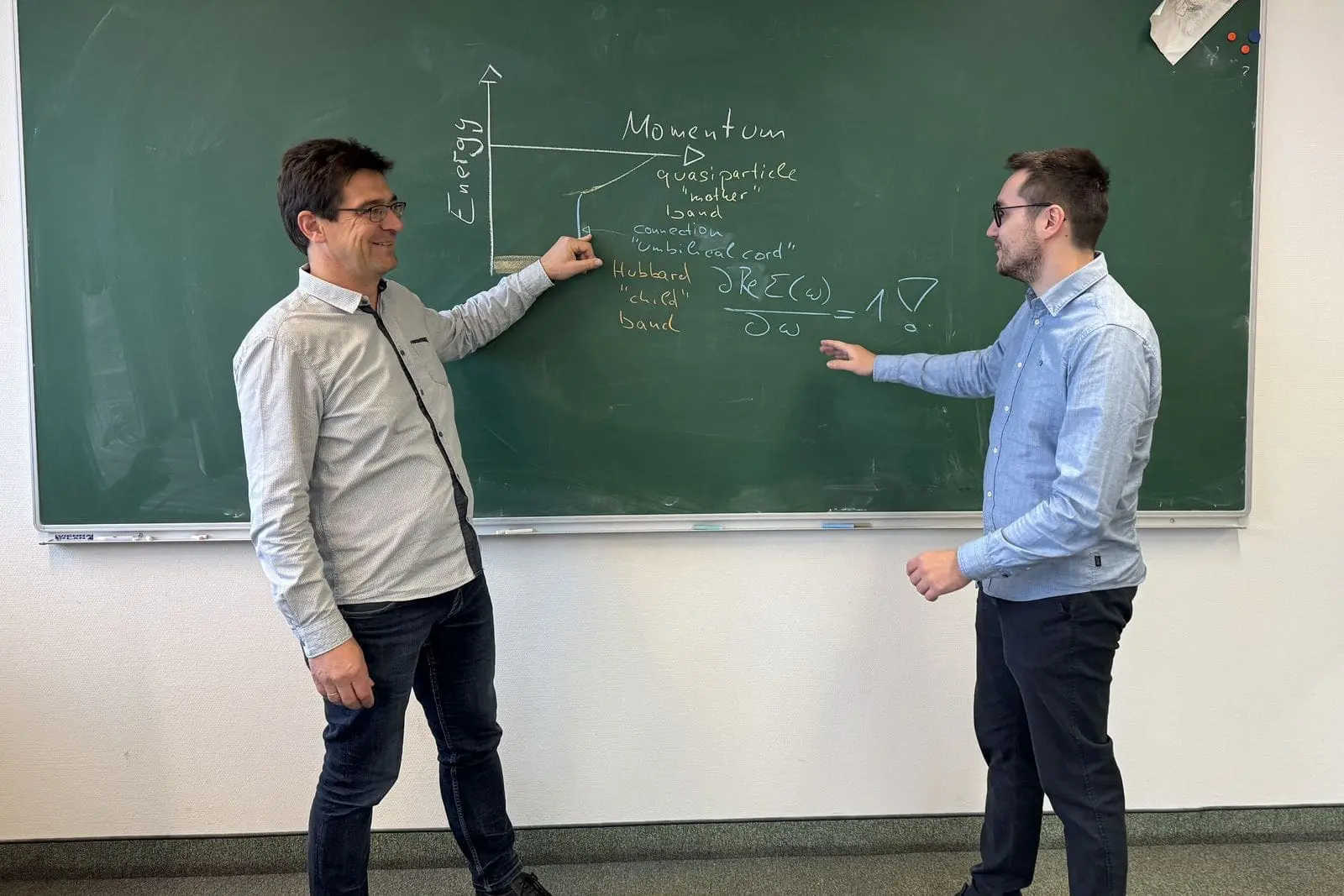
Researchers have uncovered a previously underappreciated state of matter that exists between the traditional classifications of metal and insulator, where electrons can transition between permitted energy ranges through a unique “umbilical cord” connection. This phenomenon, first observed in certain copper-containing materials known as cuprates, is a generic feature of many materials when the interaction between electrons is sufficiently strong.
By demonstrating that this effect is not an isolated anomaly, but rather a natural consequence of electron interactions, scientists at TU Wien have expanded our understanding of the behavior of solids and revealed a new class of states that must be considered in the categorization of materials. This discovery has significant implications for the field of materials science, as it suggests that there are more nuanced and complex relationships between energy and momentum values than previously thought, and may lead to new insights into the properties of technologically important classes of materials.
Introduction to Quantum States in Materials
The behavior of materials is primarily determined by the principles of quantum theory, which dictates that certain physical quantities can only assume specific values. In the context of electrons in solids, this means that electrons can only occupy specific energy ranges, known as energy bands. The difference between electrically conductive metals and non-conductive insulators can be explained by the arrangement of these energy bands. Metals have no forbidden energy range, allowing electrons to move freely, while insulators have a wide forbidden energy range that prevents electrons from switching between bands.
The interaction strength between electrons plays a crucial role in determining the arrangement of energy bands. By adjusting this interaction strength, for example through doping with different atoms, it is possible to change the material’s properties. Researchers at TU Wien have now demonstrated that when the interaction strength is changed continuously, one allowed energy range can split into two separate allowed energy ranges. This process gives rise to a new energy band, which remains connected to the original band by a kind of quantum “umbilical cord.”
The discovery of this umbilical cord-like connection has significant implications for our understanding of materials science. It suggests that there is an additional state between metals and insulators, characterized by a unique relationship between energy and momentum values. This new class of states must be taken into account when categorizing solids, and it opens up new perspectives on technologically interesting classes of materials.
Quantum Leaps and Energy Bands
In quantum theory, electrons can only assume specific energy values, and they can switch from one permitted energy value to another through a process known as a quantum jump. In solids, the situation is more complex, with entire energy ranges (or bands) being permitted rather than individual energy values. The energy and momentum of electrons play a crucial role in determining which energy band an electron occupies. To move from one permitted energy range to the next, a larger portion of additional energy is required.
The arrangement of energy bands depends on the material, particularly on how strongly the electrons interact with each other. In insulators, the permitted energy bands are separated by a wide forbidden energy range, preventing electrons from switching between bands. In conductive metals, there is no such forbidden energy range, allowing electrons to move freely. The strength of electron interaction can be adjusted through doping, which is a common technique used in semiconductor production.
The process of one allowed energy range splitting into two separate allowed energy ranges is particularly interesting, as it gives rise to a new energy band that remains connected to the original band by an umbilical cord-like connection. This phenomenon has been observed in experiments before, but its cause was initially unclear. Researchers at TU Wien have now demonstrated that this phenomenon is not an isolated case, but rather a natural consequence of the interaction strength between electrons falling within a certain range.
The Umbilical Cord Effect
The umbilical cord-like connection between two energy bands arises when one allowed energy range splits into two separate allowed energy ranges. At most momentum values, an electron has to make a decision: it can only be in either the upper or the lower energy band. However, there is one momentum value for which a wide range of energy values is possible, connecting both bands. This anomaly, with one momentum value but many energy values, has been observed in experiments before, but its cause was initially unclear.
Researchers at TU Wien have now succeeded in showing that this phenomenon is not an exotic isolated case, but rather a natural consequence of the interaction strength between electrons falling within a certain range. This means that a further class of states must now be taken into account when categorizing solids. The discovery of the umbilical cord effect has significant implications for our understanding of materials science and opens up new perspectives on technologically interesting classes of materials.
Implications for Materials Science
The discovery of the umbilical cord effect is not an isolated phenomenon, but rather part of a broader trend in solid-state physics. In 2016, the Nobel Prize in Physics was awarded for the discovery of topological states in superconductors, another new set of states defined by a specific relationship between energy and momentum values. The umbilical cord effect is a similar phenomenon, characterized by a unique relationship between energy and momentum values.
The result is quite surprising, as it shows that there is more to materials science than previously thought. The discovery of the umbilical cord effect opens up new perspectives on technologically interesting classes of materials and suggests that there may be additional states beyond the traditional classification of metals and insulators. Further research is needed to fully understand the implications of this phenomenon and to explore its potential applications in materials science.
External Link: Click Here For More