
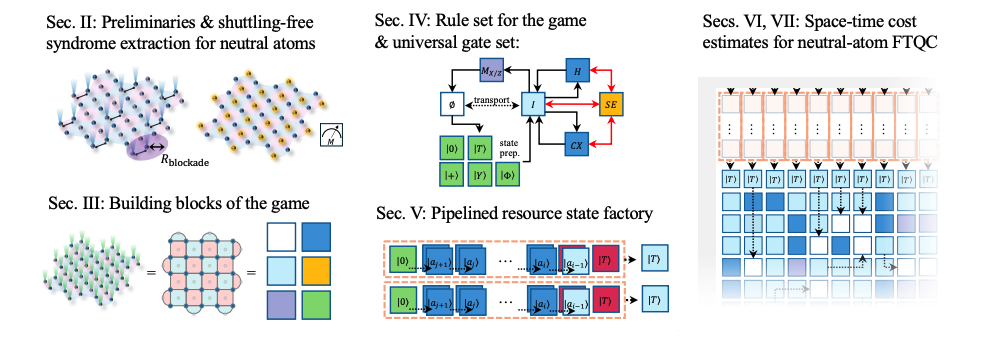
Researchers develop a theoretical framework that enables efficient, fault-tolerant quantum computation with neutral atoms, thereby overcoming limitations in syndrome extraction frequency. This game-based paradigm facilitates transversal gates and resource state design, achieving performance competitive with lattice surgery despite slower physical operations, paving the way for scalable quantum computers.
The pursuit of fault-tolerant quantum computation, essential for realising the full potential of quantum technologies, necessitates robust error correction schemes. Current approaches often rely on complex lattice surgery. Still, a team led by Shinichi Sunami and Akihisa Goban of Nanofiber Quantum Technologies, Inc., alongside Hayata Yamasaki from The University of Tokyo, present an alternative strategy in their work, “Transversal Surface-Code Game Powered by Neutral Atoms”. They detail a theoretical framework that leverages neutral atom arrays and a novel ‘game-based’ paradigm to facilitate more frequent syndrome extraction—a critical process for maintaining computational integrity—than previously achievable. This approach, building upon existing surface-code protocols, offers a pathway towards scalable, fault-tolerant quantum computers by optimising resource allocation and potentially mitigating the impact of slower physical operations inherent in neutral atom systems.
Quantum computation promises to revolutionise fields from medicine to materials science, yet realising a practical, scalable quantum computer remains a significant challenge. A central impediment lies in the inherent fragility of quantum information, susceptible to errors arising from environmental noise. Fault-tolerant quantum computation (FTQC) offers a pathway to overcome this, employing quantum error correction to protect information, but its implementation presents considerable difficulties.
Recent research addresses a critical disconnect between theoretical FTQC protocols and their practical realisation within neutral atom systems. Neutral atom qubits, utilising individual atoms trapped and controlled by lasers, represent a promising platform for quantum computation, but existing error correction schemes often demand syndrome extraction – the process of detecting errors without collapsing the quantum state – at fixed intervals. This rigidity clashes with the operational characteristics of neutral atom systems, where operations are comparatively slower than those in superconducting qubit architectures.
Researchers have developed a novel theoretical framework and a game-based paradigm to address this limitation. This approach allows for syndrome extraction at any point during the computation, offering flexibility crucial for optimising performance within the constraints of neutral atom technology. The framework centres on a concept known as ‘any-time’ syndrome extraction, departing from the rigid scheduling of conventional methods.
Crucially, this new framework maintains compatibility with the threshold theorem, a fundamental principle in quantum error correction. The threshold theorem dictates that, provided the error rate is below a certain value (the threshold), quantum error correction can, in principle, suppress errors indefinitely. Demonstrating performance comparable to established techniques, such as lattice surgery – a method for performing logical qubit operations through a series of physical qubit manipulations – is also a key achievement. The research shows that even accounting for the slower operation speeds inherent in neutral atom systems, the new framework achieves competitive performance.
This work establishes a foundation for building scalable quantum computers utilising neutral atoms, offering a pathway to overcome a significant practical hurdle in the pursuit of reliable quantum computation. The ability to perform error correction flexibly, adapting to the specific characteristics of the hardware, represents a substantial step towards realising the potential of this promising quantum computing platform.
👉 More information
🗞 Transversal Surface-Code Game Powered by Neutral Atoms
🧠 DOI: https://doi.org/10.48550/arXiv.2506.18979