

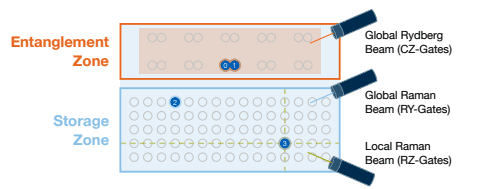
Researchers developed a routing-aware placement method for zoned neutral atom architectures, optimising atom rearrangement during computation. Implementation utilising the A* algorithm reduces rearrangement time by 17% on average, with a 49% improvement in specific cases, enhancing computational efficiency. Code is available via the Munich Toolkit.
Quantum computation relies on the precise manipulation of qubits – the quantum analogue of classical bits. A significant challenge lies in physically realising these qubits and controlling their interactions. Neutral atom qubits, leveraging the quantum properties of individual atoms, represent a developing platform with potential for scalability and long coherence, the duration for which quantum information is preserved. Optimising the arrangement and movement of these atoms within the quantum processor is crucial for efficient computation. Researchers at the Technical University of Munich and the University of California, Los Angeles, led by Yannick Stade, Wan-Hsuan Lin, Jason Cong, and Robert Wille, detail a new approach to this problem in their paper, “Routing-Aware Placement for Zoned Neutral Atom-based Quantum Computing”. Their work introduces a method that integrates the physical placement of qubits with the subsequent routing of information between them, reducing the time required to execute quantum algorithms by up to 49% and demonstrating a 17% average improvement over existing techniques. The team’s implementation is available as open-source code within the Munich Toolkit (MQT).
Routing-Aware Placement Optimizes Quantum Compilation for Neutral Atom Qubits
Neutral atom qubit technology presents a promising avenue for addressing complex computational challenges, and research actively explores methods to harness its potential. Zoned neutral atom architectures, in particular, offer advantages through inherent parallelism and improved coherence times, but realising the full capabilities of this hardware demands sophisticated compilation techniques. This article details a novel approach to quantum compilation, focusing on an integrated placement and routing methodology that demonstrably improves performance and unlocks greater efficiency in neutral atom quantum computers.
The field currently concentrates on developing compilation flows optimised for these dynamic architectures, and a key challenge lies in efficiently managing atom rearrangement – the physical movement of qubits – during computation. Suboptimal placement of qubits before routing – which determines the connections between them – introduces serialisation, hindering performance and limiting scalability. Existing compilers largely treat placement and routing as separate, independent stages, prioritising minimal travel distance during routing without considering the impact on subsequent rearrangement steps, creating a bottleneck in the compilation process.
A substantial body of work, evidenced by publications from Yifan Chen et al. (2024, arXiv preprints), investigates scalable compilation frameworks for dynamically reconfigurable neutral atom arrays, aiming to provide a comprehensive solution for translating algorithms into hardware instructions. Enhyeok Jang et al. (2024, arXiv preprint) and Daniel Bochen Tan et al. (2024, arXiv preprints) also contribute to this broader goal, focusing on compiler frameworks and scalable solutions that address the complexities of managing large qubit arrays. These efforts collectively push the boundaries of what’s possible with neutral atom quantum computation, but a critical gap remains in optimising the interplay between qubit placement and routing.
Several approaches explore specific optimisation techniques. Arctic (Decker, 2024, arXiv preprint) introduces a field-programmable quantum array scheduling technique that dynamically allocates qubits to optimise performance. ZAP (Huang et al., 2024, arXiv preprint) proposes a zoned architecture and parallelisable compiler, leveraging the inherent advantages of segmented qubit arrays to improve compilation efficiency.
This research directly addresses the critical shortcoming of existing compilers by introducing an integrated optimisation strategy. The method achieves demonstrably improved performance by considering both placement and routing simultaneously. The implementation utilises the A* search algorithm to minimise rearrangement time, resulting in faster compilation and improved overall performance. The A* algorithm is a graph traversal and pathfinding algorithm, which finds the lowest-cost path from a starting node to a goal node. In this context, the ‘cost’ represents the time required to move qubits.
Results indicate a reduction in rearrangement time, enabling researchers to explore more complex quantum algorithms and tackle more challenging computational problems. The publicly available implementation, integrated within the Munich Toolkit (MQT), facilitates further research and development in this area, encouraging collaboration and accelerating innovation.
Future work should explore the extension of this routing-aware placement method to more complex quantum algorithms and larger qubit arrays, pushing the boundaries of what’s possible with neutral atom quantum computers. Investigating the interplay between compilation strategies and hardware-specific constraints, such as limitations in atomic movement speed or control fidelity, represents a promising avenue for optimisation. Furthermore, developing automated techniques for identifying and exploiting opportunities for parallel rearrangement could further refine the compilation process and unlock the full potential of zoned neutral atom quantum computers.
The success of this research highlights the importance of considering the entire compilation pipeline as a unified system, rather than optimising individual stages in isolation. By recognising the interdependence of placement and routing, researchers can develop more efficient and effective compilation strategies that unlock the full potential of quantum hardware. This holistic approach represents a paradigm shift in quantum compilation, paving the way for future advancements.
This work establishes a new benchmark for quantum compilation, demonstrating the effectiveness of integrated optimisation strategies and providing a foundation for future research. This research represents a significant step towards realising the transformative potential of neutral atom quantum computers.
👉 More information
🗞 Routing-Aware Placement for Zoned Neutral Atom-based Quantum Computing
🧠 DOI: https://doi.org/10.48550/arXiv.2505.22715


