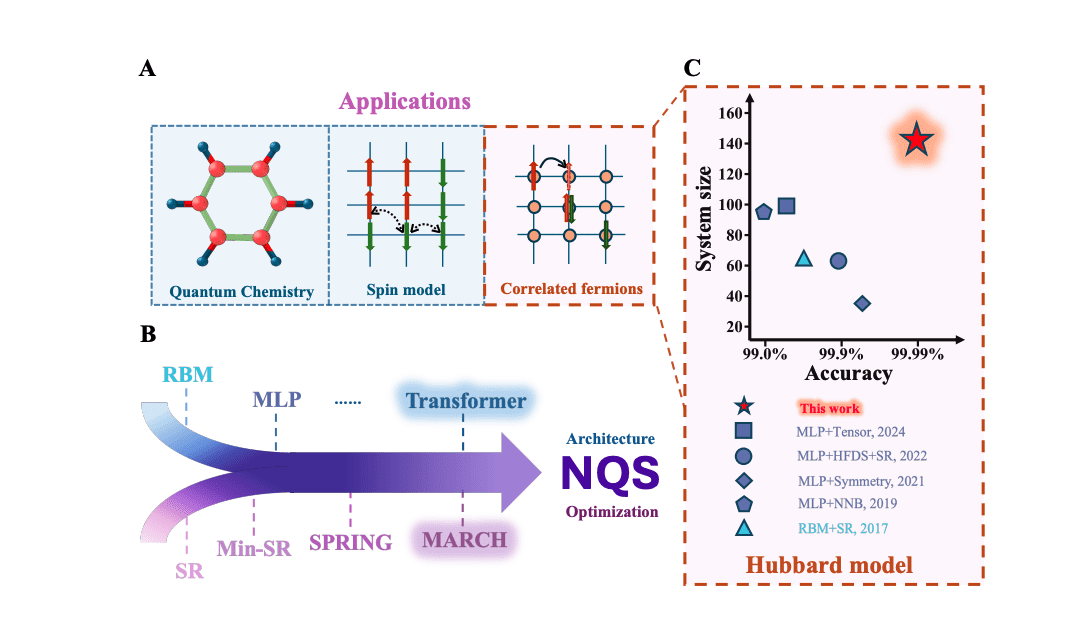
Recent research demonstrates neural states (NQS), a framework utilising transformer architectures and optimised algorithms, achieves state-of-the-art results for the doped two-dimensional Hubbard model, a key system for understanding high-temperature superconductivity. NQS effectively encodes correlations at multiple scales, confirming the half-filled stripe ground state observed in cuprates and establishing its potential for solving complex many-fermion problems.
Understanding the behaviour of interacting electrons in materials remains a central challenge in condensed matter physics, crucial for designing novel materials with desired properties. The two-dimensional Hubbard model, a simplified representation of electron interactions, serves as a fundamental testbed for exploring phenomena like high-temperature superconductivity. Now, Yuntian Gu, Wenrui Li, and colleagues present a significant advance in simulating this complex model using neural quantum states (NQS), a machine learning approach to approximating quantum many-body systems. Their work, entitled ‘Solving the Hubbard model with Neural Quantum States’, demonstrates the capability of NQS, employing transformer-based architectures and refined optimisation algorithms, to accurately predict the ground state properties of the doped two-dimensional Hubbard model, aligning with experimental findings in cuprate superconductors. The research reveals that distinct components within the NQS framework effectively capture electron correlations across varying distances, establishing NQS as a potent technique for tackling challenging problems in quantum physics involving many interacting fermions.
Recent research demonstrates the efficacy of neural quantum states (NQS) in accurately modelling the doped two-dimensional Hubbard model, a cornerstone for understanding high-temperature superconductivity. Researchers employ advanced transformer-based architectures and optimised algorithms to achieve state-of-the-art results in simulating strongly correlated electron systems, offering new insights into the mechanisms driving this phenomenon. The Hubbard model, a simplified yet crucial framework, investigates electron behaviour in materials exhibiting superconductivity, where electrical resistance vanishes at critical temperatures.
This study reveals a key feature of the NQS ansatz, the initial approximation used to begin the quantum calculation: different attention heads within the neural network directly encode correlations at varying spatial scales, enabling a comprehensive understanding of electron interactions. This capability allows the model to effectively capture both short-range and long-range electron entanglement, a critical aspect of strongly correlated materials. Entanglement describes the quantum mechanical phenomenon where particles become linked, and the state of one instantly influences the other, regardless of distance; accurately capturing this is vital for modelling complex materials.
Specifically, simulations establish the presence of a half-filled stripe pattern in the ground state of the 2D Hubbard model, incorporating next-nearest neighbour hopping terms, which aligns with experimental findings in cuprate superconductors. Hopping refers to the movement of electrons between atomic sites within the material’s lattice structure, and the observed stripe pattern provides strong evidence supporting the model’s accuracy. The presence of these stripes suggests a particular arrangement of electron density that facilitates superconductivity.
Researchers investigate the impact of varying parameters, such as doping levels and lattice structures, to gain a deeper understanding of the underlying mechanisms driving superconductivity. They plan to extend their simulations to more complex models, incorporating additional interactions and exploring different materials, aiming to create a computational platform that can predict the properties of materials with unprecedented accuracy. They will also focus on developing more efficient algorithms and leveraging the power of machine learning to accelerate the discovery of new superconducting materials, potentially leading to technological breakthroughs in energy, transportation, and computing.
Researchers demonstrate the ability of NQS to capture the complex interplay of electron interactions in strongly correlated materials, offering a powerful tool for materials discovery. They highlight the importance of accurately modelling electron entanglement, a key ingredient in understanding superconductivity. The simulations provide strong evidence supporting the validity of the NQS approach and its potential for predicting the properties of complex materials, paving the way for further exploration of materials and phenomena.
👉 More information
🗞 Solving the Hubbard model with Neural Quantum States
🧠 DOI: https://doi.org/10.48550/arXiv.2507.02644