The quest to harness the power of quantum computing increasingly focuses on integrating it with established machine learning techniques, yet designing effective quantum circuits remains a significant hurdle. Hibah Agha from the New York Institute of Technology, Samuel Yen-Chi Chen from Wells Fargo, and Huan-Hsin Tseng and Shinjae Yoo from Brookhaven National Laboratory address this challenge by developing a novel method for automatically designing quantum autoencoders. Their work introduces a neural architecture search framework that employs a genetic algorithm to systematically explore and optimise circuit configurations, overcoming the difficulties of manual design and the risk of suboptimal solutions. This automated approach demonstrates a capacity for efficient feature extraction from image data, paving the way for robust and adaptable quantum machine learning solutions suited to the limitations of current quantum hardware and promising advancements in data compression and analysis.
Quantum Autoencoders For Noise Reduction
This research focuses on Quantum Machine Learning (QML), particularly Autoencoders, Reinforcement Learning, and Architecture Search within the quantum realm. Studies explore quantum autoencoders for data compression, noise reduction, and feature extraction, crucial for improving the reliability of quantum computations. Researchers are also applying reinforcement learning to optimize quantum control and automate the design of quantum circuits, seeking efficient architectures for complex tasks. A recurring theme is mitigating errors in noisy intermediate-scale quantum (NISQ) devices, with many approaches combining classical machine learning techniques with quantum computations.
Foundational work in quantum machine learning and autoencoders provides a basis for current investigations, while recent studies demonstrate the potential of evolutionary algorithms and reinforcement learning to design effective quantum circuits. Differentiable architecture search is emerging as a promising technique for accelerating the design process. The research demonstrates a strong focus on practicality, with emphasis on noise reduction and error mitigation. Hybrid approaches, combining classical and quantum techniques, are proving to be the most promising path forward. Evolutionary algorithms and reinforcement learning are key tools for automating circuit design, and differentiable architecture search is gaining momentum.
Evolving Quantum Autoencoders with Genetic Algorithms
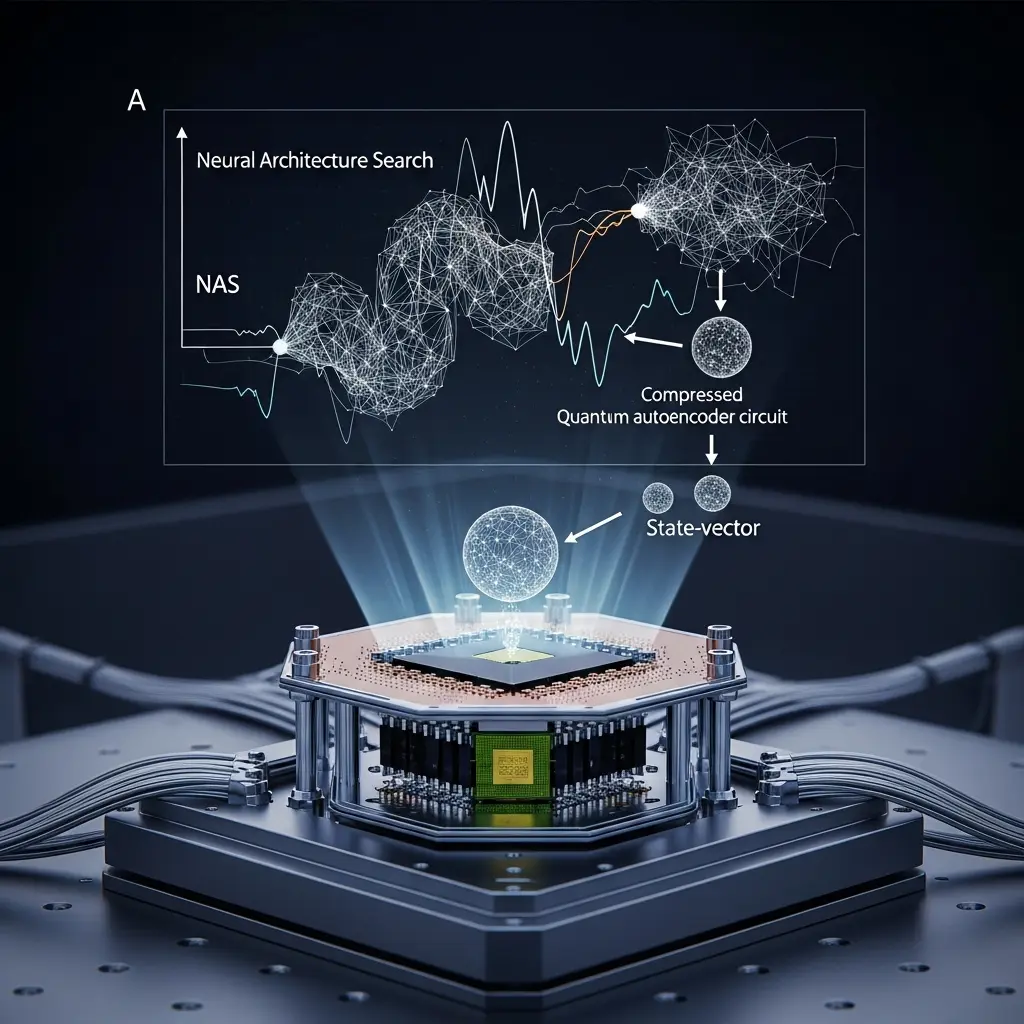
Scientists developed a novel neural architecture search (NAS) framework to automate the design of quantum autoencoders, overcoming the limitations of manual configuration. The study pioneers a method employing genetic algorithms (GAs) to systematically evolve variational quantum circuit (VQC) configurations, seeking high-performing hybrid quantum-classical autoencoders for data reconstruction. This approach avoids becoming trapped in local minima during optimization, enabling a more robust exploration of the circuit design space. The research team engineered a system where candidate quantum circuits are treated as individuals within a population, subjected to processes mirroring natural selection. Each circuit’s performance on an image dataset determines its ‘fitness’, guiding the selection of circuits for reproduction and mutation. Through iterative cycles of selection, crossover, and mutation, the GA progressively refines the population, favouring configurations that demonstrate superior data reconstruction capabilities.
Genetic Algorithms Design High-Fidelity Quantum Autoencoders
Scientists developed a novel framework for designing quantum autoencoders using genetic algorithms, achieving automated circuit design without becoming trapped in suboptimal solutions. The work demonstrates a robust method for evolving variational quantum circuit configurations, identifying high-performing hybrid quantum-classical autoencoders for data reconstruction. This approach leverages the natural parallelizability of genetic algorithms to evaluate large populations of quantum autoencoders, potentially adapting to varied data and hardware constraints. The team constructed autoencoders consisting of encoder and decoder functions, minimizing reconstruction loss across a dataset to achieve accurate data compression and reconstruction. Experiments focused on minimizing the difference between original data and reconstructed outputs, demonstrating the effectiveness of the hybrid quantum-classical approach in mitigating noise-induced errors. Measurements confirm that the developed autoencoders successfully compress data into a latent variable with reduced dimensionality, enabling efficient data representation.
Evolving Quantum Autoencoders for Data Reconstruction
This work presents a novel neural architecture search algorithm that automatically designs quantum autoencoders for effective data reconstruction. By employing a genetic algorithm, the researchers successfully evolved quantum circuit configurations, achieving enhanced feature learning with reduced computational overhead within a hybrid quantum-classical framework. The results demonstrate that optimized quantum autoencoders can improve data reconstruction performance, while also promoting diversity in circuit design and enabling principled exploration of quantum architectures. The team acknowledges that over-entanglement can sometimes hinder performance, though carefully structured, highly entangled circuits can still outperform baseline models.
They observed that modifications to circuit gates can lead to both improvements and minor degradations in performance, highlighting the sensitivity of these systems to specific configurations. Future research will focus on extending this framework to larger datasets, incorporating adaptive mutation strategies within the genetic algorithm, and investigating the ability of these evolved architectures to generalize across different machine learning tasks and hardware constraints. This work lays a foundation for automated design of quantum models, paving the way for more efficient and expressive quantum machine learning algorithms.
🗞 Neural Architecture Search for Quantum Autoencoders
🧠 ArXiv: https://arxiv.org/abs/2511.19246