

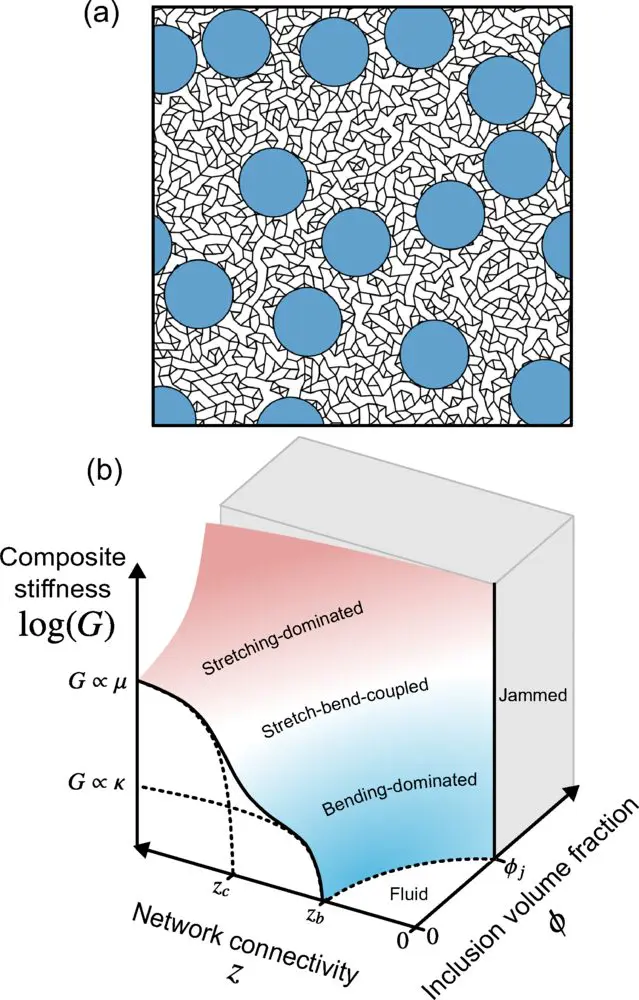
The mechanical properties of biological materials exhibit spatial heterogeneity. Typical tissues comprise a spanning fibrous extracellular matrix, within which various inclusions, such as living cells, are embedded. For decades, researchers have studied how embedded inclusions influence the stiffness of common elastic materials, and this behaviour is understood in terms of the volume fraction and shape of those inclusions. However, this understanding does not extend to disordered filamentous and fibrous networks, presenting a significant gap in knowledge. Consequently, a detailed investigation into the mechanical behaviour of these complex biological materials is required to fully characterise their properties and responses to external forces.
Fiber Networks, Gels and Mechanical Reinforcement
This body of work comprehensively examines the mechanical properties of soft materials, particularly fiber networks, gels, and composites, with a strong emphasis on reinforcement mechanisms, criticality, and phase separation. The research covers how to increase the strength and stiffness of materials like gels and polymers, including the use of fillers and controlling network architecture. A significant portion focuses on the mechanics of networks formed by fibers, such as collagen and fibrin, and the properties of gels. A key modern theme is the idea of criticality, or jamming transitions, in these networks, referring to the point where the network transitions from a floppy state to a rigid, load-bearing state.
The research explores how this transition affects mechanical properties and how it can be controlled. Many studies also deal with liquid-liquid phase separation within these networks, and how the mechanical properties of the network influence, and are influenced by, this phase separation, which is particularly relevant to biological systems. The role of fluid flow and hydrodynamic interactions in influencing the mechanical behavior of these materials is also a recurring theme. Many papers investigate the nonlinear response of these materials to deformation, including strain stiffening, where the material becomes harder as it’s stretched.
This field is highly interdisciplinary, drawing from physics, materials science, engineering, biology, and computational science. The concept of mechanical criticality is becoming increasingly important, and computational modeling is playing an increasingly important role in understanding and predicting material behaviour. Many of the concepts and techniques developed are being applied to understand the mechanics of biological tissues and cells.
Rigid Particles Dramatically Stiffen Soft Networks
Researchers have discovered that even small additions of rigid material to soft, fibrous networks can dramatically increase their stiffness, revealing new strategies for designing responsive and tunable materials. The team investigated how the inclusion of rigid particles within these networks alters their mechanical properties, finding that the resulting composite materials exhibit unexpectedly large stiffness increases. This work builds upon existing understanding of biopolymer networks, which act as resilient scaffolds in biological tissues and are responsible for their mechanical behavior. The research demonstrates that the stiffness of these composite materials is highly sensitive to the volume fraction of rigid inclusions, exceeding the behavior predicted by traditional composite models.
Specifically, the team found that the apparent shear modulus of the composite material scales with the inclusion volume fraction in a non-linear fashion, indicating a significant departure from conventional stiffening. This means that even at low concentrations of rigid particles, the composite material experiences a substantial increase in stiffness, offering potential for highly tunable material properties. Experiments revealed that the key to this enhanced stiffness lies in the interplay between the network connectivity and the characteristic length scale over which deformations occur. By controlling the distance between rigid inclusions, researchers can manipulate the way the material responds to applied forces, effectively tuning its mechanical properties.
The data confirms that the composite stiffness is strongly influenced by both the volume fraction of inclusions and the network’s inherent connectivity, opening avenues for designing materials with precisely tailored mechanical responses. This breakthrough delivers a new understanding of composite material mechanics, with implications for a wide range of applications, including biomaterials, soft robotics, and advanced composites. By leveraging these principles, scientists can design materials that respond dynamically to external stimuli, offering unprecedented control over their mechanical properties and paving the way for innovative technologies.
Rigidity Amplifies Stiffness in Disordered Networks
This research demonstrates that even small amounts of rigid material added to soft, disordered networks can dramatically increase stiffness, behaving similarly to how the size of a system affects its properties near a critical point. The team found that the stiffness of these composite materials depends on both the size and concentration of the rigid inclusions, a finding that contrasts with traditional understanding of filled composites where only concentration matters. This suggests a new pathway for tuning the mechanical properties of materials, potentially offering enhanced control over their responsiveness. The study acknowledges limitations in its predictive power at very low concentrations of rigid inclusions and in regimes approaching jamming, where the rigid components dominate the material’s behaviour. Future work should investigate whether these findings extend to three-dimensional systems, requiring further simulations to confirm the role of correlation length in these more complex structures. These results highlight the importance of considering both critical behaviour and geometric constraints when designing disordered network composites, with potential implications for engineered tissues, synthetic materials, and even fields like food science.
🗞 Criticality Enhances the Reinforcement of Disordered Networks by Rigid Inclusions
🧠 DOI: http://link.aps.org/doi/10.1103/b9bh-rrj1


