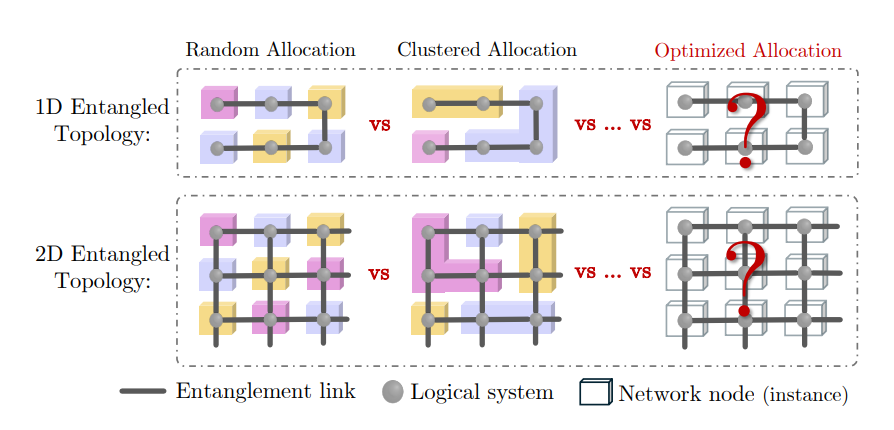
The quest for a truly scalable and resilient internet demands innovative approaches to network resource management, and researchers are now investigating the potential of quantum technologies to address this challenge. Francesco Mazza, Jorge Miguel-Ramiro, and Jessica Illiano, alongside colleagues from the University of Naples Federico II and Universität Innsbruck, demonstrate how flexible allocation of quantum bits, or qubits, within network structures significantly improves performance. Their work explores the use of complex quantum states, known as graph states, allowing for adaptable network topologies and creating shortcuts between distant nodes. This method not only reduces the average distance data must travel, but also enhances robustness against particle loss and reduces memory requirements, representing a substantial advancement over conventional networking approaches.
Entanglement Routing for Robust Quantum Networks
Researchers are exploring the architecture and routing of entanglement within quantum networks, aiming to build robust and flexible systems capable of connecting multiple users and tolerating node failures. They investigate how different types of entangled states, such as graph and cluster states, can serve as the foundation for these networks, optimizing their distribution and utilization. The goal is to move beyond simple point-to-point entanglement to more complex network designs and dynamic routing capabilities. This work argues that future quantum networks require the ability to support multiple users and applications simultaneously.
Graph and cluster states are presented as promising building blocks, offering inherent entanglement structures that enable flexible routing and computation. The research investigates how to design network topologies and routing protocols to maximize performance and resilience, particularly in the face of node failures and concurrent requests. Decoration strategies for cluster states are explored as a method for expanding network capacity and connectivity. Researchers are working on building the ‘internet of the future’ using the principles of quantum physics, creating secure connections and potentially enabling powerful new computing capabilities. This paper explores how to design this network to be reliable, even if parts of it fail, and how to connect many users at the same time. The work builds on concepts from classical networking but introduces unique challenges related to the fragile nature of quantum entanglement.
Adaptable Qubit Assignments Enhance Network Efficiency
Researchers have developed a novel approach to network resource allocation by utilizing graph states with adaptable qubit-to-node assignments. This enables flexible engineering of network topology and addresses a critical challenge in realizing a scalable and resilient quantum internet. The study pioneered a modeling framework that overlays abstract topologies onto existing physical networks, demonstrating that optimized, and even random, assignment of qubits to network nodes creates shortcuts and substantially reduces the average hop distance between remote nodes, a key metric for network efficiency. This method achieves significant improvements over conventional approaches by leveraging the intrinsic connectivity and resilience of cluster states as a core-level network resource, allowing for adaptable configurations that respond to changing network demands.
Scientists focused on minimizing the maximum inter-cluster distance to quantify the impact of their approach. Experiments involved detailed analysis of network failure scenarios, recognizing that node loss breaks entanglement and impacts network functionality. The team developed strategies to mitigate these effects through optimized qubit allocation and network topology. The research further investigated the impact of quantum data plane overhead on network throughput, demonstrating how careful network design can minimize latency and maximize data transfer rates. By drawing inspiration from established concepts in computer networking and clustering algorithms, the study successfully bridges the gap between quantum information science and practical network engineering.
Flexible Qubit Allocation Boosts Network Performance
Scientists have developed a novel approach to quantum network design, achieving significant improvements in resilience and efficiency through flexible qubit allocation. The work centers on utilizing cluster states as a core resource, enabling adaptable network topologies independent of physical layout. Researchers demonstrate that optimized, and even random, assignment of qubits to network nodes creates shortcuts and reduces the average hop distance between nodes, a key metric for network speed. Experiments reveal that this flexible allocation strategy substantially improves network performance. The team measured a reduction in average hop distance, indicating faster communication pathways, when compared to conventional network designs.
Furthermore, the research demonstrates the ability to maintain operational continuity even in the presence of node failures, a critical aspect of network resilience. By assigning multiple qubits to the same node and enabling joint manipulation, scientists engineered entanglement topologies tailored to communication requests and physical network updates. The study identifies cluster states as particularly well-suited for this purpose, leveraging their ability to aggregate multiple requests into a single flexible state.
Flexible Network Topologies and Qubit Allocation
This work presents a generalized framework for designing entangled network topologies, enabling flexible allocation of qubits to network nodes, and demonstrating how this approach overcomes limitations imposed by physical network layouts. Researchers successfully modeled resource states, specifically lattice-shaped and snake topologies, and showed that strategic qubit allocation reduces inter-node distances and improves network resilience to failures. The results demonstrate that even a completely random qubit assignment provides fair inter-node distances and ensures vertex-disjoint paths, offering a viable alternative when optimization processes are constrained by time, such as during periods of network change or high demand. The team’s findings reveal that the intrinsic failure resilience of two-dimensional cluster states, combined with thoughtful qubit allocation, significantly enhances network robustness. By proactively generating and distributing entangled resources, the system can adapt to changes in network topology, such as the addition or removal of nodes, without compromising performance. This proactive strategy allows for the creation of end-to-end entangled links across clustered networks, forming a promising foundation for future quantum communication networks.
🗞 Flexible Qubit Allocation of Network Resource States
🧠 ArXiv: https://arxiv.org/abs/2510.15776