Research indicates nerve impulses primarily utilise non-electrical, soliton pulses – termed APPulses – for rapid signalling, complementing the established Hodgkin-Huxley action potential which maintains entropy equilibrium. Synaptic transmission occurs at millisecond speeds, but information conveyance relies on these faster, mechanically synchronised APPulses, a process incompatible with Turing computation and conventional AI.
The conventional understanding of neural signalling prioritises electrical impulses as the primary mechanism for information transfer within the brain. However, recent research challenges this established view, proposing a complementary mechanical process utilising soliton pulses – self-reinforcing waves that maintain their shape over long distances – as a fundamental component of synaptic transmission. This work, conducted by Andrew S. Johnson and William Winlow, both of the Dipartimento di Biologia at the Università degli Studi di Napoli Federico II, Naples, Italy, details a novel computational mechanism centred on these pulses, termed ‘APPulses’, and their implications for neural coding. Their article, “The nature of quantum parallel processing and its implications for coding in brain neural networks: a novel computational mechanism”, posits that these non-electrical, synchronised events operate on timescales significantly faster than the Hodgkin-Huxley model of action potentials, potentially enabling a form of parallel processing incompatible with conventional, Turing-based computation and current artificial intelligence paradigms.
A Mechanical Basis for Neural Computation
Current understanding of neural signalling centres on the action potential (AP) – a rapid change in electrical potential across the neuronal membrane – as the primary means of information transfer. Recent research challenges this established view, proposing that the AP functions fundamentally as a mechanical wave propagating through the neuronal membrane. This wave, termed the ‘APPulse’ by the researchers, is posited as the primary carrier of information, potentially enabling a more nuanced form of neural computation than currently appreciated.
The work directly questions the validity of the Hodgkin-Huxley model – a dominant framework describing the ionic basis of the AP – and its derivatives, arguing these models rest on a flawed assumption regarding the timing mechanisms within the nervous system. Observations of physical swelling and mechanical changes within nerve fibres during AP propagation provide the core evidence. These observations reveal a dynamic interplay between electrical and physical phenomena, leading the authors to contend that these mechanical alterations drive the AP, rather than being a consequence of electrical events. This shifts the focus from ion flow to membrane mechanics as the primary engine of neural signalling.
Critically, information isn’t encoded in the frequency or amplitude of electrical spikes, as traditionally understood, but resides within the shape and precise timing of the mechanical wave itself. This allows for a richer and more complex coding scheme operating on microsecond timescales, significantly faster than the millisecond dynamics of conventional electrical signalling. The researchers propose this ‘computation by time’ offers a novel perspective on how the brain processes information, suggesting it functions not as a purely digital computer, but as an analog processor leveraging the continuous properties of mechanical waves.
This research highlights the importance of considering the physical properties of neurons alongside their electrical activity, demonstrating the brain is a complex electromechanical system. The mechanical properties of neurons, they argue, contribute to their ability to process information, learn, and adapt, suggesting the brain is not simply a collection of individual neurons but a highly integrated system utilising both electrical and mechanical signals.
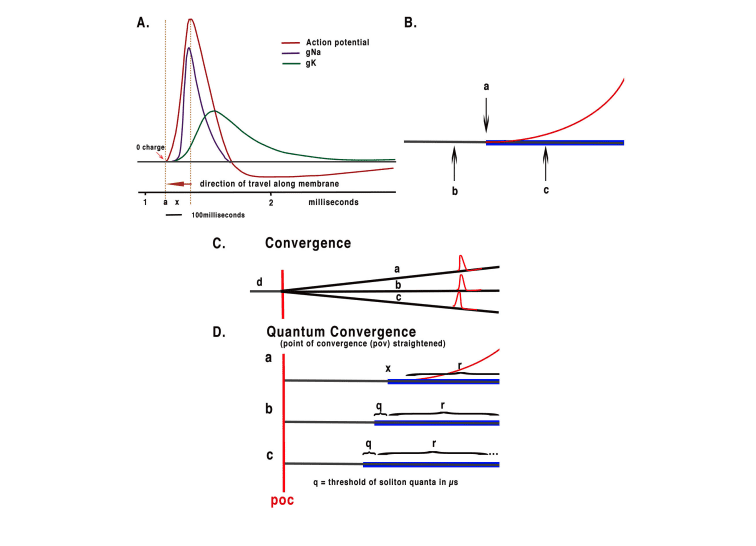
The APPulse demonstrates the ability to propagate around obstacles and through complex networks, suggesting it is a robust and reliable signal carrier. The researchers propose the mechanical properties of the neuronal membrane play a critical role in protecting the APPulse from disruption, indicating the membrane is not simply a passive barrier but an active participant in neural signalling.
This work has significant implications for the development of new technologies, such as brain-computer interfaces and neural prosthetics. Understanding the mechanical properties of neurons could lead to more effective and biocompatible devices that can interact with the nervous system. Future devices, they suggest, should incorporate mechanical sensors and actuators to mimic the natural mechanical properties of neurons.
The authors emphasize this research represents an initial step towards a new era in neuroscience, urging further exploration of the mechanical properties of neurons. Future research should focus on identifying the specific molecular mechanisms underlying the generation and propagation of the APPulse, and investigating the role of mechanical signals in various brain functions, such as learning, memory, and emotion.
The APPulse can be modulated by various factors, including neurotransmitters and hormones, suggesting the brain can dynamically regulate its mechanical properties. The mechanical properties of the neuronal membrane, they propose, play a critical role in mediating the effects of these factors.
This research challenges the traditional view of the brain as a purely electrical machine, demonstrating it is a complex electromechanical system utilising both electrical and mechanical signals to process information. The mechanical properties of neurons, they suggest, contribute to the brain’s ability to learn, adapt, and potentially generate consciousness, indicating the brain is not simply a collection of individual neurons but a highly integrated system. This perspective opens new avenues for exploring the complexities of neural computation and understanding the nature of consciousness.
Finally, the authors argue that the failure to account for mechanical aspects represents a fundamental flaw in the design of truly intelligent machines, hindering the development of AI systems that can match the performance of the human brain. They propose that future AI systems should incorporate mechanical elements and principles to achieve greater efficiency and adaptability.
👉 More information
🗞 The nature of quantum parallel processing and its implications for coding in brain neural networks: a novel computational mechanism
🧠 DOI: https://doi.org/10.48550/arXiv.2505.14503