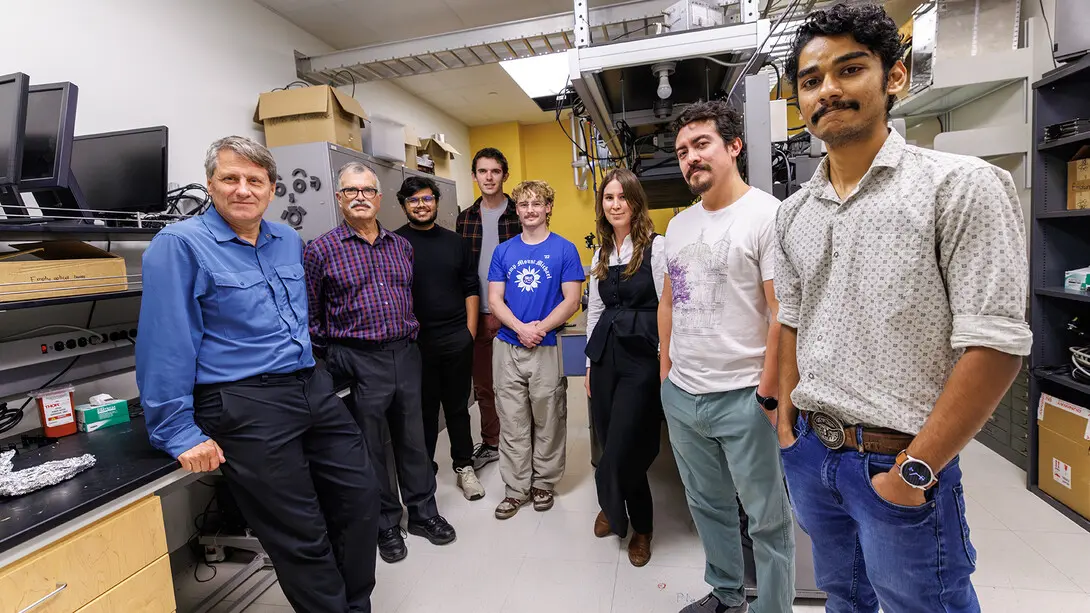
University of Nebraska–Lincoln’s Herman Batelaan has been awarded the 2026 Davisson-Germer Prize by the American Physical Society for pioneering advancements in free-electron quantum optics. The prize recognizes Batelaan’s contributions to three key areas: the re-evaluation of the Stern-Gerlach effect for electron beams, the first experimental demonstration of the Kapitza-Dirac effect—where light diffracts electrons—and expanded understanding of the Aharonov-Bohm effect. Conducted within Batelaan’s laboratory at the university since joining the faculty in 1999, this work combines theoretical modeling with experimental validation of fundamental quantum mechanical phenomena, significantly enhancing the field of atomic physics and surface science.
Batelaan Awarded Prestigious Davisson-Germer Prize
Herman Batelaan, a physics professor at the University of Nebraska–Lincoln, has been awarded the prestigious 2026 Davisson-Germer Prize by the American Physical Society. The prize recognizes his groundbreaking work in free-electron quantum optics, specifically exploring how electrons interact with light and matter at a quantum level. Batelaan’s research builds upon the legacy of Davisson and Germer, whose 1927 experiment confirmed the wave-particle duality of electrons – a cornerstone of quantum mechanics.
Batelaan’s contributions center around three key areas: re-examining the Stern-Gerlach effect for electron beams, the first demonstration of the Kapitza-Dirac effect, and expanding our understanding of the Aharonov-Bohm effect. The Kapitza-Dirac effect is particularly notable; Batelaan’s team proved electrons can diffract from light, effectively reversing the findings of the original Davisson-Germer experiment where electrons diffracted off matter. This demonstrated light’s ability to act as a diffraction grating for electrons.
This award marks a first for the University of Nebraska–Lincoln, acknowledging Batelaan’s nearly four-decade commitment to foundational physics. His work isn’t purely theoretical; it combines rigorous experimentation with advanced theoretical modeling. Current research, funded by the National Science Foundation, explores the quantum measurement problem and tests fundamental principles like the Pauli exclusion principle under extreme conditions – pushing the boundaries of our quantum understanding.
Key Research Areas in Quantum Physics
A key area of current quantum research focuses on refining our understanding of electron behavior, particularly in free-electron quantum optics. Dr. Herman Batelaan’s recent work has revisited fundamental experiments like the Stern-Gerlach effect – traditionally used to measure quantum spin – revealing previously unrecognized errors in established theory. His team also achieved the first demonstration of the Kapitza-Dirac effect, proving electrons can diffract from light itself, acting as an optical grating. This reverses the findings of the 1927 Davisson-Germer experiment, highlighting a deeper interplay between light and matter at the quantum level.
Another vital research direction involves pushing the boundaries of foundational quantum principles. Batelaan’s lab is actively investigating the quantum measurement problem, exploring why particles exist in multiple states until measured, “choosing” a single outcome. Simultaneously, they’re testing the limits of the Pauli exclusion principle – which dictates no two identical fermions can occupy the same quantum state – by examining what happens when a quantum wave is disturbed faster than light’s speed. These experiments seek to reveal if and how quantum mechanics breaks down under extreme conditions.
Finally, much of this research isn’t solely theoretical. Batelaan’s team combines rigorous experimentation with detailed theoretical modeling. Current NSF-funded projects demonstrate this approach, tackling both the measurement problem and the Pauli exclusion principle test concurrently. This synergy between theory and experiment is crucial for validating new models and ensuring that our understanding of the quantum world remains grounded in observable reality, paving the way for future technologies leveraging these principles.
Batelaan’s Career and Research Origins
Herman Batelaan’s groundbreaking research in quantum physics, recently recognized with the 2026 Davisson-Germer Prize, began with a foundation built across multiple international institutions. After earning degrees from Leiden and Utrecht universities in the Netherlands, Batelaan pursued postdoctoral research with pioneers like Harold Metcalf (laser cooling) and Nobel laureate Anton Zeilinger. This diverse experience shaped his focus on fundamental questions in quantum mechanics, eventually leading him to the University of Nebraska–Lincoln in 1999 to collaborate on polarized electron studies.
Batelaan’s work at Nebraska quickly established a unique research program, focusing on free-electron quantum optics. His team achieved several firsts, including the first demonstration of the Kapitza-Dirac effect – diffracting electrons from light, reversing the principle behind the 1927 Davisson-Germer experiment. They also re-examined the Stern-Gerlach effect for electrons, correcting a decades-old error. These experiments meticulously combined theoretical modeling with precise measurements, pushing the boundaries of established quantum physics.
Driven by a deep curiosity, Batelaan’s current research—supported by NSF funding—continues to challenge core quantum principles. One experiment investigates the quantum measurement problem, while another tests the limits of the Pauli exclusion principle under extreme conditions. Beyond experimentation, Batelaan emphasizes mentorship, actively training the next generation of scientists and viewing their success as a key measure of his own accomplishments.
Continuing Research and Future Directions
Herman Batelaan’s recent recognition with the Davisson-Germer Prize fuels ongoing research at the University of Nebraska–Lincoln focused on foundational quantum mechanics. Current NSF-funded projects are directly probing the limits of established theory. One experiment investigates the quantum measurement problem—specifically, how particles “choose” a definite state when observed—while another tests the validity of the Pauli exclusion principle under conditions exceeding the speed of light. These aren’t incremental studies, but challenges to core tenets of quantum physics.
Batelaan’s team is uniquely positioned to advance this research due to their demonstrated ability to reverse conventional thinking. Their 2023 demonstration of the Kapitza-Dirac effect—diffracting electrons from light—directly countered the 1927 Davisson-Germer experiment which established electron diffraction by matter. This ability to manipulate electron behavior using light opens doors to novel quantum devices and a deeper understanding of wave-particle duality—a cornerstone of quantum theory.
Looking ahead, Batelaan is co-authoring a book detailing the electron double-slit experiment, aiming to make complex quantum concepts accessible. This commitment to both cutting-edge experimentation and educational outreach positions his lab as a vital hub. Beyond specific experiments, the focus remains on exploring seemingly settled questions, recognizing that even well-established textbooks may conceal unresolved mysteries at the quantum level.