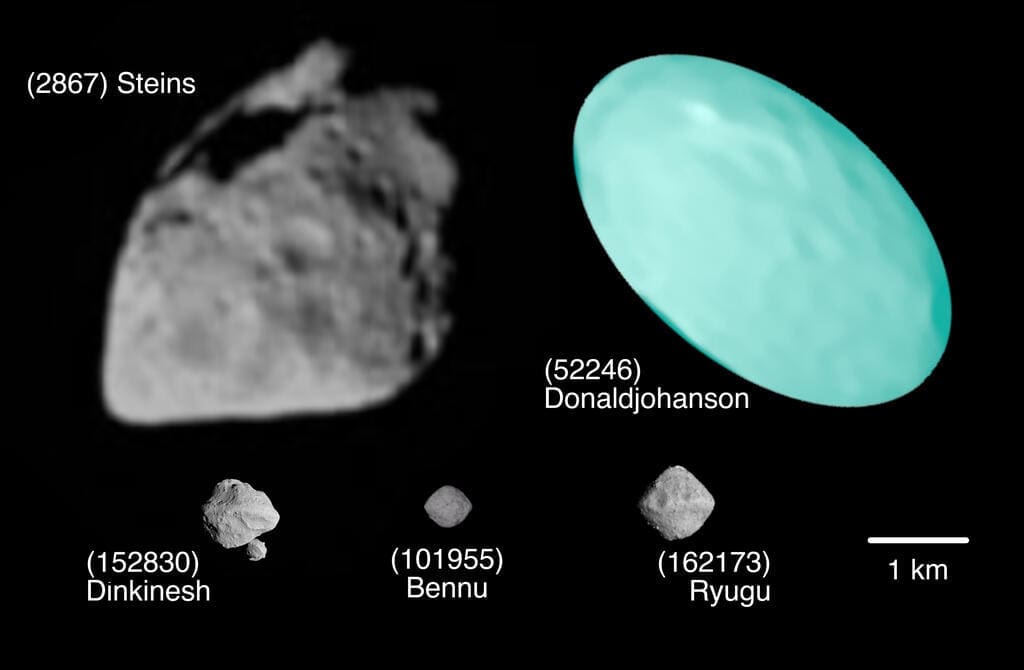
Southwest Research Institute-led modelling has determined that the main belt asteroid (52246) Donaldjohanson likely formed approximately 150 million years ago from a parent asteroid breakup. This assessment highlights its evolution in orbit and spin properties, with NASA’s Lucy spacecraft set to fly by this three-mile-wide asteroid on April 20, 2025.
The mission aims to gather data on Donaldjohanson’s shape, surface geology, and cratering history, which could offer insights into the formation processes of such asteroids. As a member of the Erigone collisional family, Donaldjohanson’s characteristics suggest it may be elongated and a slow rotator due to thermal torques. The flyby is anticipated to provide unique perspectives on its peculiarities and potential connections to other asteroids like Bennu and Ryugu, enhancing our understanding of solar system evolution.
Asteroid Donaldjohanson Formation History
The formation history of asteroid Donaldjohanson is rooted in a significant event approximately 150 million years ago. Modeling led by Southwest Research Institute (SwRI) suggests that this main belt asteroid originated from the fragmentation of a larger parent body. This breakup created the Erigone collisional family, to which Donaldjohanson belongs, characterized by asteroids sharing similar orbital paths.
Donaldjohanson’s peculiar characteristics, such as its elongated shape and slow rotation, are likely due to thermal torques acting over time. These features make it distinct from other asteroids like Bennu and Ryugu, which have been studied by NASA’s OSIRIS-REx and JAXA’s Hayabusa2 missions. The upcoming Lucy mission flyby in April 2025 will provide critical data on its surface geology, shape, and cratering history, offering insights into its evolution.
The Lucy mission, set to visit multiple asteroids, aims to study the diversity of these bodies and their role in the early solar system. By examining Donaldjohanson, scientists hope to better understand the processes that shaped the asteroid belt and the broader history of our solar system.
NASA Lucy Mission Overview
The NASA Lucy mission is a groundbreaking endeavor set to explore multiple asteroids, including Donaldjohanson. Launched in 2021, Lucy is designed to study the Trojan asteroids, which are remnants from the early solar system. However, its trajectory also allows for a flyby of Donaldjohanson, providing an opportunity to gather valuable data about this unique asteroid.
The mission’s scientific instruments include high-resolution cameras, spectrometers, and other tools to analyze the physical properties and composition of the asteroids it encounters. These instruments will help scientists determine the age, origin, and evolutionary history of these celestial bodies.
Flyby Objectives for Asteroid Donaldjohanson
During the Lucy mission’s flyby of Donaldjohanson, key objectives include capturing high-resolution images to study its surface features, analyzing its composition using spectrometers, and measuring its gravitational field. These measurements will provide insights into the asteroid’s structure, formation history, and potential hazards it may pose.
The data collected during this flyby will contribute to a broader understanding of asteroids in the main belt and their role in the solar system’s evolution. By studying Donaldjohanson, scientists aim to uncover clues about the conditions present during the early stages of planet formation.
Connections to Other Asteroid Missions
The Lucy mission builds on the successes of previous asteroid exploration missions, such as NASA’s OSIRIS-REx and JAXA’s Hayabusa2. These missions have provided valuable insights into the composition and behavior of asteroids, paving the way for more ambitious explorations like Lucy.
By studying a diverse range of asteroids, including those in the main belt and the Trojans, scientists can piece together a more complete picture of our solar system’s history. The data collected by Lucy will complement findings from other missions, fostering a deeper understanding of asteroid dynamics and their implications for planetary science.
Significance of Studying Asteroids as Fossils
Asteroids are often referred to as fossils of the early solar system because they contain preserved materials from its formation. By studying these celestial bodies, scientists can gain insights into the conditions and processes that shaped our planets billions of years ago.
The Lucy mission’s study of Donaldjohanson and other asteroids will help unravel the mysteries of planetary formation and evolution. Understanding the composition and history of these asteroids is crucial for reconstructing the early solar system and determining how it gave rise to the diverse array of planets we see today.
More information
External Link: Click Here For More