

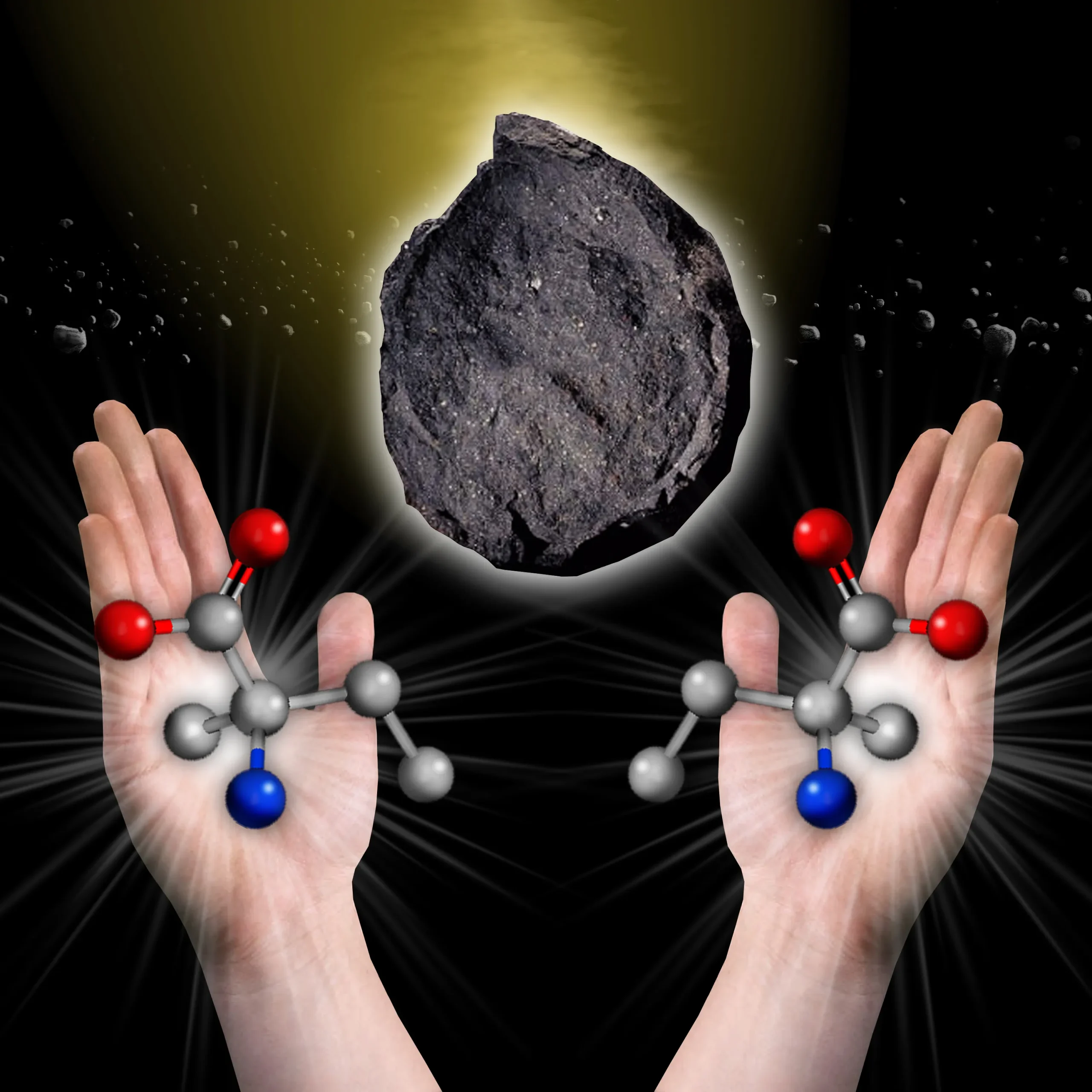
NASA-funded researchers have deepened the mystery of why life on Earth uses molecules with specific orientations, a phenomenon known as homochirality. The team discovered that RNA, a molecule thought to have potentially held the instructions for life before DNA emerged, can favor making building blocks of proteins in either left-hand or right-hand orientation. This challenges the idea that early life was predisposed to select left-handed amino acids dominating modern proteins.
The study, published in Nature Communications, tested RNA molecules called ribozymes under simulated early-Earth conditions and found they could favor either left- or right-handed amino acids. According to Irene Chen of UCLA, corresponding author of the paper, this suggests that RNA did not initially have a predisposed chemical bias for one form of amino acids.
The research has implications for understanding the origin of life on Earth and beyond. As Jason Dworkin, senior scientist for astrobiology at NASA’s Goddard Space Flight Center, notes, “Understanding the chemical properties of life helps us know what to look for in our search for life across the solar system.” The study was supported by grants from NASA, the Simons Foundation Collaboration on the Origin of Life, and the National Science Foundation.
The Mystery of Life’s Handedness Deepens
The origin of life on Earth remains one of the most intriguing and complex puzzles in the fields of biology and astrobiology. A recent discovery funded by NASA has shed new light on this mystery, but it has also deepened our understanding of why life uses molecules with specific orientations. The research, published in Nature Communications, reveals that RNA (ribonucleic acid), a key molecule thought to have potentially held the instructions for life before DNA emerged, can favor making the building blocks of proteins in either the left-hand or right-hand orientation.
Proteins are the workhorse molecules of life, used in everything from structures like hair to enzymes that speed up or regulate chemical reactions. The 20 different amino acid building blocks that make up these proteins can be arranged in a huge variety of combinations, similar to the way the 26 letters of the alphabet are arranged to form words. However, some amino acid molecules can be built in two ways, resulting in mirror-image versions, like left and right hands. Life uses the left-handed variety of these amino acids, a characteristic known as homochirality.
The RNA World Hypothesis
The discovery has implications for our understanding of the origin of life on Earth. DNA (deoxyribonucleic acid) is the molecule that holds the instructions for building and running a living organism, but it is complex and specialized. Scientists believe that something simpler should have preceded it billions of years ago during the early evolution of life. A leading candidate for this is RNA, which can both store genetic information and build proteins. The hypothesis that RNA may have preceded DNA is called the “RNA world” hypothesis.
If the RNA world proposition is correct, then perhaps something about RNA caused it to favor building left-handed proteins over right-handed ones. However, the new research did not support this idea, deepening the mystery of why life went with left-handed proteins. The experiment tested RNA molecules that act like enzymes to build proteins, called ribozymes, and found that they can favor either left- or right-handed amino acids.
The Experiment and Its Implications
The researchers simulated early-Earth conditions of the RNA world by incubating a solution containing ribozymes and amino acid precursors. They tested 15 different ribozyme combinations and found that ribozymes can favor either left-handed or right-handed amino acids. This suggested that RNA did not initially have a predisposed chemical bias for one form of amino acids, challenging the notion that early life was predisposed to select left-handed-amino acids.
The findings suggest that life’s eventual homochirality might not be a result of chemical determinism but could have emerged through later evolutionary pressures. This has significant implications for our understanding of how life arose on Earth and how we search for life elsewhere in the solar system.
The Search for Life Beyond Earth
Understanding the chemical properties of life helps us know what to look for in our search for life across the solar system. Researchers are analyzing samples from meteorites and asteroids, such as those extracted by NASA’s OSIRIS-REx mission, for evidence of life including ribozymes and proteins. The research was supported by grants from NASA, the Simons Foundation Collaboration on the Origin of Life, and the National Science Foundation.
The discovery has far-reaching implications for our understanding of the origin of life on Earth and beyond. As we continue to explore the mysteries of life’s handedness, we may uncover new insights into how life arose and evolved on our planet, and potentially elsewhere in the universe.
External Link: Click Here For More


