The ability to manipulate light at the nanoscale holds immense potential for advances in telecommunications, signal processing, and quantum technologies, and researchers are increasingly turning to thin-film lithium niobate as a key material. Alessandra Sabatti, Jost Kellner, Robert J. Chapman, and colleagues at the Institute for Quantum Electronics, ETH Zurich, have now achieved a breakthrough in controlling the nonlinear optical properties of this material with unprecedented precision. The team successfully developed a technique, termed nanodomain poling, to create periodic structures within lithium niobate films with periods as small as 215 nanometres. This innovation overcomes limitations of conventional methods and enables the efficient generation of light interactions involving waves travelling in opposite or even backward directions, paving the way for new devices with tailored spatial and spectral properties for quantum signal processing and metrology.
Periodic Poling Limits Nonlinear Wave Interactions
The ability to control light at the nanoscale is crucial for advancements in telecommunications, signal processing, and emerging quantum technologies. Thin-film lithium niobate is a promising material for integrated photonics due to its strong interaction with light and its potential for creating efficient nonlinear devices. Researchers have now overcome limitations in structuring this material, enabling the creation of devices capable of efficiently generating light interactions involving counter- and back-propagating waves, opening new avenues for quantum signal processing, computing, and metrology. Traditionally, controlling light properties within lithium niobate relies on a process called periodic poling, which aligns microscopic domains within the material.
Existing techniques were limited to relatively large poling periods, hindering the development of advanced quantum applications. The team achieved a breakthrough by engineering the growth of nanoscale domains directly on the sidewalls of the lithium niobate waveguides, preventing the lateral merging of domains that typically occurs with conventional methods. This precise control over domain geometry allows for the creation of photon pairs with tailored spatial and spectral properties, crucial for quantum technologies. Specifically, the researchers demonstrated efficient counter-propagating and, for the first time, backward-propagating spontaneous parametric down-conversion, a process that generates pairs of entangled photons. These entangled photons exhibit unique characteristics, such as high heralded purity and broadband spectral properties, making them ideal for applications in quantum communication, sensing, and computation. The demonstrated efficiencies represent a significant step towards realizing practical, integrated quantum photonic circuits, bringing us closer to realizing the full potential of integrated quantum photonics.
Fabricating Ultrashort Periodic Poling in Lithium Niobate
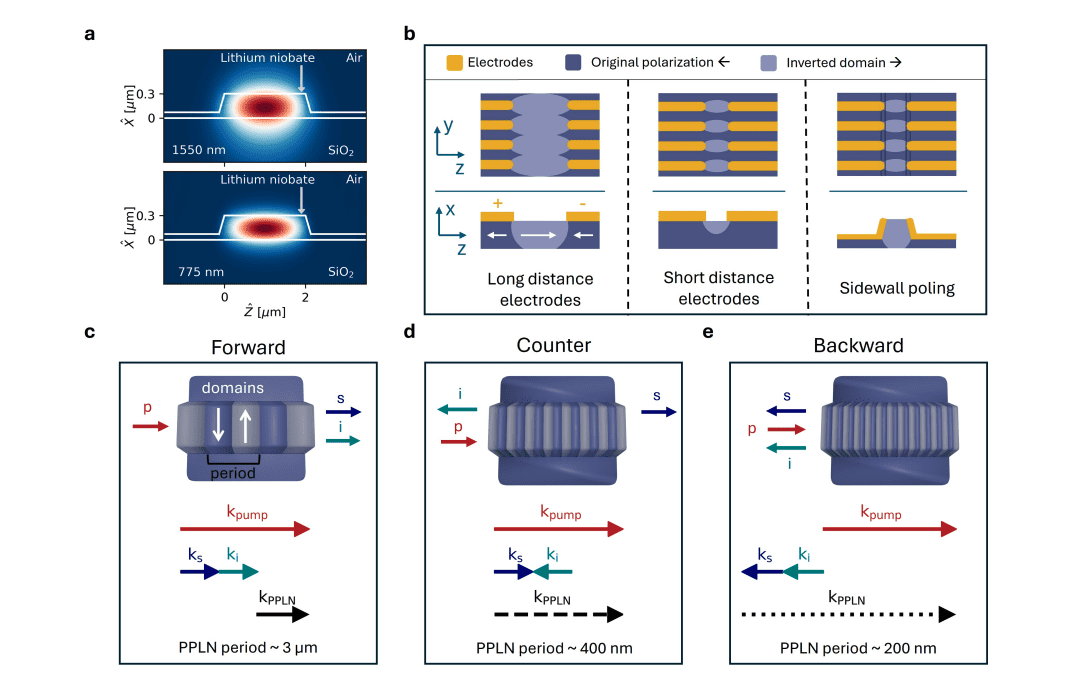
The research achieves a method with unprecedented precision, paving the way for new efficient approaches to integrated quantum information processing, quantum computing and metrology. The process of periodic poling with ultrashort periods was investigated in a thin-film lithium niobate sample. Achieving such short periods presents a challenge, as neighbouring domains tend to merge during the poling process, rendering phase matching unfeasible. A highly efficient periodic poling must exhibit domain inversion throughout the entire film depth, extending in the x direction, and a 50% duty cycle in the y direction. The periodic domains are generated in a nucleation process with a growth rate that generally differs in the z direction compared to the x and y directions. For sub-micron periods, conventional methods struggle to balance film depth and lateral growth, limiting conversion efficiency.
Sidewall Poling Boosts Conversion Efficiency Significantly
Results indicate that closer electrode spacing allows for calibrated lateral growth, but limits film depth, resulting in low frequency conversion efficiency. To address this, sidewall poling, a technique previously demonstrated by other researchers, was employed. This method involves etching the waveguide first, then patterning electrodes directly onto the sidewalls, enabling nucleation to occur not only on the film surface but also along the entire etched depth. The influence of wave directionality on three phase matching processes was investigated. The process of spontaneous parametric down-conversion was examined in terms of wave propagation direction and momentum mismatch, which is inversely proportional to the poling period.
A conventional configuration involves all three waves propagating together, while a counter-propagating scheme utilizes waves travelling in opposite directions. Finally, the researchers investigated a configuration where the pump generates two backward-propagating photons, requiring an ultrashort poling period of 215 nm. The sample was fabricated by etching lithium niobate waveguides and depositing titanium electrodes directly onto the structured film. Reduced waveguide top width was found to be necessary to achieve well-separated domains. On-chip nonlinear spectrum and efficiency were measured using second harmonic generation.
👉 More information
🗞 Nanodomain poling unlocking backward nonlinear light generation in thin film lithium niobate
🧠 DOI: https://doi.org/10.48550/arXiv.2507.13004