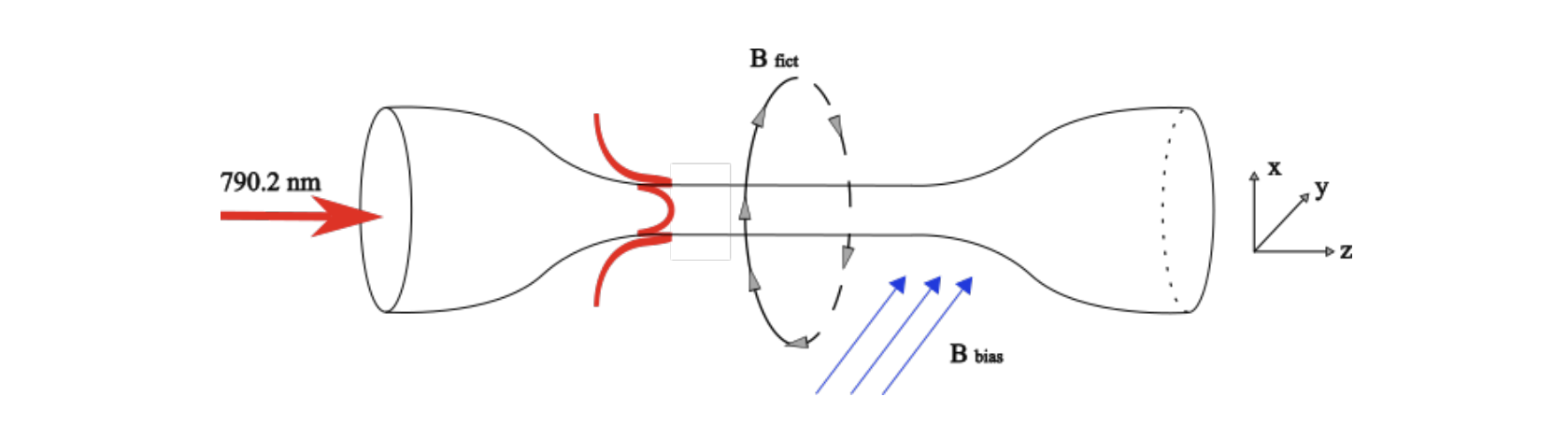
Rydberg atoms, with their unique properties and potential for quantum technologies, face a significant challenge from atomic motion that disrupts their delicate quantum states. Alexey Vylegzhanin, Dylan J. Brown, and colleagues at the Okinawa Institute of Science and Technology Graduate University, alongside collaborators at Aarhus University and the Université de Toulouse, present a novel approach to confining both ground and Rydberg state rubidium atoms with unprecedented stability. Their research introduces a trap that utilises the light guided through an optical nanofibre to create a ‘fictitious’ magnetic field, effectively minimising disruptive forces on the atoms. This innovative technique promises to overcome a key limitation in building robust quantum simulators and networks, paving the way for practical, one-dimensional atom arrays integrated with nanofibre technology and offering a significant step towards scalable quantum computing.
Rydberg Atom Trapping and Dephasing Control
Cold Rydberg atoms are emerging as a leading platform for powerful quantum technologies, including simulators and networks. These atoms possess long-lived excited states and strong interactions, making them ideal for manipulating and entangling quantum bits. However, a significant challenge hinders progress: dephasing, the loss of quantum information due to atomic motion. Researchers are therefore focused on developing methods to trap and control Rydberg atoms with extreme precision. Currently, many experiments rely on free space or complex optical tweezers.
A promising alternative involves integrating Rydberg atoms with nanostructured materials, such as optical nanofibres. These fibres, with diameters measured in micrometres, can confine atoms and facilitate efficient coupling of light, potentially forming the backbone of quantum communication networks. Researchers have proposed a novel trap design that combines an external magnetic field with a “fictitious” magnetic field induced by light travelling within the optical nanofibre. This light-induced field arises from the polarization of light, effectively mimicking a real magnetic field on the atoms. By carefully controlling the strength and polarization of the light, and combining it with an external field, the researchers can create a trap that confines both ground and Rydberg state atoms.
The team’s calculations demonstrate that this combined trap can be tuned to minimize differences in the trapping potential experienced by the ground and Rydberg states. This is crucial because any discrepancy in the trap’s strength could lead to unwanted atomic motion and dephasing. This innovative approach offers a pathway towards building scalable and robust quantum networks based on Rydberg atoms integrated with nanofibre technology, potentially revolutionizing quantum communication and computation.
Rydberg Atom Confinement with Light-Induced Fields
Researchers are developing innovative methods to trap and control Rydberg atoms, which hold significant promise for building quantum technologies. A key challenge is maintaining the coherence of their quantum states, as atomic motion can introduce disruptive effects. To address this, the team designed a specialized trap that simultaneously confines both the ground state and a highly excited Rydberg state of rubidium atoms. The approach involves carefully engineering the trap’s potential to minimize energy differences between the ground and Rydberg states, thereby reducing dephasing. By manipulating the polarization of the light within the nanofibres, using either single or multiple guided modes, researchers can fine-tune the shape and depth of the trap.
Importantly, the size of the Rydberg atom itself plays a role, affecting how it interacts with the light field and the resulting ponderomotive potential. This technique builds upon existing methods for trapping atoms, but offers a unique advantage by simultaneously addressing the needs of both ground and Rydberg states. The design is not limited to rubidium; with appropriate adjustments, the method can also be applied to caesium atoms. Beyond simply trapping the atoms, this approach paves the way for creating one-dimensional arrays of Rydberg atoms integrated with nanofibres, a crucial step towards building scalable quantum networks and exploring advanced quantum simulations. The ability to precisely control and confine these atoms is essential for realizing the full potential of Rydberg atom-based quantum technologies.
Nanofibre Traps Stabilize Rydberg Atom Coherence
Researchers have developed a novel method for trapping and controlling Rydberg atoms, which hold significant promise for advancements in quantum technologies. These atoms, known for their unique properties and strong interactions, are challenging to manipulate due to their sensitivity to external forces. This new approach addresses a key limitation: dephasing caused by atomic motion. The method utilizes an optical nanofibre, a strand of glass thinner than a human hair, to create a specialized trapping environment. By combining light-induced fictitious magnetic fields with an external bias field, the researchers engineered a trap that effectively confines the atoms.
This innovative approach relies on the unique interaction between atoms and light with elliptical polarization within the nanofibre, generating a force that holds the atoms in place. The trap’s design carefully balances the forces acting on both the ground and Rydberg states, ensuring they experience similar confinement and minimizing disruptive motion. Crucially, the team demonstrated the ability to create a trap potential for Rydberg atoms comparable to that of the ground state atoms. This is a significant achievement, as differences in trap potential can lead to dephasing, a loss of quantum information.
By carefully selecting Rydberg states with specific properties, the researchers minimized these differences, paving the way for more stable and reliable quantum systems. This development has important implications for building all-fiber quantum networks, where Rydberg atoms act as crucial nodes for transmitting and processing quantum information. The nanofibre not only traps the atoms but also efficiently couples them to light, enabling the transmission of quantum signals through optical fibres.
Light-Induced Traps for Rydberg Atoms
This work presents a novel approach to trapping cold Rydberg atoms using light-induced fictitious magnetic fields generated by optical nanofibres. Researchers demonstrate that by carefully engineering the light field, specifically using quasi-linear or quasi-circularly polarised light, it is possible to create a trap that confines both the ground state and Rydberg state atoms. This is achieved by minimising differential light shifts between the two states, a key challenge in maintaining quantum coherence. Calculations demonstrate the feasibility of this trap design, showing that appropriate Rydberg states can be selected to ensure comparable trapping potentials for both the ground and Rydberg states.
🗞 Towards a fictitious magnetic field trap for both ground and Rydberg state Rb atoms via the evanescent field of an optical nanofibre
🧠 DOI: https://doi.org/10.48550/arXiv.2507.12827