

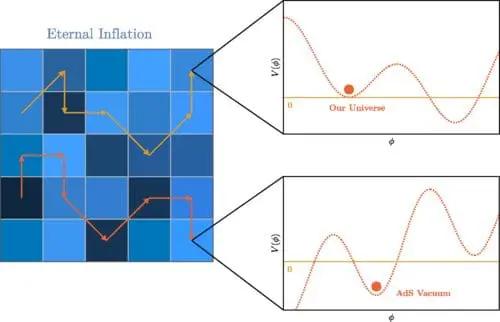
The concept of a multiverse has long fascinated scientists, and recent research has shed new light on the possibility of a multiverse arising from landscapes without de Sitter minima. This phenomenon challenges our current understanding of the universe and the laws of physics, raising important questions about the nature of reality and the possibility of other forms of life. In this article, we delve into the details of this fascinating topic, exploring how eternal inflation can lead to a multiverse with unique properties, and what implications this has for open problems in fundamental physics.
Can a Multiverse Arise from Landscapes without de Sitter Minima?
The concept of a multiverse has long fascinated scientists, and recent research has shed new light on the possibility of a multiverse arising from landscapes without de Sitter minima. In this article, we will delve into the details of this fascinating topic.
One of the key findings is that a multiverse can indeed arise from such landscapes, and it can be populated during a period of eternal inflation without trans-Planckian field excursions or flat potentials. This raises important questions about the values of the cosmological constant and the weak scale. In order to understand these concepts better, let us first explore what is meant by “landscapes” and “de Sitter minima.”
Landscapes refer to the possible configurations of a theory’s parameters, which can be thought of as a landscape with hills and valleys. De Sitter minima, on the other hand, are points in this landscape where the energy density of the vacuum is lower than elsewhere. In the context of eternal inflation, these minima play a crucial role in determining the properties of the multiverse.
The idea that a multiverse can arise from landscapes without de Sitter minima may seem counterintuitive at first, but it is actually a natural consequence of the theory. This is because the energy density of the vacuum is not fixed and can vary depending on the configuration of the parameters. In this scenario, the multiverse can be populated during a period of eternal inflation, without the need for trans-Planckian field excursions or flat potentials.
This raises important questions about the values of the cosmological constant and the weak scale. The cosmological constant is a measure of the energy density of the vacuum, while the weak scale refers to the strength of the weak nuclear force. In order to understand these concepts better, let us first explore what is meant by “eternal inflation” and how it relates to the multiverse.
Eternal inflation is a concept that was introduced in the 1980s as a way to explain the observed homogeneity and isotropy of the universe. The idea is that our universe is just one bubble in a much larger sea of universes, each with its own unique properties. This raises important questions about the nature of reality and the possibility of other forms of life.
In this scenario, the multiverse can be thought of as a vast expanse of universes, each with its own unique properties. The concept of eternal inflation provides a way to understand how these universes came into being and how they are connected.
The idea that a multiverse can arise from landscapes without de Sitter minima is an important one, as it challenges our current understanding of the universe and the laws of physics. It also raises important questions about the nature of reality and the possibility of other forms of life.
Can We Write Models of Eternal Inflation Compatible with Distance and Refined de Sitter Conjectures?
One of the key findings is that it is easy to write models of eternal inflation compatible with the distance and refined de Sitter conjectures. This raises important questions about the nature of reality and the possibility of other forms of life.
In order to understand this concept better, let us first explore what is meant by “distance” and “refined de Sitter conjectures.” Distance refers to the idea that universes are separated from each other by a certain distance. Refined de Sitter conjectures refer to the idea that the energy density of the vacuum is not fixed and can vary depending on the configuration of the parameters.
The concept of eternal inflation provides a way to understand how these universes came into being and how they are connected. This raises important questions about the nature of reality and the possibility of other forms of life.
In this scenario, the multiverse can be thought of as a vast expanse of universes, each with its own unique properties. The concept of eternal inflation provides a way to understand how these universes came into being and how they are connected.
The idea that we can write models of eternal inflation compatible with distance and refined de Sitter conjectures is an important one, as it challenges our current understanding of the universe and the laws of physics. It also raises important questions about the nature of reality and the possibility of other forms of life.
What Are the Implications for Open Problems in Fundamental Physics?
The concept of a multiverse arising from landscapes without de Sitter minima has important implications for open problems in fundamental physics. One of the key findings is that this scenario can have an impact on our understanding of the universe and the laws of physics.
In order to understand these implications better, let us first explore what is meant by “open problems” in fundamental physics. Open problems refer to questions or challenges that remain unanswered or unaddressed in a particular field of study.
The concept of eternal inflation provides a way to understand how universes came into being and how they are connected. This raises important questions about the nature of reality and the possibility of other forms of life.
In this scenario, the multiverse can be thought of as a vast expanse of universes, each with its own unique properties. The concept of eternal inflation provides a way to understand how these universes came into being and how they are connected.
The idea that a multiverse can arise from landscapes without de Sitter minima is an important one, as it challenges our current understanding of the universe and the laws of physics. It also raises important questions about the nature of reality and the possibility of other forms of life.
Can We Understand the Multiverse Better?
One of the key findings is that we can understand the multiverse better by exploring the concept of eternal inflation. This raises important questions about the nature of reality and the possibility of other forms of life.
In order to understand this concept better, let us first explore what is meant by “eternal inflation.” Eternal inflation refers to the idea that our universe is just one bubble in a much larger sea of universes, each with its own unique properties. This raises important questions about the nature of reality and the possibility of other forms of life.
The concept of eternal inflation provides a way to understand how these universes came into being and how they are connected. This raises important questions about the nature of reality and the possibility of other forms of life.
In this scenario, the multiverse can be thought of as a vast expanse of universes, each with its own unique properties. The concept of eternal inflation provides a way to understand how these universes came into being and how they are connected.
The idea that we can understand the multiverse better by exploring the concept of eternal inflation is an important one, as it challenges our current understanding of the universe and the laws of physics. It also raises important questions about the nature of reality and the possibility of other forms of life.
Publication details: “A multiverse outside of the swampland”
Publication Date: 2024-09-03
Authors: Raffaele Tito D’Agnolo, Paolo Mangini, Gabriele Rigo, Lian-Tao Wang, et al.
Source: Physical review. D/Physical review. D.
DOI: https://doi.org/10.1103/physrevd.110.055007


