

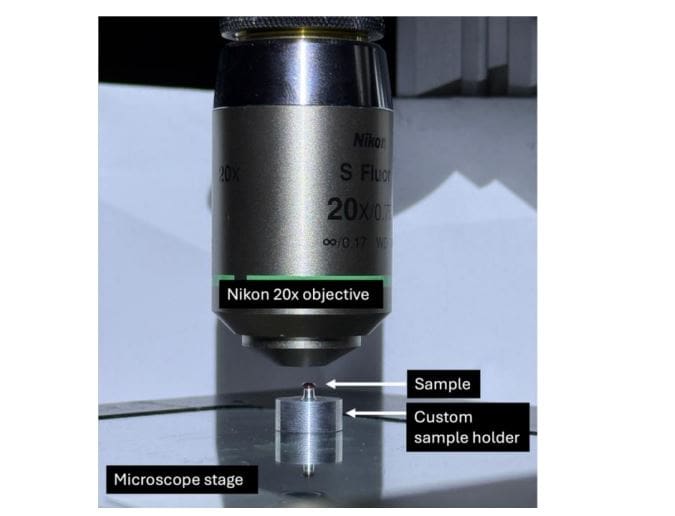
Diamonds possess a remarkable combination of properties that make them valuable for both technological applications and scientific study, driving demand for methods to analyse these gemstones without causing damage. Elana G. Alevy, Samuel D. Crossley, and colleagues at the University of Arizona, along with Lam T. Nguyen, Vu D. Phai, and Khanh Q. Kieu, now present a significant advance in this field, demonstrating high-resolution, three-dimensional imaging of diamonds using multiphoton microscopy. This technique reveals sub-micrometer details of a diamond’s internal structure, including fluorescent defects and inclusions, offering new insights into its formation and history. The ability to non-destructively map these features promises to improve gemstone quality assessment, advance the development of diamond-based technologies, and trace the origins and treatments of these precious stones.
The technique allows scientists to create three-dimensional images of internal structures and defects, revealing crucial information about color origin, treatment history, and authenticity. Beyond simply visualizing these features, the method maps the internal structure of gemstones in detail, providing a comprehensive understanding of their composition. The study focuses heavily on diamonds, demonstrating the ability to differentiate between natural, treated, and synthetic stones based on their unique fluorescence signatures and internal structures.
Researchers successfully identified specific defects responsible for color and potentially detected treatments designed to alter clarity or hue. This versatile method extends beyond diamonds, offering potential for analyzing a wide range of geologic materials and gemstones. The technique utilizes multiphoton excitation, which allows the laser to penetrate deeper into the sample and reduces scattering compared to traditional microscopy. Analysis relies on detecting the fluorescence emitted by defects within the gemstone when excited by the laser. The system employs a pulsed laser to stimulate nonlinear optical emissions within the samples. This laser generates short pulses of light, delivering energy to initiate the imaging process. The research team harnessed nonlinear optical phenomena, specifically second and third harmonic generation, which arise from the unique crystalline structure and refractive index variations within diamonds. These signals provide contrast based on the symmetry and interfaces present in the material, revealing internal features without damaging the sample.
Scientists also excited two and three-photon excitation fluorescence by targeting trace amounts of rare earth elements and crystalline defects, further enhancing the visualization of internal structures. This technique stimulates nonlinear optical emissions, providing detailed insights into both natural and synthetic diamonds, as well as diamond simulants. Results demonstrate the ability to distinguish between various fluorescent defects and physical characteristics using these nonlinear optical emissions, offering a new tool for gemological appraisal. Analysis of natural diamonds revealed complex structural features and fluorescent inclusions throughout their interiors.
The team recorded emission peaks consistent with N3 centers commonly found in naturally formed type Ia diamonds. A pink diamond from the Argyle mine exhibited planar features extending more than one millimeter deep, detected through three-photon fluorescence and second harmonic generation signals. Spectral analysis of this Argyle diamond showed broad fluorescence and localized third harmonic generation, indicating a change in refractive index at the interface between the diamond and a mineral inclusion. Synthetic diamonds exhibited shifted emission wavelengths compared to natural diamonds. In contrast, cubic zirconia lacked substantial nonlinear optical signals except for third harmonic generation, and moissanite exhibited strong second harmonic generation throughout its interior. This approach reveals insights into both the structural and compositional variations within diamonds, offering a new tool for classification and analysis. The technique resolves crystallographic occurrences of emission centers, which are relevant to both scientific research and technological applications. By examining harmonic generations and nonlinear fluorescent emissions, scientists can gain a deeper understanding of the optical properties of diamonds and their internal features.
The method’s capabilities extend to identifying features indicative of a diamond’s origin and any treatments it may have undergone. Future development of this microscopy could incorporate shorter wavelength lasers to stimulate fluorescence throughout the bulk of diamond samples, revealing growth patterns and synthesis methods. Integrating Raman spectrometry would further verify gemstone identity, while dichroic mirrors could isolate signals from specific fluorescent centers, enabling live imaging of defects. These modifications demonstrate the adaptability of the technique for investigating the formation history of diamonds and other gemstones.
👉 More information
🗞 High resolution 3D imaging of diamonds with multiphoton microscopy
🧠 ArXiv: https://arxiv.org/abs/2511.21544


