The fundamental relationship between time’s symmetry and the direction of cause and effect presents a long-standing challenge in physics, and now, researchers are revealing a surprising connection between the two. Eliot Jean, Ralph Silva, and V. Vilasini, from the Institute for Theoretical Physics at ETH Zürich and the Université Grenoble Alpes, demonstrate an operational equivalence between seemingly disparate frameworks, the multi-time state formalism and the post-selected closed timelike curve framework. Their work establishes that any quantum process achievable with arbitrary pre- and post-selection can also be realised using cyclic causal influences, and vice versa, through explicit mappings between the two approaches. This discovery not only clarifies the deep connections between time symmetry and causality, but also opens new avenues for exploring the fundamental limits of quantum information processing and the nature of time itself.
Independent Evolution of Quantum System Parts
This work explores the theoretical foundations of multi-time states (MTS), a concept where different parts of a quantum system evolve independently in time, and 2-time objects (2TO/2TS), a specific type of MTS. Researchers investigate the relationships between these concepts, building a framework for understanding systems where time doesn’t flow uniformly. The core idea is to understand how these complex temporal arrangements relate to standard quantum mechanics and potentially, to physical systems exhibiting unusual time behaviour. Multi-time states allow for different parts of a system to experience time independently, moving beyond the standard assumption of a single, global time.
A special case, the 2-time object, organizes the system into parts evolving either forwards or backwards in time. Researchers demonstrate that any MTS can be constructed from a 2TO by manipulating the temporal order of its components. The team establishes that isomorphic MTS, those with the same structure but different time orderings, are related by transformations called free operations, which avoid paradoxes like closed timelike curves. These free operations define a partial order, revealing a fundamental structure governing the relationships between different multi-time states. This research provides a formal foundation for understanding these concepts and rigorously proves key theorems relating them.
This work represents a highly theoretical exploration of quantum states with multiple independent time evolutions, potentially relevant to areas like quantum gravity and cosmology. The key contribution lies in developing a framework for understanding the relationships between different types of multi-time states and identifying a partial order based on permissible operations. Further research could clarify the physical interpretation of these states and their potential applications.
Operational Equivalence of Time and Causality Frameworks
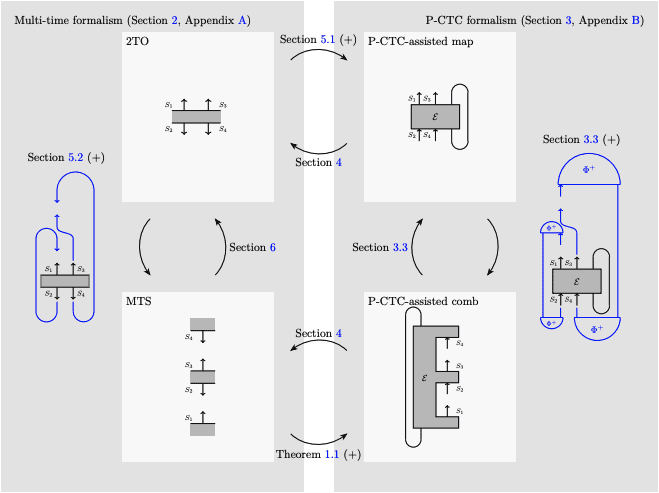
Researchers addressed a long-standing question concerning the fundamental relationship between the symmetrical nature of physical laws and our perception of time’s direction, specifically causality. They investigated two advanced frameworks: the multi-time state (MTS) formalism and the post-selected closed timelike curve (P-CTC) framework, both of which allow for more flexible treatment of time and causality. The goal was to determine if these frameworks, while seemingly different, describe the same underlying physical reality. The core of their innovative methodology involved demonstrating a direct operational equivalence between these two frameworks, previously suspected but never rigorously proven.
They extended the P-CTC framework by defining ‘time-labelled P-CTC assisted combs’, a more versatile structure capable of handling complex temporal arrangements and open processing possibilities. This allowed them to establish explicit mappings between any MTS and its equivalent P-CTC assisted comb, and vice versa. This explicit mapping is a key result, detailing precisely how to translate between the language of MTS and P-CTCs. The researchers constructed a method for converting any process described within one framework into an equivalent process within the other, while carefully tracking the resources, specifically the number and dimensionality of the P-CTCs, required for the conversion.
This detailed mapping provides a concrete tool for exploring the implications of each framework and for designing new quantum information processing protocols. Furthermore, the team explored a resource-theoretic perspective, treating MTS as a resource and defining a hierarchy based on their usefulness. They identified which types of MTS are most and least valuable when P-CTCs are available to manipulate causality, establishing a partial order that could lead to a deeper understanding of information processing capabilities. This resource-theoretic approach, combined with the established operational equivalence, opens avenues for investigating the power of causal loops and their potential applications in quantum technologies.
MTS and P-CTC Frameworks are Equivalent
Researchers have established a fundamental connection between how time appears to flow in physical laws and the apparent directionality of cause and effect. Conventional quantum theory assumes a clear order to events, but this new work demonstrates an equivalence between this standard view and scenarios where influences can, in principle, travel backwards in time. The research centres on two theoretical frameworks: the multi-time state (MTS) formalism and the post-selected closed timelike curve (P-CTC) framework, both of which explore the boundaries of causality. Previously, while structural similarities between these frameworks were known, it remained unclear if they were fundamentally interchangeable.
This study definitively proves that any process describable using the MTS framework can also be perfectly replicated using the P-CTC framework, and vice versa. The researchers have developed explicit methods to translate between the two, demonstrating a concrete mapping between them. The implications suggest that time symmetry, a core principle of physics, and seemingly paradoxical cyclic causality are, in fact, two sides of the same coin. The team’s approach involved extending the P-CTC framework to create more versatile “time-labelled combs”, which allow for greater flexibility in describing temporal relationships.
They then demonstrated that any complex multi-time process could be broken down and reconstructed using these combs, effectively proving the operational equivalence. Importantly, the research reveals that the number of time-travel-like loops (P-CTCs) required for this translation can vary, offering insights into the resources needed to manipulate time in these theoretical scenarios. Furthermore, the researchers explored a “resource-theoretic” perspective, examining how these multi-time states relate to each other when time-travel loops are not allowed. This analysis reveals a hierarchy of usefulness, with certain types of multi-time states being more easily transformed into others without invoking these loops.
Time Symmetry and Causality Are Equivalent
This research establishes a fundamental equivalence between two theoretical frameworks used to explore the interplay of time symmetry and causality: the multi-time state (MTS) formalism and the post-selected closed timelike curve (P-CTC) framework. The team demonstrates that any process achievable within the MTS framework can also be replicated using P-CTCs, and conversely, any process possible with P-CTCs has an equivalent representation within the MTS framework. This equivalence is achieved through explicit mappings between the core objects of each theory, revealing a deeper connection than previously understood. The significance of this work lies in providing a unified perspective on how time symmetry, a fundamental property of physical laws, relates to the directional flow of causality we observe.
By demonstrating operational equivalence, the research suggests that cyclic causal influences, those enabled by P-CTCs, are not fundamentally distinct from standard quantum processes described by the MTS formalism. This offers a new lens through which to examine the foundations of quantum mechanics and the nature of time itself. The authors acknowledge that their analysis relies on the concept of post-selection, which involves discarding certain outcomes of a process, and that further research is needed to explore the implications of this requirement.
👉 More information
🗞 An equivalence between time-symmetry and cyclic causality in quantum theory
🧠 ArXiv: https://arxiv.org/abs/2508.02463