

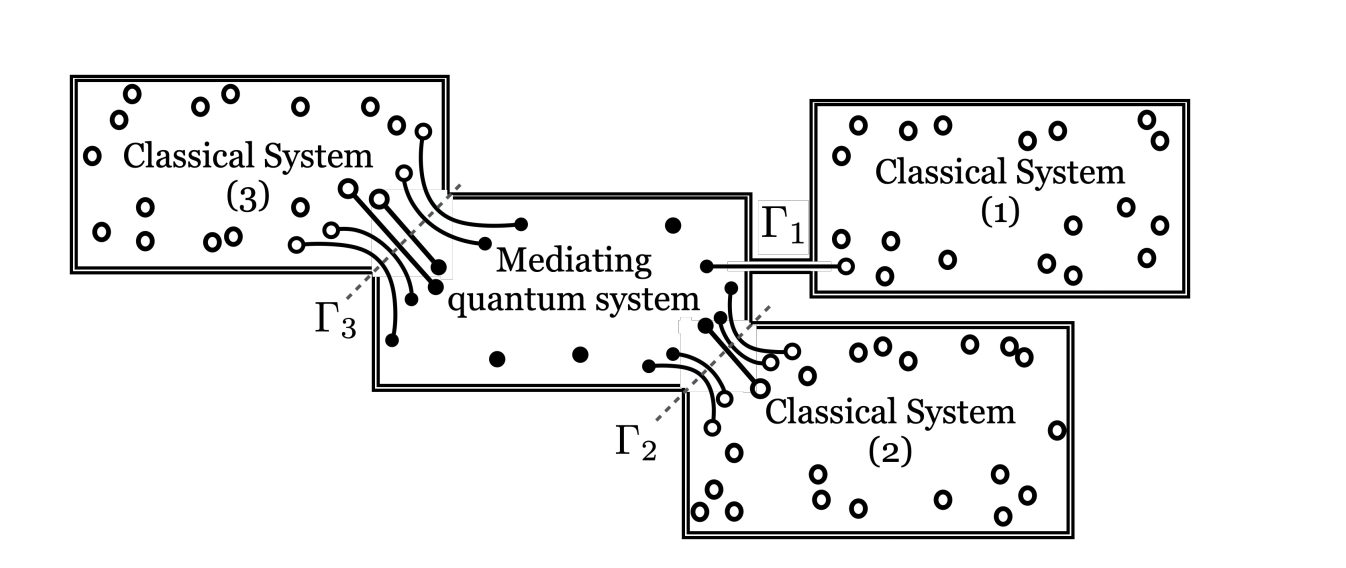
The flow of information and its associated entropy are fundamental to understanding complex systems, yet tracking these quantities presents a significant challenge in hybrid classical-quantum devices. Julian Rapp, Radhika H. Joshi, and Alwin van Steensel, all from the Peter Grünberg Institute, along with colleagues including Yuli V. Nazarov from Delft University of Technology, now present a new theoretical framework to overcome this limitation. Their work extends existing methods to account for strong interactions between quantum systems and their classical surroundings, allowing researchers to directly observe how entropy changes within these devices. The results demonstrate that both quantum coherence and the mixing of classical and quantum elements can actually restrict the flow of entropy, creating a kind of informational bottleneck, and this framework offers a powerful new tool for designing more efficient and reliable quantum technologies.
This work addresses a fundamental challenge in quantum physics, as traditional methods struggle to accurately track information when quantum systems are strongly coupled to their surroundings. The team’s method involves evolving multiple “virtual replicas” of the system, enabling the direct calculation of information flow even when interactions are strong. This advancement builds upon existing theoretical tools, extending their capabilities to encompass more realistic scenarios. The core of this work lies in accurately quantifying how entropy, a measure of disorder and information loss, changes within a quantum system. By using multiple replicas, researchers can overcome limitations of previous methods, which were restricted to situations where the quantum system and its environment interacted weakly.
Entropy Flow in Strongly Hybrid Quantum Systems
Researchers have developed a new theoretical framework for understanding how entropy flows in quantum systems, particularly those interacting strongly with their environment. This work addresses a long-standing challenge in the field, as traditional methods struggle to accurately track entropy when quantum systems are heavily “hybridized” with classical ones, a common situation in solid-state quantum technologies. The team’s approach overcomes these limitations by evolving multiple “virtual replicas” of the system, allowing for direct calculation of entropy flow even in strong coupling regimes. The core of this advancement lies in extending a previously established theoretical tool to encompass strong quantum-classical interactions.
The results demonstrate that both quantum coherence and hybridization jointly suppress net entropy transfer, creating a kind of thermodynamic bottleneck. This finding challenges previous assumptions that entropy flow is solely governed by excitation and decay probabilities, revealing a more nuanced role for quantum effects. The team’s method allows them to track Rényi entropy, a generalization of the more common von Neumann entropy, providing a more complete picture of entropy dynamics. This new framework has significant implications for the development of quantum circuit theory and the accurate modeling of quantum nanostructures, and paves the way for more efficient and reliable quantum technologies.
Hybrid Quantum Systems Slow Entropy Transfer
This work introduces a generalized theoretical framework for quantifying entropy and information flow in quantum, classical hybrid systems, extending beyond traditional methods limited to weak coupling between systems. By evolving multiple virtual replicas of the system, researchers accurately model entropy dynamics even when quantum and classical components share substantial degrees of freedom, a condition known as strong hybridization. The results demonstrate that hybridization, combined with quantum coherence, can suppress net entropy transfer, creating a bottleneck effect that slows down irreversible thermodynamic processes.
The framework’s accuracy has been verified by demonstrating agreement with established results in the weak-coupling limit, while also revealing significant deviations in the strong-coupling regime, particularly at lower temperatures. This ability to model entropy flow has direct implications for the design of quantum devices, including solid-state quantum processors and quantum thermal machines, where controlling information and energy exchange is crucial.
🗞 Information Transport in Classic-Quantum Hybrid System
🧠 ArXiv: https://arxiv.org/abs/2508.07870


