

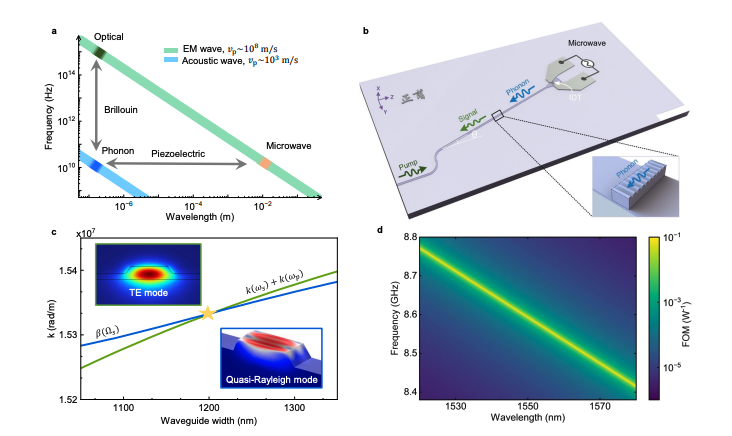
Efficient conversion between microwave and optical signals underpins a diverse range of technologies, including quantum computing and advanced radar systems, yet current methods often suffer from limited bandwidth and scalability. Yuan-Hao Yang, Jia-Qi Wang, and Zheng-Xu Zhu, alongside Yu Zeng, Ming Li, Yan-Lei Zhang, and colleagues, now present a breakthrough in this field, demonstrating the first multi-channel microwave-to-optics conversion using a novel traveling-wave architecture. This approach utilizes a hybrid photonic-phononic waveguide on a thin-film lithium niobate platform, achieving continuous phase-matching and significantly expanding operational bandwidths to over 40nm in the optical domain and 250MHz in the microwave domain. By harnessing the unique properties of lithium niobate, the team achieves coherent conversion between microwave and optical signals at room temperature and, remarkably, demonstrates simultaneous operation of nine independent conversion channels within a single device, paving the way for seamless integration of microwave and optical technologies and enabling advancements in quantum networking and signal processing.
Hybrid Brillouin Converter for Quantum Applications
Scientists have developed a hybrid photonic-phononic device that efficiently converts microwave signals into optical frequencies, a crucial step for integrating these technologies for quantum computing and communication. The device combines waveguides for both light and sound, leveraging the Brillouin interaction to upconvert microwave signals. Detailed characterization of the device revealed key parameters, including photon and phonon propagation losses and quality factors, alongside efficiencies of the components driving the conversion process. These measurements allow for accurate modeling and optimization of the system’s performance.
The team achieved a system efficiency of 1. 6x 10 -4 , with an internal conversion efficiency of 1. 5x 10 -2 per pump power. They identified an optimal waveguide length that maximizes conversion efficiency, dependent on the quality of the acoustic waves within the device. Simulations suggest that with improved acoustic wave quality, the device could achieve efficiencies exceeding 50% with a compact waveguide length of less than 3cm. This research demonstrates the potential of this hybrid approach for creating high-efficiency microwave-to-optical converters, paving the way for advancements in quantum technologies and beyond.
Lithium Niobate Enables Broad Bandwidth Conversion
Researchers have engineered a novel microwave-to-optics (M2O) converter using a traveling-wave architecture on a thin-film lithium niobate platform, overcoming the bandwidth limitations of traditional methods. This innovative design achieves continuous phase-matching, enabling an unprecedented operational bandwidth exceeding 40nm in the optical domain and 250MHz in the microwave domain. By harnessing the strong piezoelectric and photoelastic effects of lithium niobate, the team successfully converted 9GHz microwave signals to 1550nm telecom wavelengths, achieving an internal efficiency of 2. 2% and a system efficiency of 2.
4x 10 -4 at room temperature. To demonstrate multi-channel capabilities, the team implemented a dual-pump configuration and expanded to an optical frequency comb with 50GHz spacing, simultaneously applying nine independent radio frequency signals. Successful conversion of all signals was confirmed through heterodyne measurement, revealing expected beat notes in the radio frequency spectra. This innovative approach supports up to 70 independent conversion channels within a single device, offering full reconfigurability through control of optical pump wavelengths. This achievement represents a significant step towards seamless integration of microwave and optical technologies, enabling applications in quantum information processing, high-efficiency microwave signal processing, and advanced radar systems.
Broadband Microwave-to-Optics Conversion via Phonons
Researchers have demonstrated a groundbreaking microwave-to-optics (M2O) conversion using a novel traveling-wave architecture with a hybrid phononic waveguide on thin-film lithium niobate. This approach bridges the significant frequency gap between microwave and optical photons by utilizing phonons as intermediate carriers, enabling continuous phase-matching across a broad spectrum, exceeding 40nm in the optical domain and 250MHz in the microwave domain. This represents a substantial advancement beyond traditional cavity-based systems limited by discrete resonances. The breakthrough relies on harnessing the strong piezoelectric and photoelastic effects within the lithium niobate material, facilitating coherent conversion between 9GHz microwaves and 1550nm telecom wavelengths.
Experiments revealed an internal conversion efficiency of 2. 2%, with a system efficiency of 2. 4x 10 -4 at room temperature, demonstrating the potential for practical applications. Crucially, the team demonstrated simultaneous operation of nine conversion channels within a single device, showcasing scalability and versatility. Numerical simulations predicted a strong Brillouin interaction, primarily attributed to the photoelastic effect, and detailed analysis showed that efficient conversion is possible when specific criteria are met. This innovative approach paves the way for seamless integration of microwave and photonic technologies, with potential applications in distributed quantum computing, high-efficiency microwave signal processing, and advanced radar systems.
Broadband Microwave-to-Optical Conversion Demonstrated
Researchers have demonstrated a new approach to converting microwave signals into optical signals, achieving multi-channel operation and significantly exceeding the bandwidth limitations of existing technologies. By implementing a traveling-wave architecture with a thin-film lithium niobate waveguide, the team successfully converted microwave frequencies to optical frequencies with an internal efficiency of 2. 2% at room temperature, and simultaneously operated nine conversion channels within a single device. This breakthrough relies on harnessing the piezoelectric and photoelastic properties of the material to create continuous phase-matching, enabling a bandwidth exceeding 40 nanometers in the optical domain and 250 megahertz in the microwave domain.
This achievement paves the way for improved integration of microwave and optical technologies, with potential applications in quantum information processing, high-efficiency microwave signal processing, and advanced radar systems. Optimizing the phonon mode quality factor and waveguide length could further enhance the internal conversion efficiency, potentially reaching even higher levels of performance. This work establishes a new platform for efficient microwave-to-optics conversion and represents a significant step towards realizing practical quantum interfaces and advanced signal processing capabilities.
🗞 Multi-Channel Microwave-to-Optics Conversion Utilizing a Hybrid Photonic-Phononic Waveguide
🧠 ArXiv: https://arxiv.org/abs/2509.10052


