Understanding the fundamental properties of exotic quantum states of matter represents a major challenge in modern physics, and recent work by Avijit Maity from the Tata Institute of Fundamental Research, Aman Kumar from Florida State University, and Vikram Tripathi from the Tata Institute of Fundamental Research, alongside their colleagues, offers a significant step forward. The team successfully identifies and characterises chiral topological order within complex magnetic materials, a feat previously hampered by the difficulty of directly assessing key properties from the underlying microscopic models. They demonstrate a new method, based on a mathematical tool called the modular commutator, which allows scientists to determine the presence of this order directly from the material’s quantum state, independent of its physical geometry. This breakthrough establishes a powerful new technique for exploring strongly correlated magnetic materials and promises to accelerate the discovery of novel quantum phases of matter.
Identifying chiral topological order in microscopic spin models presents a significant challenge, particularly for non-abelian systems, as directly evaluating the chiral central charge remains difficult. Researchers address this by employing the modular commutator, a technique that avoids directly calculating this elusive quantity. The method involves constructing a modular commutator from microscopic spin operators, allowing for the identification of chiral topological order without relying on conventional approaches. This innovative technique proves effective in analysing various spin models, offering a new pathway to characterise and understand complex quantum states of matter.
Building on this modular commutator formalism, researchers numerically obtain the chiral central charge directly from single ground-state wave functions of two-dimensional interacting spin models that have chiral topological order. This provides a geometry-independent and bulk diagnostic of chirality, allowing for analysis unaffected by specific system shapes. The team studied the Zeeman-Kitaev honeycomb model and the kagome antiferromagnet, both subjected to scalar spin chirality perturbations, introducing controlled variations to observe their effects. Results consistently demonstrate that the modular commutator accurately reflects the chiral properties of these complex systems, offering a powerful tool for characterising topological order.
Chiral Central Charge From Tensor Categories
This document details the theoretical foundations and computational methods used in identifying chiral topological order in spin models. It explains how different topological phases of matter are classified, introducing the concept of a Unitary Modular Tensor Category, a mathematical framework for describing the properties of anyons and their interactions. Anyons, particles exhibiting exotic exchange statistics, form the basis of topological quantum computation, and the chiral central charge, a number characterising the chiral aspect of a topological phase, is also explained.
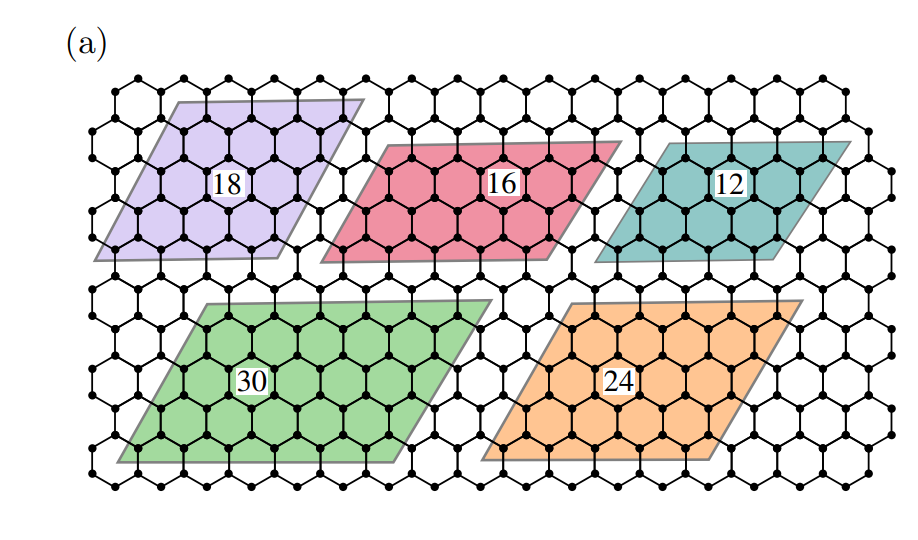
The document details the computational methods employed to obtain the numerical results, describing Exact Diagonalization, a technique used to find the exact energy eigenvalues and eigenstates of a quantum Hamiltonian for a finite system. As this method is limited to finite systems, researchers used clusters of different sizes to approximate the behaviour of an infinite system, employing periodic boundary conditions to minimise finite-size effects. The document further explains how the chiral central charge and topological entanglement entropy were calculated from the numerical data, detailing the process of subsystem partitioning and explaining entanglement entropy and topological entanglement entropy.
This supplementary material enables reproducibility by allowing other researchers to verify the results, ensures transparency by providing a clear and detailed account of the methods and calculations, establishes the theoretical foundation for interpreting the results, and provides completeness by offering all the necessary information to fully understand the research.
Chiral Central Charge Calculated From Wave Functions
Scientists have successfully calculated the chiral central charge directly from the wave functions of two-dimensional spin models exhibiting chiral topological order. This achievement overcomes a long-standing challenge in the field, providing a new method for diagnosing chirality independent of specific geometric constraints. The team applied the modular commutator formalism to the Zeeman-Kitaev honeycomb model and the kagome antiferromagnet, both perturbed by scalar spin chirality, and found results consistent with established theoretical predictions.
Furthermore, the research confirms the topological entropy of these systems, offering an independent verification of their topological order. The calculated chiral central charge for the kagome Heisenberg model with scalar spin chirality closely matches the expected value of one, while the value obtained for the Kitaev model is in excellent agreement with the theoretical prediction of one-half. These findings establish modular commutators as a powerful tool for numerically probing chiral topological order in strongly correlated magnetic materials.
The authors acknowledge that their calculations are limited by the finite size of the systems studied, and extrapolation techniques were necessary to approach the thermodynamic limit. Future research will likely focus on applying this method to more complex models and larger systems, potentially revealing new insights into the behaviour of topological phases of matter and furthering our understanding of exotic quantum phenomena.
🗞 Identifying chiral topological order in microscopic spin models by modular commutator
🧠 ArXiv: https://arxiv.org/abs/2510.06086