Understanding how light and matter interact at the molecular level is crucial for developing new technologies, but accurately modelling these interactions presents a significant computational challenge. Carlos M. Bustamante, Franco P. Bonafé, and colleagues from the Max Planck Institute for the Structure and Dynamics of Matter, alongside Maxim Sukharev from Arizona State University and Abraham Nitzan from the University of Pennsylvania, now present a new method to overcome these limitations. Their approach combines realistic simulations of light confinement within cavities with detailed modelling of molecular behaviour, allowing researchers to investigate how large numbers of molecules respond to light at the atomic level. This advancement enables the calculation of light transmission spectra and reveals complex molecular responses dependent on factors like position and orientation, bringing simulations closer to real-world experimental conditions and opening new avenues for exploring polaritonic chemistry.
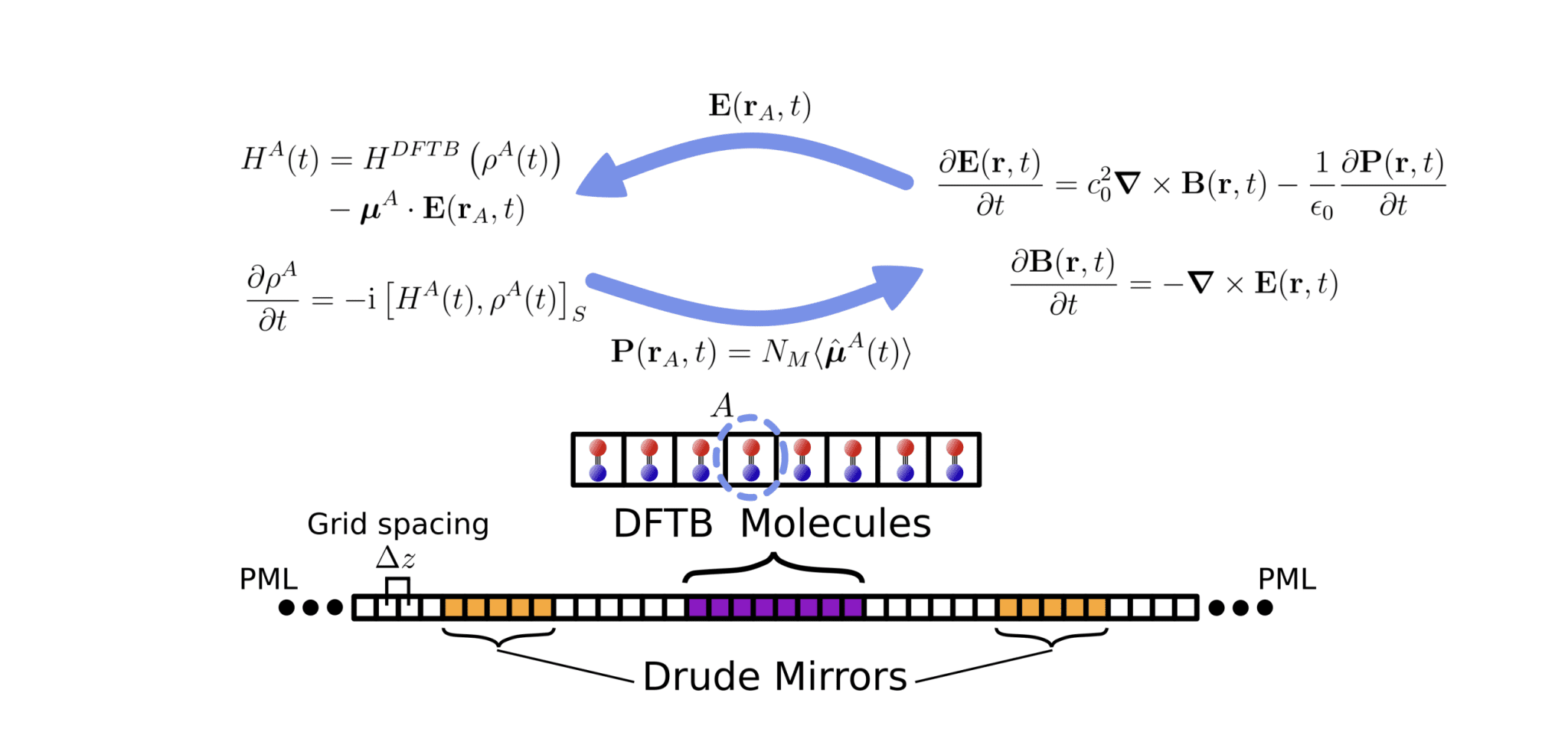
The team addressed limitations in existing methods by combining techniques from both classical electromagnetics and quantum mechanics to provide a more comprehensive and efficient simulation of light-matter interactions. This implementation accurately models the behaviour of light within optical cavities while simultaneously describing the quantum mechanical properties of molecules, enabling the study of complex systems previously inaccessible to detailed theoretical analysis. The framework integrates time-dependent density functional tight-binding calculations with finite-difference time-domain electromagnetics.
A key innovation is the full minimal coupling approach, which accurately captures the interaction between light and molecules beyond simplified approximations. This multiscale approach bridges the gap between molecular and electromagnetic scales, offering a balance between accuracy and computational cost, and the open-source implementation promotes reproducibility and collaboration. The researchers demonstrated the framework’s capabilities through several simulations, accurately modelling the formation of polaritons and their impact on molecular properties. The method captures local modifications of chemical properties induced by strong coupling, often missed by simpler models, and successfully simulated complex phenomena such as spontaneous emission and radiative thermalization. The team engineered a method that combines the rigorous numerical solution of Maxwell’s equations with quantum molecular dynamics at the density functional tight-binding level, offering a powerful new tool for simulating realistic chemical environments. This implementation accurately models both collective and local effects, demonstrating how molecular responses depend on their number, geometry, position, and orientation within the cavity. Simultaneously, the team employs density functional tight-binding theory to describe the electronic structure and dynamics of the molecules at an atomistic level, providing a quantum mechanical description of their behaviour. This combination allows for the simulation of a large number of molecules interacting with the cavity modes, offering a comprehensive picture of the system’s response. Scientists harness this approach to calculate transmission spectra, revealing the characteristic polaritonic signals that indicate strong light-matter coupling.
Simulating Light-Molecule Interactions in Optical Cavities
Researchers have developed a novel computational method that accurately simulates the interaction between light and molecules within optical cavities, overcoming limitations inherent in existing approaches. This breakthrough combines the numerical propagation of Maxwell’s equations with electron dynamics calculated using a density functional tight-binding method, enabling the study of complex polaritonic chemistry processes. The method allows for simulations involving a large number of molecules interacting with cavity modes, mirroring experimental setups and calculating transmission spectra that reveal key polaritonic signals. Results demonstrate the ability to analyze spatial and orientational dependencies of local effects under strong electronic coupling, and to investigate heterogeneities within molecular ensembles. By propagating electromagnetic fields in one and two dimensions, the researchers validated their approach using established numerical techniques like the finite difference time domain method.
Cavity Simulations Reveal Molecular Dynamics Complexity
This work presents a new computational implementation that combines simulations of light propagation with molecular quantum dynamics, allowing researchers to explore molecular behaviour within optical cavities. The method numerically solves Maxwell’s equations to model realistic cavities and then integrates these results with molecular simulations performed at the density functional tight-binding level. This approach enables the calculation of transmission spectra, mirroring experimental observations, and provides detailed information about the behaviour of individual molecules within the cavity, including their orientation and location. The simulations demonstrate that spectral information alone is insufficient to fully understand the complex processes occurring inside the cavity; factors such as molecular number, position, and geometry also play significant roles. The computational cost of these simulations is currently low, completing within hours or even minutes on standard computers, but extending the method to three dimensions or larger molecular systems will require high-performance computing resources.
👉 More information
🗞 Molecular polaritons dynamics in realistic cavities
🧠 ArXiv: https://arxiv.org/abs/2508.18842