
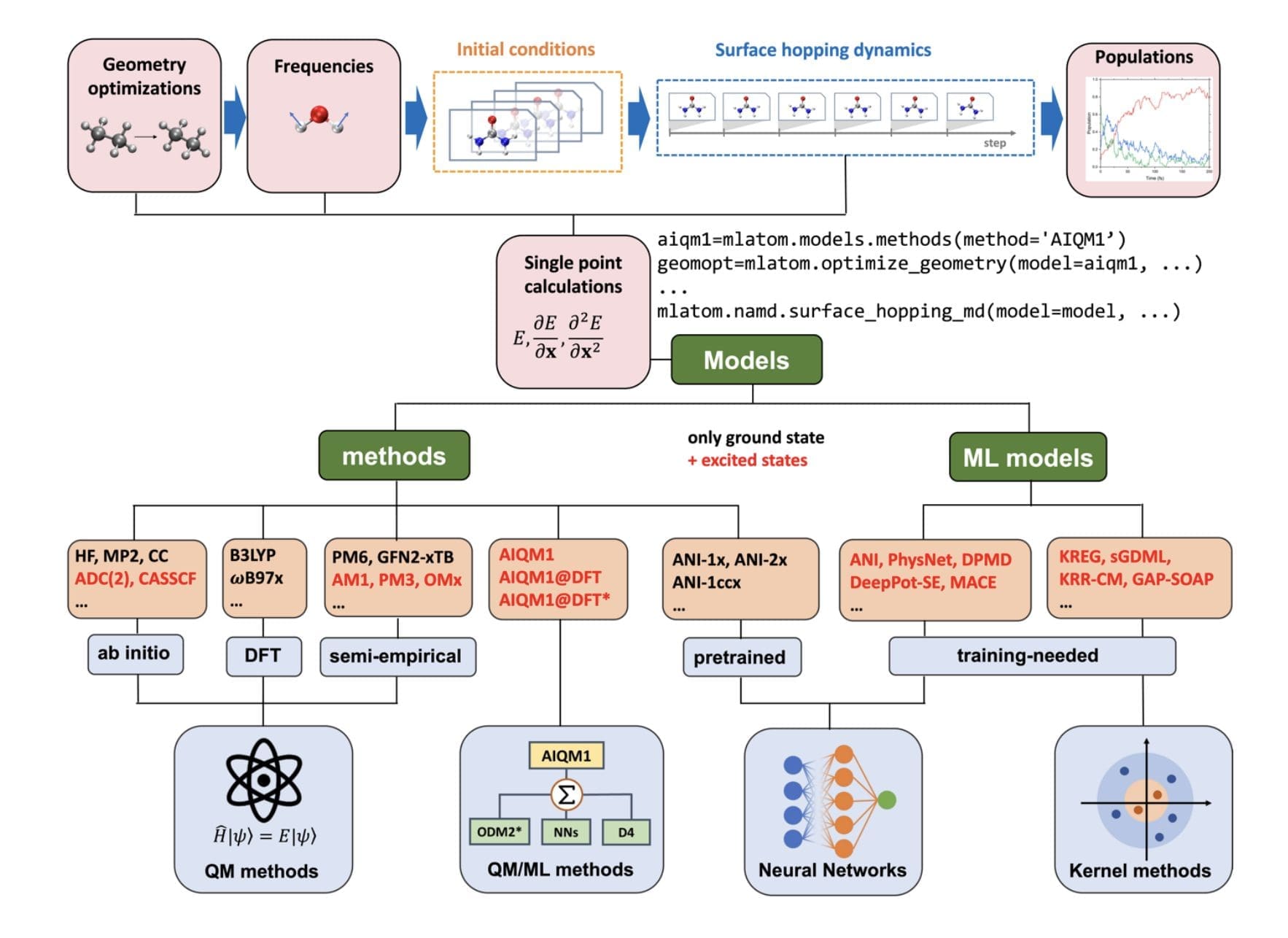
The MLatom software ecosystem is an open-source platform developed by researchers from various institutions, designed for on-the-fly surface hopping nonadiabatic dynamics based on the Landau-Zener-Belyaev-Lebedev (LZBL) algorithm. The ecosystem allows for dynamics to be performed via Python API with a range of quantum mechanical (QM) and machine learning (ML) methods.
It also includes AIQM1, a tool based on Δ-learning. The MLatom ecosystem is essential for understanding photophysical and photochemical processes and can be integrated into protocols for building ML models for nonadiabatic dynamics. The researchers plan to further integrate MLatom with NewtonX to enhance its functionalities.
What is the MLatom Software Ecosystem?
The MLatom software ecosystem is an open-source platform designed for on-the-fly surface hopping nonadiabatic dynamics based on the Landau-Zener-Belyaev-Lebedev (LZBL) algorithm. This ecosystem was developed by a team of researchers from various institutions including the College of Chemistry and Chemical Engineering at Xiamen University, Zhejiang Laboratory, the Faculty of Chemistry at the University of Warsaw, Aix Marseille University, and the State Key Laboratory of Physical Chemistry of Solid Surfaces at Xiamen University.
The MLatom ecosystem allows for dynamics to be performed via Python API with a wide range of quantum mechanical (QM) and machine learning (ML) methods. These include ab initio QM, semiempirical QM methods, and many types of machine learning potentials. Users can also build their own combinations of QM and ML methods. The ecosystem also includes AIQM1, a tool based on Δ-learning that can be used out of the box.
How Does MLatom Work?
The MLatom software ecosystem operates by propagating a swarm of independent trajectories, each using the forces for a single adiabatic electronic state. The nonadiabatic nature of the dynamics is recovered by allowing the trajectories to hop with some probability to another electronic state surface. This is achieved through the LZBL algorithm, which calculates hopping probabilities from the potential energy surface topography. This algorithm is gaining momentum because it speeds up simulations and enables surface hopping even for methods where nonadiabatic couplings are not available.
The MLatom ecosystem also provides example scripts that enable users to obtain final population plots by simply providing the initial geometry of a molecule. These scripts perform geometry optimization, normal mode calculations, initial condition sampling, parallel trajectories propagation, population analysis, and final result plotting.
What are the Applications of MLatom?
The MLatom software ecosystem is essential for understanding photophysical and photochemical processes. It is particularly useful for on-the-fly surface hopping dynamics, which is the most widely used type of nonadiabatic dynamics simulations. The ecosystem can be seamlessly integrated into the protocols for building ML models for nonadiabatic dynamics.
The researchers showcased how AIQM1, a tool within the MLatom ecosystem, reproduces the isomerization quantum yield of trans-azobenzene at a low cost. In the future, a deeper and more efficient integration of MLatom with NewtonX will enable a vast range of functionalities for surface hopping dynamics.
How Does MLatom Compare to Other Software Packages?
The LZBL algorithm used in the MLatom software ecosystem has been implemented in several other surface-hopping packages such as ZagHop, ABIN, PySurf, and Libra. However, these packages require interfaces to third-party electronic structure software to calculate the energies and forces for the electronic states involved with the QM methods.
The MLatom ecosystem stands out because it allows for the use of machine learning models to evaluate forces and energies, which can significantly speed up the process. This potential is underutilized for the LZBL approximation, although there is a growing interest in using ML to accelerate LZBL surface hopping dynamics.
What is the Future of MLatom?
The field of ML methods applied to surface hopping is rapidly developing, and there is a need for a versatile software ecosystem that enables easy use, modification, and extension. The MLatom software ecosystem meets this need for nonadiabatic dynamics.
The researchers plan to further integrate MLatom with NewtonX to enable a vast range of functionalities for surface hopping dynamics. This will facilitate similar workflows via the Python API, making the ecosystem even more user-friendly and efficient.
Publication details: “MLatom software ecosystem for surface hopping dynamics in Python with
quantum mechanical and machine learning methods”
Publication Date: 2024-04-09
Authors: Lina Zhang, Sebastian Pios, Mikołaj Martyka, Fuchun Ge, et al.
Source: arXiv (Cornell University)
DOI: https://doi.org/10.48550/arxiv.2404.06189