

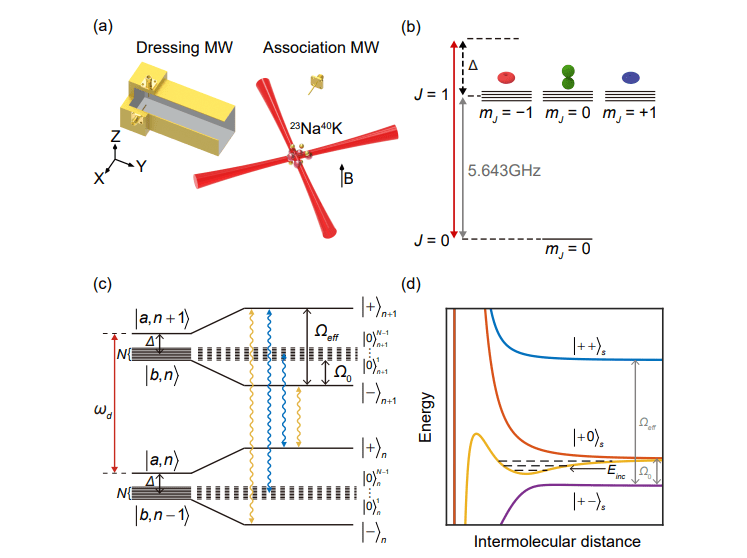
The pursuit of ultracold polyatomic molecules represents a significant frontier in physics, promising advances in precision measurement and our understanding of complex quantum systems. Zhengyu Gu, Xuansheng Zhou from Shanxi University, and Wei Chen, along with Fulin Deng and Tao Shi from the Chinese Academy of Sciences, now demonstrate a crucial step towards realising this goal by creating and characterising tetratomic states from ultracold sodium and potassium atoms. The team achieves this through a novel technique combining microwave association and microwave dressing, effectively manipulating the energy levels of the molecules to encourage the formation of these complex structures. This breakthrough not only provides insights into few-body physics within dressed molecular systems, but also establishes a promising pathway for the creation and control of increasingly complex ultracold polyatomic molecules, potentially unlocking new avenues for quantum simulation and exploration.
Ultracold diatomic molecules have achieved significant breakthroughs in recent years, enabling the exploration of quantum chemistry, precision measurements, and strongly correlated many-body physics. Extending ultracold molecular complexity to polyatomic molecules, such as triatomic and tetratomic molecules, has attracted considerable interest. However, realizing ultracold polyatomic molecules remains technically challenging due to their complex energy-level structures. While a few experiments have successfully demonstrated the formation of such molecules, significant hurdles persist in achieving the necessary levels of control and cooling.
Microwave Shielding and NaK Tetramer Characterization
This research details a method for suppressing molecular loss and characterizing the formation of tetrameric molecules from ultracold sodium-potassium (NaK) mixtures. The team observed evidence for the formation of four-molecule bound states, facilitated by the application of carefully controlled microwave fields, and characterized their properties using spectroscopic techniques. Detailed calculations of molecular collisions predict the formation of tetramer states, showing resonances in different angular momentum channels, providing a theoretical foundation for understanding the observed loss features. The experiment demonstrates that optimizing the relative phase of the microwave fields minimizes molecular loss, as confirmed by an extended lifetime of the molecular gas. Spectroscopic analysis reveals an additional loss peak, providing strong evidence for the association of tetrameric molecules, which proves robust even with changes in the polarization of the microwave field.
Tetramer Formation via Microwave-Dressed Molecules
Scientists have achieved a breakthrough in the creation and control of ultracold polyatomic molecules, successfully demonstrating a new technique for associating tetratomic molecules from fermionic sodium-potassium (NaK) mixtures. The team employed a novel microwave association technique, combining microwave dressing with precise spectroscopic measurements, to create and probe weakly bound tetramer states. A microwave dressing field, carefully tuned in energy, mixed the ground state and the first rotational state, creating new, dressed states and a manifold of dark states. This dressing process induced an effective electrical dipole moment, crucial for the subsequent association of tetramers. By applying a second microwave field, scientists drove transitions between the dressed states and the dark states, ultimately forming weakly bound tetramer states. Detailed spectroscopic measurements revealed structures indicating the formation of these tetramers, confirming the viability of this microwave-based approach for creating and studying complex polyatomic molecules.
Tetramer Spectroscopy Reveals Binding Energy Control
This research demonstrates the first successful microwave spectroscopy of tetratomic molecules created from microwave-dressed fermionic atoms, representing a significant step towards controlling ultracold polyatomic molecules. By combining microwave association with microwave dressing techniques, scientists have not only observed these tetramers but also precisely measured their binding energy through detailed spectroscopic analysis. The ability to form and characterize these tetramers opens new avenues for exploring complex few-body physics beyond the three-body problem, including investigations into four-body resonances and correlated dynamics. Furthermore, the technique provides a platform for studying internal-state-controlled quantum chemistry and energy transfer processes in ultracold polyatomic systems. While the current work focuses on a specific atomic combination, the researchers note that their method offers a general framework applicable to other ultracold diatomic molecular systems.
👉 More information
🗞 Tetratomic states of microwave dressed and associated ultracold 23Na40K molecules
🧠 ArXiv: https://arxiv.org/abs/2509.23634


