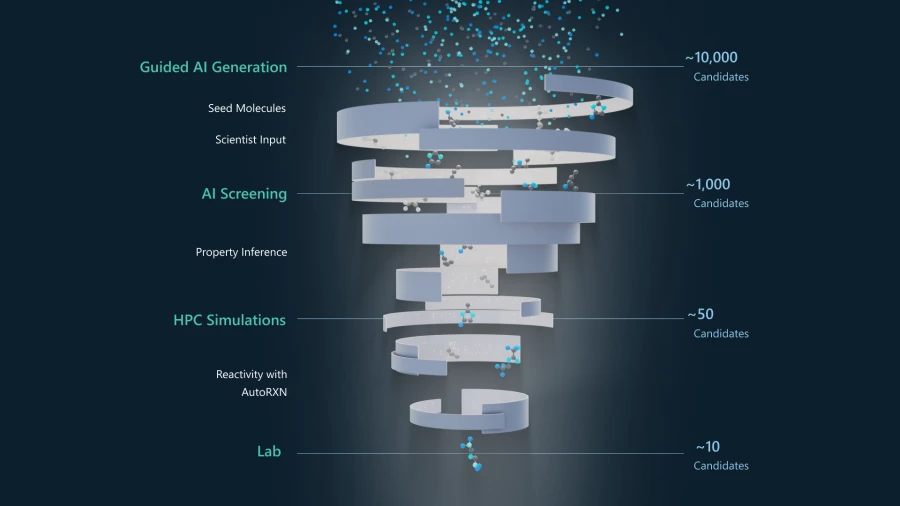
Microsoft’s Azure Quantum Elements is integrating new tools based on generative AI and high-performance computing to make research in chemistry and materials science faster and more accessible. The platform uses Copilot, a natural-language interface, to increase the speed of solving complex scientific problems. Azure Quantum Elements has helped scientists make breakthroughs in sustainable batteries and pharmaceutical innovations. The platform is now introducing two new capabilities: Generative Chemistry and Accelerated DFT. Generative Chemistry helps scientists discover new molecules quickly, while Accelerated DFT increases the speed of density functional theory codes, a popular method in computational chemistry.
Azure Quantum Elements: Enhancing Scientific Research with AI and High-Performance Computing
Azure Quantum Elements, a product of Microsoft, is revolutionizing research in chemistry and materials science by integrating new tools based on generative AI and high-performance computing. These tools are designed to increase the productivity of scientific research and remove barriers to scientific discovery by significantly reducing the effort and expertise required to perform complex tasks.
Azure Quantum Elements uses Copilot, a natural-language interface that can be used by both experts and non-experts, making it accessible to a wider audience and increasing the speed at which complex scientific problems can be solved. Since its launch, Azure Quantum Elements has played a crucial role in helping scientists achieve breakthroughs in areas such as sustainable batteries and pharmaceutical innovations.
Generative Chemistry: A New Approach to Discovering Novel Molecules
One of the major challenges in the field of chemistry is narrowing down an enormous number of candidate molecules to find the few that are best suited for a particular application. This challenge often results in the streetlight effect, where the vast number of possibilities is reduced to a manageable size, not based on the properties of the compounds, but by focusing only on those that have been studied previously.
Generative Chemistry, a new capability in Azure Quantum Elements, aims to address this challenge. It uses generative AI to bring to light a much larger portion of the estimated 10^60 possible combinations of atoms, presenting scientists with novel candidates that are likely to serve the intended purpose. This end-to-end workflow involves multiple steps, from providing information on desired molecular characteristics to performing highly accurate HPC simulations on the top candidates.
Accelerated DFT: Speeding Up Density Functional Theory Calculations
Density functional theory (DFT) is a popular method in computational chemistry due to its efficiency and accuracy in modeling quantum-mechanical properties. However, most DFT codes need to be run directly by the user in high-performance computing clusters, which can be a difficult task. Moreover, DFT requires substantial compute power and becomes constrained as the molecules being studied or designed increase in complexity and size.
To simplify and improve this process, Azure Quantum and Microsoft Research have designed and launched Accelerated DFT, a code used to simulate the electronic structure of molecules. Accelerated DFT can determine the properties of molecules with thousands of atoms in a matter of hours, performing substantially faster than other DFT codes.
Azure Quantum Elements and Quantum Computing
Azure Quantum Elements is continually evolving to become a more effective tool for scientists by harnessing AI, high-performance computing, and emerging hybrid-computing capabilities that bring the power of quantum computing to scientific challenges. Recently, a chemical catalyst was simulated by combining classical supercomputers, AI, and logical qubits created with Microsoft’s qubit-virtualization system and Quantinuum’s H1 hardware.
In the future, Microsoft plans to offer a quantum supercomputer that can simulate interactions of molecules and atoms at the quantum level, which is beyond the reach of classical computers. This capability is expected to transform research and innovation across many industries.
Responsible Development and Deployment of AI and Quantum Computing
As advances in AI and quantum computing continue to help researchers solve global scientific challenges, Microsoft is committed to ensuring that these technologies are developed and deployed responsibly. The company will continue to adopt thoughtful safeguards, building on its commitments to responsible AI and embracing responsible computing practices as these capabilities grow.

External Link: Click Here For More