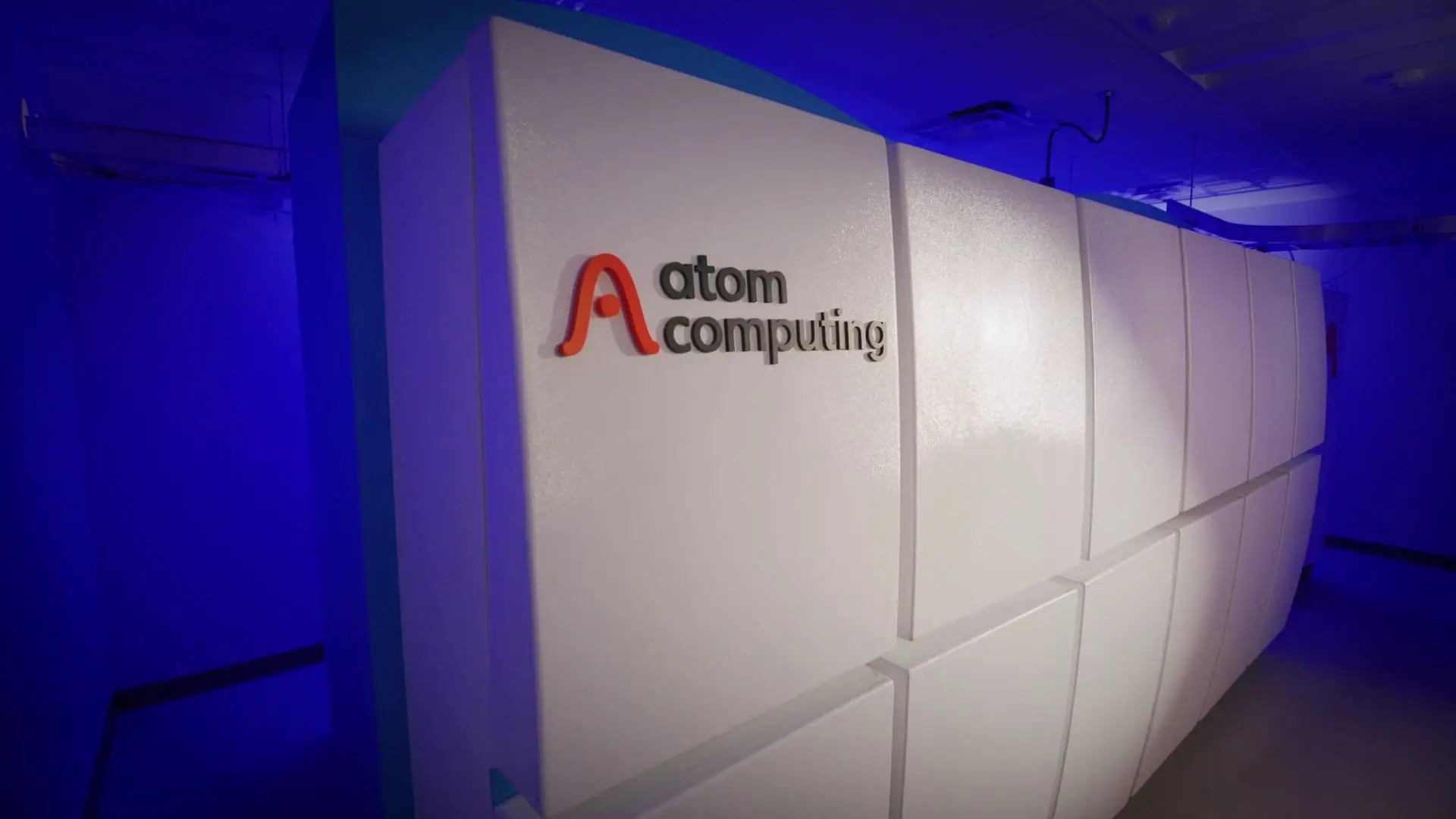
Microsoft and Atom Computing have made significant strides in quantum computing, achieving a major milestone by creating and entangling 24 logical qubits on a commercial quantum machine. This breakthrough resulted from a collaboration between Microsoft’s quantum experts, Dr. Krysta Svore, and Atom Computing’s founder and CEO, Dr. Ben Bloom.
The achievement demonstrates the potential of neutral-atom qubits, which are more robust and reliable than traditional superconducting qubits. By combining these qubits with Microsoft’s qubit-virtualization system, the companies have created a state-of-the-art reliable quantum computer that integrates with Azure Elements, a cloud-based scientific research and discovery platform. This technology has far-reaching implications for fields such as chemistry and materials science, enabling rapid progress and exploration of new applications.
Microsoft and Atom Computing have successfully created 24 logical qubits by applying Microsoft’s qubit-virtualization system to Atom Computing’s neutral-atom qubits. These logical qubits were entangled in a cat state, also known as a Greenberger-Horne-Zeilinger (GHZ) state, the highest number of entangled logical qubits on record.

The error rates of these logical qubits are
The error rates of these logical qubits are significantly below the 50% threshold for entanglement, demonstrating their high fidelity. Moreover, the teams took steps to detect and correct errors as well as losses of neutral-atom qubits during experiments. This resulted in an impressive error rate of 10.2%, which is 4.1 times better than the baseline physical error rate of 42%.
But that’s not all – when errors were detected and losses were detected and corrected, the error rate improved to 26.6%, still 1.6 times better than the physical error rate. This marks the first demonstration on record of loss correction in a commercial neutral-atom system.
The teams also used 28 logical qubits to perform successful computations based on the Bernstein-Vazirani algorithm, producing a more accurate solution than the corresponding computation based on physical qubits. This ability to compute while detecting and correcting errors is crucial for scaling up to achieve scientific quantum advantage.
To make this technology accessible to researchers and scientists, Microsoft and Atom Computing offer a comprehensive scientific suite combining logical qubits, cloud HPC, and advanced AI models. This suite, which includes Azure Elements, enables exploration across multiple fields, including chemistry and materials science, while also providing opportunities for skilling and education.
Azure Elements uses AI and cloud high-performance computing
Azure Elements uses AI and cloud high-performance computing (HPC) to accelerate the pace of scientific research and discovery. Its capabilities include Generative Chemistry, which brings the power of generative AI to chemistry research, and Accelerated DFT, which offers substantial increases in speed over other DFT codes for modeling quantum-mechanical properties.
This suite has far-reaching implications for scientific discovery and exploring how quantum capabilities can provide solutions to complex problems in other industries. As Dr. Ben Bloom, Founder and CEO of Atom Computing, notes, “By coupling our state-of-the-art neutral-atom qubits with Microsoft’s qubit-virtualization system, we are now able to offer reliable logical qubits on a commercial quantum machine.”
External Link: Click Here For More