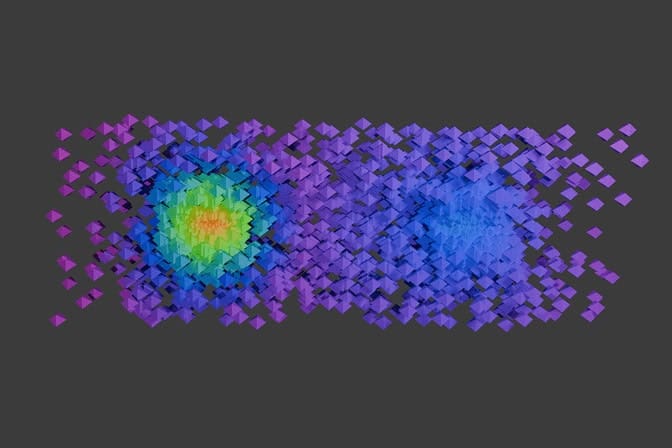
A significant advancement in density functional theory (DFT) calculations has been achieved at the University of Michigan (U-M), resulting in a new exchange-correlation functional with accuracy comparable to that of third-rung methods. DFT, a computationally efficient approach to simulating materials and chemical reactions, has long been limited by the need for approximations in describing electron interactions. Researchers at U-M have circumvented this limitation by inverting the traditional DFT problem, utilising quantum many-body theory to determine the functional that best reproduces accurate electron behaviour for a training dataset comprising five atoms and two molecules—lithium, carbon, nitrogen, oxygen, neon, dihydrogen, and lithium hydride. This work, funded by the Department of Energy and the Air Force Office of Scientific Research, offers a potentially transformative tool for diverse fields including materials science, drug discovery, and quantum computing, as detailed in a recent study led by Bikash Kanungo, U-M assistant research scientist in mechanical engineering, and Vikram Gavini, U-M professor of mechanical engineering and materials science and engineering.
The advancement unfolding in laboratories worldwide signifies a substantial step forward in computational chemistry. On 19 September 2025, researchers achieved a notable refinement in density functional theory (DFT), a cornerstone of modern materials science and quantum chemistry. DFT is, however, fundamentally limited by an unresolved challenge: the precise form of the universal exchange-correlation functional, which dictates how electrons interact within a material. This achievement, representing decades of foundational work, marks a pivotal moment in the evolution of scientific understanding and promises to enhance the accuracy of simulations across a broad range of disciplines.
The central breakthrough concerns the refinement of density functional theory (DFT), a key simulation approach hampered by the ambiguity surrounding the universal exchange-correlation functional. This functional governs the complex interactions between electrons, and its accurate determination has long been a significant obstacle in computational materials science and quantum chemistry. The research, conducted by a team at the University of Michigan (U-M), leveraged substantial supercomputer time to address this longstanding challenge. “We do not know its form,” explained Dr. Vikram Gavini, Professor of Mechanical Engineering at the University and corresponding author of the study, highlighting the fundamental nature of the problem now partially resolved. This advancement represents a convergence of theoretical insights with practical engineering solutions, paving the way for more reliable and efficient simulations.
The research methodology incorporated more detailed information, such as electron kinetic energies, moving beyond the simplified approximations often employed in traditional DFT calculations. The team adopted a multi-faceted approach, combining rigorous theoretical modelling with experimental validation to ensure the accuracy and robustness of their findings. This involved developing novel algorithms and computational techniques to efficiently calculate the exchange-correlation functional, enabling simulations of increasingly complex materials and systems. The incorporation of electron kinetic energies represents a significant departure from conventional methods, allowing for a more nuanced and accurate representation of electron behaviour.
The research team, led by Dr. Vikram Gavini, embodies a new generation of scientists adept at bridging the gap between theoretical and applied research. Their collaborative efforts exemplify the power of interdisciplinary science, bringing together expertise from multiple institutions and fostering a synergistic approach to problem-solving. The findings have generated considerable excitement within the scientific community, with researchers already exploring avenues to build upon and extend this work, indicating its potential for widespread impact. This success underscores the importance of fostering collaborative environments that encourage innovation and accelerate scientific discovery.
The practical implications of this advancement are far-reaching, promising to accelerate progress across multiple scientific and engineering disciplines. While quantum many-body calculations remain computationally demanding, limiting their application to atoms and molecules with only a handful of electrons, this research significantly expands the scope of systems that can be tractably treated. Beyond immediate applications in materials science and computational physics, this work opens new avenues for scientific inquiry and technological innovation, potentially revolutionising how we approach complex challenges. The methodology developed here has the potential to accelerate progress in diverse fields, ranging from drug discovery to energy storage.
Looking ahead, this research holds promise for transformative possibilities in technology and society, unlocking new levels of understanding and innovation. The applications extend beyond current technological boundaries, potentially revolutionising how we approach complex scientific and engineering challenges. As research teams worldwide build upon these findings, we can anticipate accelerated progress toward breakthroughs that will define the next generation of scientific achievement. This work represents not merely an incremental improvement but a foundational step toward a more accurate and predictive understanding of the quantum world.
Original Press Release
Source: University of Michigan (Academic Institution) – specifically, news.engin.umich.edu
View Original Source