
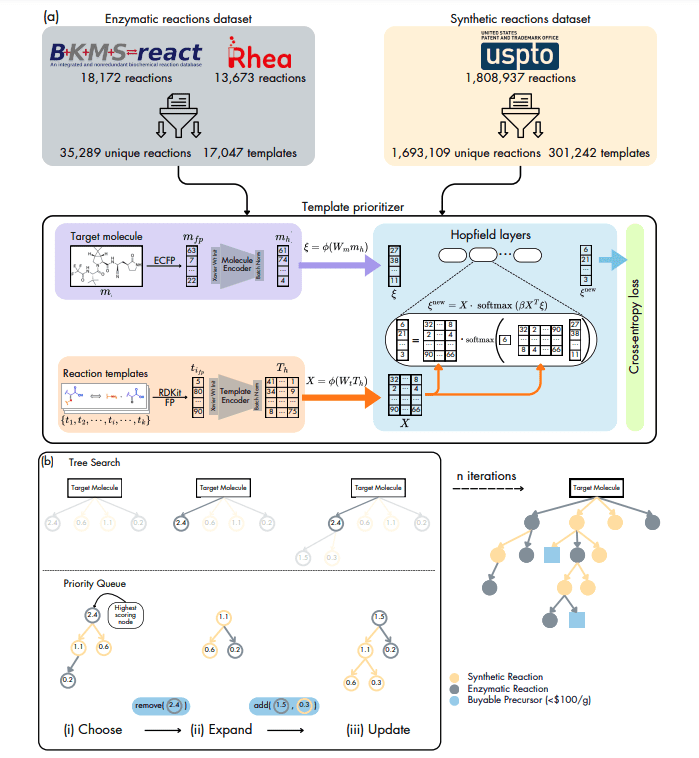
On April 2, 2025, researchers Shivesh Prakash, Viki Kumar Prasad, and Hans-Arno Jacobsen introduced MHNpath, a machine learning framework leveraging Hopfield networks for step-wise synthesis planning. This innovative tool enables users to prioritize reaction pathways based on cost, temperature, and toxicity, facilitating the creation of greener and more cost-effective chemical routes.
MHNpath is a retrosynthetic tool leveraging Hopfield networks and novel metrics to prioritize reaction templates for efficient synthesis planning. It features a tunable scoring system enabling users to optimize pathways based on cost, temperature, and toxicity, promoting greener and cost-effective routes. Case studies with complex molecules from ChemByDesign demonstrate its ability to predict novel synthetic and enzymatic pathways. Benchmarking against PaRoutes shows MHNpath generates shorter, cheaper, moderate-temperature routes using green solvents, exemplified by compounds like dronabinol, arformoterol, and lupinine.
The core of this advancement lies in the creation of hierarchical tree structures that represent potential reaction pathways. Each node in these trees corresponds to a specific chemical compound, while the edges connecting them signify the transformations required to move from one compound to another. This structure not only provides a clear visual representation of the synthesis process but also incorporates critical data such as costs, temperatures, and enzymes involved in each step.
One of the most striking aspects of this research is its ability to handle complex molecules with ease. For instance, the system successfully navigated the synthesis of 4-ethenyl-2-fluorophenol and 5-(6-amino-2-fluoro-purin-9-yl)-2-ethynyl-2-(hydroxymethyl)tetrahydrofuran-3-ol, both of which are notoriously challenging to produce. By breaking down these processes into manageable components, the algorithm demonstrates a remarkable capacity for problem-solving in synthetic chemistry.
The implications of this work extend far beyond the laboratory. By optimizing synthesis pathways, researchers can significantly reduce costs and improve efficiency, making it easier to develop new drugs and materials. This is particularly relevant in an era where the demand for novel pharmaceuticals is outpacing traditional methods of production.
However, the journey has not been without its challenges. The documentation highlights several molecules that proved resistant to the algorithm’s optimization efforts, underscoring the complexity of certain chemical systems. Despite these hurdles, the progress made represents a significant leap forward in the application of machine learning to chemistry.
As this technology continues to evolve, it holds immense promise for reshaping the future of synthetic chemistry. By providing researchers with powerful tools to navigate the intricate landscape of molecular synthesis, this approach accelerates discovery and opens up new avenues for innovation across industries.
In conclusion, this research marks a pivotal moment in the intersection of machine learning and chemistry. It not only demonstrates the potential of algorithmic optimization in synthetic processes but also sets the stage for a new era of efficiency and creativity in chemical research. As we look ahead, the possibilities are as vast as they are exciting—a testament to the boundless potential of interdisciplinary collaboration.
👉 More information
🗞 A User-Tunable Machine Learning Framework for Step-Wise Synthesis Planning
🧠 DOI: https://doi.org/10.48550/arXiv.2504.02191