

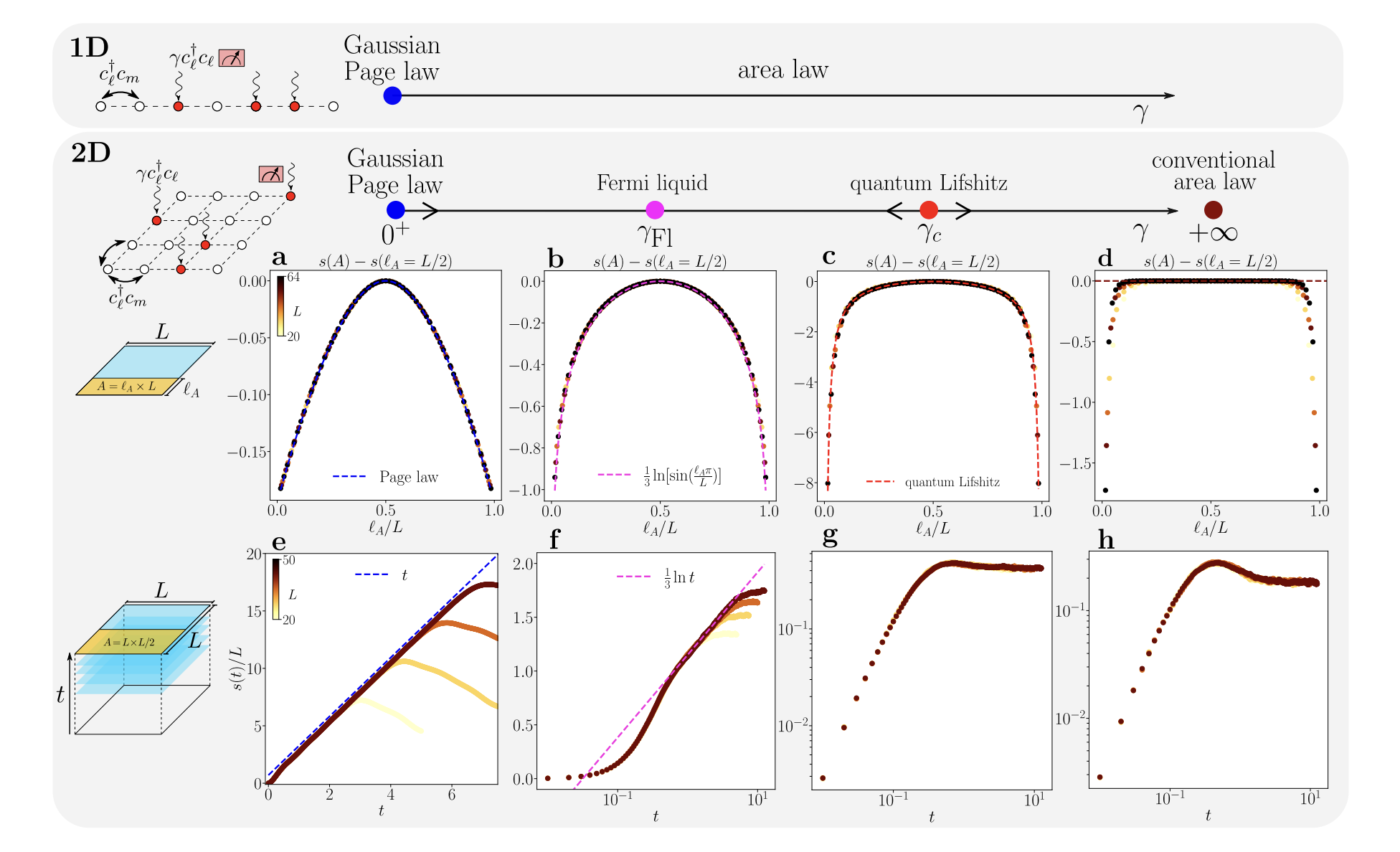
The behaviour of quantum systems under constant observation remains a fundamental question in physics, and new research sheds light on the surprising phases that emerge when quantum particles are continuously monitored. Karim Chahine from Universität zu Köln and Michael Buchhold from Universität zu Köln and Universität Innsbruck, along with their colleagues, investigate these measurement-induced transitions by examining the entanglement Hamiltonian of free fermions. Their work reveals three distinct fixed points, chaotic, Fermi-liquid, and Lifshitz, that define metallic, localized, and potentially multifractal phases, extending beyond existing theoretical frameworks. By analysing spectral properties, the researchers demonstrate that the Hamiltonian provides a powerful tool for identifying and characterizing these phases, offering precise estimates of critical points and revealing unexpected scaling structures in monitored quantum dynamics.
Monitored Fermions Exhibit Three Dynamical Fixed Points
Scientists have comprehensively mapped the dynamical phases of monitored free fermions, revealing a detailed picture of how entanglement evolves in these quantum systems. Through extensive numerical analysis, the team identified three distinct fixed points governing the system’s behaviour: a Gaussian fixed point at very low monitoring rates, a Fermi-liquid fixed point exhibiting logarithmic entanglement growth and spatial-temporal invariance, and a quantum Lifshitz fixed point marking a transition to a localized phase. These fixed points define the boundaries between metallic, localized, and potentially multifractal regimes within the monitored quantum dynamics. The research demonstrates that the entanglement entropy scales according to specific laws at each fixed point, providing a precise characterization of the system’s behaviour.
Measurements confirm a Gaussian Page law at infinitesimal monitoring, while the Fermi-liquid fixed point exhibits logarithmic growth, and the Lifshitz fixed point signals the onset of area-law entanglement. Furthermore, the team employed random matrix theory to analyse the entanglement Hamiltonian, revealing complementary insights into ergodicity and localization. Short-range spectral correlations sharply detect the ergodic to non-ergodic transition at the quantum Lifshitz fixed point, yielding a precise estimate of the critical point and a correlation length exponent consistent with a known mathematical model. Long-range probes corroborated this picture, while a mathematical measure uncovered signatures of a possible non-ergodic extended, or multifractal, regime at intermediate monitoring strengths. These findings establish a powerful framework for diagnosing metallic, localized, and multifractal regimes in monitored quantum dynamics, highlighting unexpected scaling structures and critical phenomena beyond current theoretical approaches.
Monitoring Rate Drives Fermionic Phase Transitions
This research investigates the behaviour of monitored free fermions, revealing a surprisingly rich phase diagram governed by the rate of monitoring. The study identifies three distinct fixed points, each corresponding to a different state of the system. At very low monitoring rates, the system exhibits chaotic behaviour, while at moderate rates, it settles into a metallic phase characterised by logarithmic entanglement scaling and emergent space-time invariance. Crucially, the team pinpointed a measurement-induced entanglement transition, governed by a Lifshitz fixed point, which marks the shift towards a localised, non-ergodic phase.
The researchers demonstrate that mathematical measures accurately detect this transition and provide precise estimates of the critical point. Furthermore, the analysis suggests the possible existence of a non-ergodic extended, or multifractal, regime at intermediate monitoring strengths, though this requires further investigation. The authors acknowledge a discrepancy between their calculated critical exponent and values reported in other numerical studies, highlighting an area for future research. Beyond this, the findings extend beyond current theoretical models, particularly regarding the emergence of Lifshitz-type critical scaling and Fermi-liquid behaviour, suggesting the need for new analytical frameworks to fully understand these monitored systems.
Monitored Fermions Reveal Stable Quantum States
Scientists have comprehensively investigated the behaviour of monitored free fermions, identifying key characteristics of their quantum entanglement. The research focuses on understanding how continuous measurement affects the system, specifically searching for stable states known as fixed points. The team identified three distinct fixed points: a Gaussian fixed point at low monitoring rates, a Fermi-liquid fixed point at moderate rates, and a quantum Lifshitz fixed point marking a transition to a localized phase. These fixed points define the boundaries between different behaviours within the monitored quantum dynamics.
The study analyzes the scaling of quantum entanglement to characterize these fixed points. By examining how entanglement changes with system size, the researchers pinpointed the Fermi liquid fixed point and calculated the mutual information between different parts of the system, revealing the critical point where the system undergoes a transition. These findings provide further evidence supporting the theoretical framework and experimental observations presented in the research.
🗞 Spectral Transitions of the Entanglement Hamiltonian in Monitored Free Fermions
🧠 ArXiv: https://arxiv.org/abs/2509.08584


