

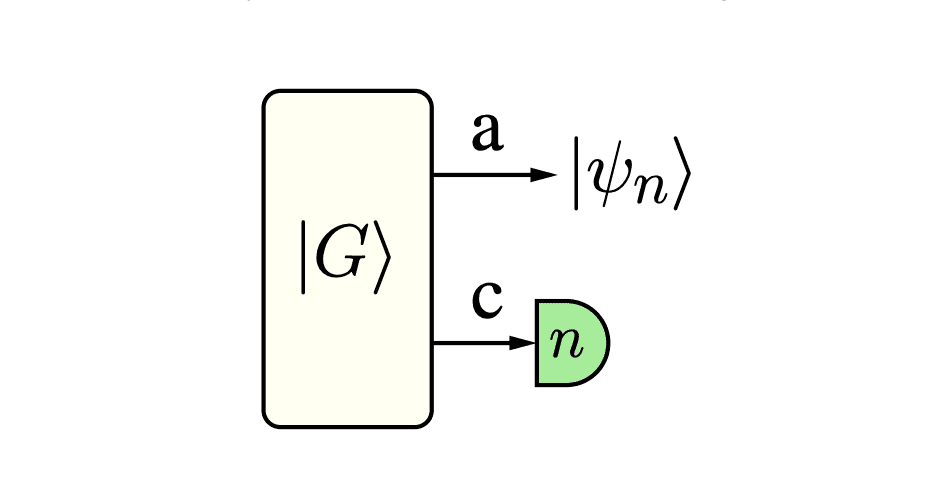
Generating complex, non-classical states of light represents a significant challenge in quantum optics, yet these states are crucial for advancing technologies like quantum computing and communication. Jaromír Fiurášek from Palacký University and colleagues demonstrate a method for maximising the efficiency of generating these states from readily available Gaussian light sources, using photon counting measurements. The team analytically calculates the maximum probability of successfully ‘heralding’ the creation of a non-classical state, and importantly, reveals that the number of experimental attempts needed scales only modestly with the complexity of the desired state. This breakthrough suggests that creating highly complex optical states, even those with a high degree of quantum entanglement, is now practically achievable with existing technology, provided sufficiently strong light squeezing is available.
Specific outcomes of these heralding events remain a central focus of research. A simple yet important approach involves measuring the number of photons in one mode of a two-mode entangled Gaussian state. This work demonstrates that the maximum heralding probability for this two-mode setup can be calculated analytically, and it investigates how this probability depends on the number of detected photons, n. The results show that the number of experimental trials needed scales only polynomially with n, enabling the generation of highly complex optical quantum states with high stellar rank.
Non-Gaussian States, Generation and Characterization
This is a comprehensive collection of research related to quantum optics, specifically focusing on non-Gaussian states of light, their creation, characterization, and applications in quantum information processing. The research explores several key themes and areas of investigation, including the generation of states that cannot be described by Gaussian wavefunctions, essential for universal quantum computation. Researchers also focus on representing states in terms of stellar states, using observables to definitively prove non-Gaussianity, and measuring correlations beyond the second order to reveal non-Gaussian features. Applications of non-Gaussian states are being explored in universal quantum computation, quantum communication, quantum metrology, and quantum error correction, relying on mathematical concepts such as orthogonal polynomials, special functions, and matrix decompositions.
Research in this area can be categorized by approach, including photon subtraction/addition, generalized photon subtraction, squeezing and displacement, measurement-induced non-Gaussianity, and Fock state generation. State characterization involves stellar decomposition, non-Gaussianity witnesses, higher-order correlation functions, and quantum state tomography. The research also encompasses mathematical tools like Laguerre and Hermite polynomials, Gaussian functions, and Autonne and Takagi decompositions, alongside experimental techniques such as superconducting nanowire single-photon detectors, optical parametric oscillators, and homodyne detection. Key observations reveal a focus on resource states, mathematical sophistication, and experimental challenges related to photon loss and decoherence, with stellar decomposition emerging as a powerful analytical tool. In conclusion, this collection of research provides a comprehensive overview of the current state of research in non-Gaussian quantum optics, highlighting the key challenges and opportunities in this exciting field.
Scalable Generation of Complex Quantum States
Scientists have achieved a significant breakthrough in the generation of complex quantum states of light, demonstrating a method for preparing highly non-classical states with a scalable approach. The work centers on a two-mode Gaussian state where photon number measurements on one mode herald the preparation of a targeted state in the other, and researchers have now analytically calculated the maximum heralding probability for this setup. This analytical solution allows for precise optimization of the state preparation process, revealing that the number of experimental trials needed scales only polynomially with the number of detected photons, n. Calculations are based on the Bargmann representation of quantum states, a mathematical tool particularly well-suited for analyzing this two-mode setup.
Researchers optimized the success probability of preparing these states and found that for specific parameter choices, the scaling with n remains polynomial. Numerical calculations further suggest this beneficial scaling holds true even when both control parameters are non-zero, broadening the applicability of the method. This analytical approach provides a powerful tool for designing and optimizing quantum state preparation schemes, paving the way for advancements in optical quantum technologies.
Polynomial Scaling Enables Complex State Generation
This research demonstrates that complex states of light, possessing non-classical properties, can be reliably generated from more readily available Gaussian states through photon counting measurements. The team investigated a two-mode setup, revealing that the probability of successfully generating these targeted states scales favorably with the number of detected photons, specifically polynomially. This finding is significant because it establishes the practical feasibility of creating highly complex quantum states with a scalable approach.
👉 More information
🗞 Maximum heralding probabilities of non-classical state generation from two-mode Gaussian state via photon counting measurements
🧠 ArXiv: https://arxiv.org/abs/2510.01951


