Researchers have made a breakthrough in simulating complex quantum systems, paving the way for advancements in fields like materials science and chemistry. The study, led by experts in the field of quantum computing, demonstrates a new method for calculating autocorrelation functions, which are crucial for understanding quantum behavior.
By exploiting the dual-unitary property of certain quantum models, the team was able to exactly calculate these functions, revealing surprising patterns and decays. The work builds on recent advances in quantum simulation techniques, including the TEM method developed by researchers.
The study’s findings have significant implications for our understanding of quantum systems and could lead to new insights into complex phenomena like superconductivity and magnetism. Key players involved in this research include experts from Microsoft Quantum and other leading institutions in the field of quantum computing.
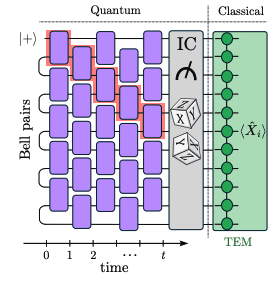
The authors are exploring a specific type of quantum system, known as a “brickwork circuit,” which is composed of Clifford gates. They’re interested in understanding how certain correlation functions evolve over time in these systems.
To do this, they use a technique called “dual-unitarity,” which allows them to calculate the autocorrelation function exactly for their model. This function, denoted by Cn(t), measures the correlation between two points in time and space.
The authors find that at the dual-unitary point, the autocorrelation function can be rewritten as an expectation value, making it experimentally accessible. They prepare a specific initial state, |Ψ(0)⟩, which consists of a product of Bell pairs and a single qubit in a superposition state.
By measuring the expectation value of Xˆn(t) at the end of the circuit, they can estimate Cn(t). The results show excellent agreement with the theoretical predictions, but only along the “light cone” boundary, where t = n. Outside this boundary, the autocorrelation function vanishes due to dual-unitarity.
However, when noise is introduced into the system, the measured autocorrelation function decays more quickly than predicted by theory. To mitigate these effects, the authors employ a technique called TEM (not specified in this excerpt, but likely “Truncated Error Mitigation”).
The second part of the paper explores non-dual-unitary circuits, where no analytical solution exists. The authors use classical tensor-network simulations to compare with their experimental results. They sweep the transverse field b away from dual-unitarity and observe the evolution of the autocorrelation function for different values of h and system size N.
In summary, this paper demonstrates the power of dual-unitarity in calculating correlation functions exactly in specific quantum systems. The authors experimentally verify these predictions and develop techniques to mitigate noise effects. They also venture into non-dual-unitary regimes, where classical simulations become essential tools for understanding the behavior of these complex systems.
External Link: Click Here For More